This documentation provides user guides and tutorials for mid-level Java developers to build SaaS applications with multi-tenancy on the Quantum framework, in a structure similar to Spring’s reference documentation. Artifacts are generated as HTML and PDF via Maven.
1. Quick links
-
Executive Brief: Executive Brief for Business Leaders
-
Tutorial Guide: Quantum Tutorial
-
Reference Guide: Quantum Reference Guide
-
Ontologies in Quantum: Modeling relationships and cascading
-
Multiple Auth Providers: Multi-provider auth, OIDC, and per-tenant key pairs
-
MCP Server and Client: MCP integration with Claude, agent tools, and end-to-end examples
-
AI Agent Integration: AI Agent APIs (tools, schema, execute)
2. Executive Brief
Quantum Framework: Executive Brief for Business Leaders
This brief is written for senior business and technology leaders who do not write code. It explains what the Quantum framework is, the business problems it solves, and why its approach to ontologies, data governance, and layered architecture is valuable across industries. A supply chain scenario is used to ground the concepts in familiar outcomes.
3. What Quantum is (in one page)
Quantum is a foundation for building secure, multi‑tenant business applications where multiple parties need to collaborate on shared data without losing control of their own data. It reduces time‑to‑value by giving product teams a consistent way to:
-
Define the language of the business (via an ontology) so the system understands how things relate: orders, shipments, customers, facilities, approvals, etc.
-
Enforce policy‑driven data access and data placement (data governance) so people only see what they should, and data lives where it should.
-
Offer a consistent API and query model to the UI and to partner systems, avoiding a tangle of bespoke endpoints.
-
Operate as a true multi‑tenant SaaS: each organization is separate by default, with explicit, auditable sharing when needed.
Think of Quantum as a “business‑aware operating system” for enterprise SaaS: you focus on the domain and outcomes, while the framework bakes in the cross‑cutting concerns.
4. Why this matters to the business
-
Faster delivery of new products and modules: teams assemble capabilities instead of re‑building plumbing.
-
Lower integration friction: partners and internal apps access data through consistent, governed interfaces.
-
Reduced risk: privacy, residency, and least‑privilege access are enforced by policy rather than scattered code.
-
Explainable security: clear answers to “who can do what, with which data, and why.”
-
Future‑proof data: an ontology makes relationships explicit so you can extend, analyze, and automate without re‑platforming.
5. Core concepts in plain language
5.1. Ontologies: the business map
An ontology is a formal map of the important things in your business and how they relate. In Quantum, the ontology:
-
Names the key entities (Shipment, PurchaseOrder, Partner, Invoice, Facility, etc.).
-
Captures how those entities connect (e.g., Shipment fulfills a PurchaseOrder; Partner operates a Facility).
-
Lets rules and analytics reason over those relationships (e.g., "show me all shipments for orders from strategic suppliers").
Business value - Shared understanding across teams and systems—no more mismatched semantics. - Richer navigation and reporting—less brittle than hard‑coded joins and endpoints. - Safer automation—policies and workflows operate on concepts the business understands, not table names.
See also: Modeling relationships and cascading (Ontology Guide).
5.2. Data governance: policy‑driven access and placement
Data governance in Quantum is not an afterthought. It is expressed as human‑readable policies that:
-
Decide who can perform which action (VIEW, CREATE, APPROVE, EXPORT, etc.) on which domain objects.
-
Filter results so users see only the records they are entitled to.
-
Determine where new data belongs (which tenant or shared domain) to satisfy ownership and residency rules.
Business value - Compliance by construction: residency, separation, and least‑privilege enforced centrally. - Clear audit: policies explain why a user saw or changed specific data. - Low cost of change: update a rule, not a dozen services.
See also: Permissions and Policy Guide.
5.3. Layered architecture: clarity and agility
Quantum separates concerns so teams can move independently while staying consistent:
-
Identity and tenancy layer: integrates enterprise SSO, supports partner logins, and isolates each organization by default.
-
Policy layer: human‑readable rules specify who can do what and where data lives.
-
Ontology layer: defines entities and relationships; enables graph‑style reasoning and cascaded actions.
-
Data access & query layer: consistent list/filter/query for all domains; fewer bespoke endpoints.
-
Workflow & state layer: patterns for long‑running processes and completion tasks.
-
Seed packs & configuration layer: versioned baseline data and settings for rapid, repeatable onboarding.
Business value - Predictable delivery: features fit naturally into the layers instead of reinventing plumbing. - Easier governance: one place to review identity, policy, and data placement. - Extensibility: add domains and relationships without ripping up the foundation.
6. Supply chain: how the pieces come together
Consider a multi‑party supply chain platform where shippers, suppliers, carriers, and 3PLs collaborate.
Business needs - Secure cross‑company sharing without exposing everything. - Role‑appropriate visibility: planners, operators, and analysts each see what they need. - Auditability and compliance across regions. - Rapid partner onboarding without long IT cycles.
How Quantum addresses these needs
-
Ontology maps the domain
-
Entities: PurchaseOrder, Shipment, Item, Partner, Facility, Appointment, Invoice.
-
Relationships: Shipment fulfills PurchaseOrder; Partner operates Facility; Appointment schedules Facility for Shipment.
-
Outcomes: Ask meaningful questions like “Which late shipments are tied to orders from strategic suppliers with capacity constraints?”
-
Data governance via policy
-
Private by default: each company’s data is isolated within its tenant.
-
Deliberate sharing: create a "collaboration bubble" for a specific order or shipment so the buyer and a chosen carrier see the same milestones and documents—nothing more.
-
Residency & scope: EU shipments remain in‑region; policies pin reads/writes accordingly.
-
Layered delivery
-
Identity/tenancy: enterprises use SSO; smaller partners use passwords; all mapped consistently.
-
Policy: human‑readable rules control who can VIEW, UPDATE, or APPROVE across areas like Collaboration or Finance.
-
Ontology: relationships drive navigation, automation, and impact analysis.
-
Query: one consistent List API powers dashboards and reports without proliferating endpoints.
-
Seed packs: onboard a new supplier with a versioned baseline—roles, code lists, sample workflows—applied in minutes.
Measurable business outcomes - Time‑to‑value: new partners live in days, not weeks. - Lower operating risk: explainable access and audit trails by design. - Better decisioning: cross‑entity insights (“orders at risk by lane and supplier”) with less IT effort. - Product agility: add a returns workflow or a new KPI without re‑architecting.
For a business‑friendly deep dive, see the Supply Chain Collaboration guide (Supply Chain).
7. Where Quantum fits in your landscape
-
Complement to ERP/TMS: Quantum doesn’t replace your systems of record; it coordinates collaboration around them with governed data sharing.
-
Safer data mesh: connect domains through the ontology and policies rather than ad‑hoc point‑to‑point contracts.
-
Cloud‑ready foundation: designed for multi‑tenant SaaS, whether deployed privately or as a shared service.
8. Getting started: pragmatic rollout
-
Start with one domain and one outcome (e.g., shipment visibility and exception handling for a key lane).
-
Define the ontology for that slice and the access policies.
-
Use seed packs to bootstrap pilot tenants and iterate quickly.
-
Expand to adjacent domains (orders, appointments, invoices) once the core is delivering value.
9. Summary for executives
Quantum gives you a governed, business‑aware foundation for multi‑party applications. Its ontology makes the business explicit; its policies make access and residency enforceable and explainable; and its layered architecture accelerates delivery while lowering risk. The result: faster product cycles, safer collaboration, and durable data assets that keep paying dividends as you grow.
10. Tutorial Guide
Quantum Tutorial: Build a Multi-tenant SaaS with Quantum
This tutorial takes you end-to-end through building a small SaaS application on the Quantum framework. It pulls in the core concepts and how-to content from the main index in a progressive, hands-on flow so you can learn by doing.
Audience: Mid-level Java developers building multi-tenant SaaS on Quarkus and MongoDB. Prerequisites: JDK 17+, Maven, Docker (for local MongoDB), and basic familiarity with Quarkus. Artifacts: The docs can be built as HTML/PDF via Maven; the code snippets compile against the Quantum modules published in this repo.
What you’ll build: A small, tenant-aware service with domain models, REST CRUD, flexible queries, security, migrations, and seed packs for baseline data.
Each section starts with:
-
Problem: What we are solving
-
Why for SaaS: Why this matters in multi-tenant systems
-
How Quantum helps: Concepts and features that address the problem
-
Walkthrough: Code and configuration that build on prior sections
Throughout, we reuse and expand the same example to reinforce learning. The reference guide links back to these sections for deeper context.
11. 1. Project setup
Problem: Getting a runnable project scaffolded with Quantum and Quarkus.
Why for SaaS: Consistent project structure and dependencies are critical to scale teams and environments.
How Quantum helps: Provides opinionated dependencies, conventions, and ready-made modules for multi-tenancy, security, persistence, and seeding.
Walkthrough: Follow the steps below to create and run your first service.
11.1. Getting Started: Your First Quantum Application
This section walks through creating a simple multi-tenant Product catalog to demonstrate core Quantum concepts.
11.1.1. Prerequisites
-
Java 17+
-
Maven 3.8+
-
MongoDB (local or cloud)
-
Basic Quarkus knowledge (see Quarkus Foundation)
11.1.2. Project Setup
Create a new Quarkus project with Quantum dependencies:
mvn io.quarkus:quarkus-maven-plugin:create \
    -DprojectGroupId=com.example \
    -DprojectArtifactId=product-catalog \
    -DclassName="com.example.ProductResource" \
    -Dpath="/products"
Add Quantum dependencies to pom.xml:
<dependency>
    <groupId>com.e2eq.framework</groupId>
    <artifactId>quantum-framework</artifactId>
    <version>${quantum.version}</version>
</dependency>
11.1.3. Configuration
Create .env file (copy from template):
MONGODB_USERNAME=your-username
MONGODB_PASSWORD=your-password
MONGODB_DATABASE=product-catalog
MONGODB_HOST=localhost:27017
JWT_SECRET=your-secret-key
Basic application.properties:
# MongoDB
quarkus.mongodb.connection-string=${MONGODB_CONNECTION_STRING:mongodb://localhost:27017}
quarkus.mongodb.database=${MONGODB_DATABASE:product-catalog}

# JWT Authentication
auth.provider=custom
auth.jwt.secret=${JWT_SECRET:change-me-in-production}
auth.jwt.expiration=60

# CORS for development
quarkus.http.cors=true
quarkus.http.cors.origins=http://localhost:3000
11.1.4. Your First Model
Create a Product model with multi-tenancy built-in:
package com.example.model;

import com.e2eq.framework.annotations.FunctionalMapping;
import com.e2eq.framework.model.persistent.base.BaseModel;
import dev.morphia.annotations.Entity;
import lombok.Data;
import lombok.EqualsAndHashCode;
import lombok.NoArgsConstructor;
import lombok.experimental.SuperBuilder;

import jakarta.validation.constraints.NotBlank;
import jakarta.validation.constraints.Size;
import java.math.BigDecimal;

@Entity
@Data
@NoArgsConstructor
@SuperBuilder
@EqualsAndHashCode(callSuper = true)
@FunctionalMapping(area = "catalog", domain = "product")
public class Product extends BaseModel {

    @NotBlank
    @Size(max = 50)
    private String sku;

    @NotBlank
    @Size(max = 200)
    private String name;

    private String description;
    private BigDecimal price;
    private boolean active = true;
}
Key points:
- Extends BaseModel for automatic DataDomain, audit fields, and ID management
- @FunctionalMapping declares this model’s business area and domain for security rules
- Standard Jakarta validation annotations
- Lombok reduces boilerplate
11.1.5. Repository
Create a repository interface:
package com.example.repository;

import com.e2eq.framework.model.persistent.morphia.MorphiaRepo;
import com.example.model.Product;

public interface ProductRepo extends MorphiaRepo<Product> {
    // Custom queries can be added here
}
11.1.6. REST Resource
Create a REST endpoint:
package com.example.resource;

import com.e2eq.framework.rest.resources.BaseResource;
import com.example.model.Product;
import com.example.repository.ProductRepo;
import jakarta.ws.rs.Path;

@Path("/products")
public class ProductResource extends BaseResource<Product, ProductRepo> {
    // Inherits all CRUD endpoints: GET, POST, PUT, DELETE
    // GET /products/list - paginated list with filtering
    // GET /products/id/{id} - get by ID
    // POST /products - create new product
    // PUT /products/set?id={id}&pairs=field:value - update fields
    // DELETE /products/id/{id} - delete product
}
11.1.7. Running the Application
Start your application:
./mvnw quarkus:devThe application provides: - Swagger UI at http://localhost:8080/q/swagger-ui/ - Dev UI at http://localhost:8080/q/dev/
11.1.8. Testing Your API
Create a product:
curl -X POST http://localhost:8080/products \
  -H "Content-Type: application/json" \
  -d '{
    "sku": "WIDGET-001",
    "name": "Super Widget",
    "description": "The best widget ever",
    "price": 29.99,
    "active": true
  }'
List products:
curl "http://localhost:8080/products/list?limit=10&sort=+name"Filter products:
curl "http://localhost:8080/products/list?filter=active:true&&price:>##20"11.1.9. What You Get Automatically
With this minimal setup, Quantum provides:
Multi-tenancy: Each product is automatically tagged with the creator’s DataDomain (tenant, org, owner)
Security: DataDomain filtering ensures users only see their own data by default
Validation: Jakarta Bean Validation runs before persistence
Audit Trail: Automatic createdBy, createdDate, lastUpdatedBy, lastUpdatedDate fields
Consistent APIs: Standard REST patterns across all resources
Query Language: Powerful filtering with the ANTLR-based query syntax
OpenAPI: Automatic API documentation
11.1.10. Next Steps
-
Add authentication: Authentication Guide
-
Create sharing rules: Permissions Guide
-
Learn the query language: Query Language
-
See real-world example: Supply Chain Tutorial
11.1.11. Optional: Enable Ontology Modules
You can adopt ontology incrementally. If you don’t enable it, everything works as before.
Quick checklist
1) Add dependencies (app-level) - quantum-ontology-core, quantum-ontology-mongo, quantum-ontology-policy-bridge
2) Turn it on via config
e2eq.ontology.enabled=true3) Provide an ontology registry (TBox) - Start with an in-memory registry (recommended initially). See Ontologies in Quantum.
4) Wire data and indexes - Inject EdgeDao as a CDI bean (@Inject); indexes are ensured automatically at startup. - Indices: (tenantId, p, dst) and (tenantId, src, p)
5) Materialize edges on entity changes - Use OntologyMaterializer when sources or intermediates change (e.g., Order/Customer/Org/Address/Shipment in the e‑commerce example).
6) Use edges in queries/policies - Wrap BSON via ListQueryRewriter or constrain by _id sets. See Integrating Ontology.
Notes
-
Keep it optional: only wire beans and create collections when e2eq.ontology.enabled=true.
-
Multi-tenant: always pass tenantId from RuleContext.
12. 2. Platform overview
Problem: Understanding the moving parts and how they fit together.
Why for SaaS: You’ll be composing features (tenancy, security, APIs, data) across many modules and services.
How Quantum helps: A cohesive model with clear boundaries and integration points.
Walkthrough: Read the overview and keep it handy as you progress.
12.1. Overview: Building SaaS with Quantum
Quantum is a Quarkus-based framework that accelerates building multi-tenant SaaS platforms on MongoDB. It provides:
-
Multi-tenancy primitives for tenant creation, isolation, and data sharing
-
A domain-first programming model with Functional Areas, Functional Domains, and Actions
-
Data security and contextual evaluation via DataDomain, DomainContext, and RuleContext
-
Consistent REST resources for find/get/list/save/update/delete operations
-
Pluggable authentication with a provided JWT module and extension points
This guide targets mid-level Java developers and follows a structure similar to Spring’s reference docs. Use Maven to generate HTML/PDF: see docs module README for commands.
12.1.1. SaaS and Multi‑Tenancy First
SaaS solutions require:
-
Onboarding automation: programmatic tenant creation, freemium/trial flows
-
Isolation with selective sharing
-
Policy-driven access that adapts to user, org, tenant, and action
-
Operational efficiency (observability, cost control, upgradeability)
Quantum’s building blocks address these needs out-of-the-box while remaining flexible to fit your architecture.
13. 3. Domain modeling fundamentals
Problem: Modeling your domain effectively for persistence and API exposure.
Why for SaaS: Cross-tenant scale and isolation drive modeling choices (IDs, natural keys, versioning, ownership).
How Quantum helps: Provides base models, annotations, and repository patterns to model tenant-safe entities.
Walkthrough: Build a minimal domain model and persist it.
13.1. Modeling with Functional Areas, Domains, and Actions
Quantum organizes your system around three core constructs:
-
Functional Area: A broad capability area (e.g., Identity, Catalog, Orders, Collaboration).
-
Functional Domain: A cohesive sub-area within an area (e.g., in Collaboration: Partners, Shipments, Tasks).
-
Actions: The set of operations applicable to a domain (CREATE, UPDATE, VIEW, DELETE, ARCHIVE, plus domain-specific actions).
These constructs allow:
-
Fine-grained sharing: Point specific functional areas to shared databases while others remain strictly segmented.
-
Policy composition: Apply RuleContext decisions at the level of area/domain/action.
13.1.1. Prefer Annotations for Functional Mapping (recommended)
Starting with this version, you should use annotations to declare a model or resource’s Functional Area/Domain and the Action being performed. The legacy bmFunctionalArea() and bmFunctionalDomain() methods are still supported for backward compatibility in this release, but they will be phased out soon.
-
Class-level mapping: use @FunctionalMapping(area = "<area>", domain = "<domain>") on your model or resource class.
-
Method-level action: use @FunctionalAction("<ACTION>") on your JAX-RS resource methods when the action is not implied by the HTTP verb.
Example: model annotated with FunctionalMapping
import dev.morphia.annotations.Entity;
import lombok.*;
import lombok.experimental.SuperBuilder;
import com.e2eq.framework.model.persistent.base.BaseModel;
import com.e2eq.framework.annotations.FunctionalMapping;

@Entity
@Data
@NoArgsConstructor
@SuperBuilder
@EqualsAndHashCode(callSuper = true)
@FunctionalMapping(area = "catalog", domain = "product")
public class Product extends BaseModel {
    private String sku;
    private String name;
    // No need to override bmFunctionalArea/bmFunctionalDomain when using @FunctionalMapping
}
Example: resource method annotated with FunctionalAction
import jakarta.ws.rs.*;
import jakarta.ws.rs.core.MediaType;
import com.e2eq.framework.annotations.FunctionalAction;

@Path("/products")
@Produces(MediaType.APPLICATION_JSON)
@Consumes(MediaType.APPLICATION_JSON)
public class ProductResource {

    // Action will default from HTTP verb (POST -> CREATE), but you can be explicit:
    @POST
    @FunctionalAction("CREATE")
    public Product create(Product payload) { /* ... */ return payload; }

    // GET will infer VIEW automatically when building the ResourceContext
    @GET
    @Path("/{id}")
    public Product get(@PathParam("id") String id) { /* ... */ return new Product(); }
}
How the framework uses these annotations
-
SecurityFilter: If the matched resource class has @FunctionalMapping, it uses area/domain from the annotation. If the method has @FunctionalAction, it uses that value; otherwise, it infers the action from the HTTP method (GET=VIEW, POST=CREATE, PUT/PATCH=UPDATE, DELETE=DELETE). If annotations are absent, it falls back to the existing path- and convention-based logic.
-
MorphiaRepo.fillUIActions: If the model class has @FunctionalMapping, its area/domain are used to resolve allowed UI actions; otherwise, it falls back to the legacy bmFunctionalArea()/bmFunctionalDomain() methods.
-
PermissionResource: When listing functional domains, it prefers @FunctionalMapping on entity classes and falls back to bmFunctionalArea()/bmFunctionalDomain() when missing.
Migration notes
-
Preferred: add @FunctionalMapping to each model class (or resource class) and remove the bmFunctionalArea/bmFunctionalDomain overrides.
-
Transitional: you can keep the legacy methods; they will be used only if the annotation is not present.
-
Future: bmFunctionalArea and bmFunctionalDomain will be removed in a future release; plan to migrate now.
13.1.2. DataDomain on Models
All persisted models carry DataDomain (tenantId, orgRefName, ownerId, etc.) for rule-based filtering and cross-tenant sharing.
Example model:
import dev.morphia.annotations.Entity;
import lombok.Data;
import lombok.EqualsAndHashCode;
import lombok.NoArgsConstructor;
import lombok.experimental.SuperBuilder;
import com.e2eq.framework.model.persistent.base.BaseModel;

@Entity
@Data
@NoArgsConstructor
@SuperBuilder
@EqualsAndHashCode(callSuper = true)
public class Product extends BaseModel {
    private String sku;
    private String name;

    @Override
    public String bmFunctionalArea() { return "Catalog"; }

    @Override
    public String bmFunctionalDomain() { return "Product"; }
}
13.1.3. Persistence Repositories
Define a repository to persist and query your model. With Morphia:
import com.e2eq.framework.model.persistent.morphia.MorphiaRepo;

public interface ProductRepo extends MorphiaRepo<Product> {
    // custom queries can be added here
}
13.1.4. Exposing REST Resources
Expose consistent CRUD endpoints by extending BaseResource.
import com.e2eq.framework.rest.resources.BaseResource;
import jakarta.ws.rs.Path;

@Path("/products")
public class ProductResource extends BaseResource<Product, ProductRepo> {
    // Inherit find, get, list, save, update, delete endpoints
}
With this minimal setup, you get standard REST APIs guarded by RuleContext/DataDomain and enriched with UIAction metadata.
13.1.5. Lombok in Models
Lombok reduces boilerplate in Quantum models and supports inheritance-friendly builders.
Common annotations you will see:
-
@Data: Generates getters, setters, toString, equals, and hashCode.
-
@NoArgsConstructor: Required by frameworks that need a no-arg constructor (e.g., Jackson, Morphia).
-
@EqualsAndHashCode(callSuper = true): Includes superclass fields in equality and hash.
-
@SuperBuilder: Provides a builder that cooperates with parent classes (useful for BaseModel subclasses).
Example:
@Data
@NoArgsConstructor
@SuperBuilder
@EqualsAndHashCode(callSuper = true)
public class Product extends BaseModel {
  private String sku;
  private String name;
}
Notes: - Prefer @SuperBuilder over @Builder when extending BaseModel/UnversionedBaseModel. - Keep equals/hashCode stable for collections and caches; include callSuper when needed.
13.1.6. Validation with Jakarta Bean Validation
Quantum uses Jakarta Bean Validation to enforce invariants on models at persist time (and optionally at REST boundaries).
Typical annotations:
-
@Size(min=3): String/collection length constraints.
-
@Valid: Cascade validation to nested objects (e.g., DataDomain on models).
-
@NotNull, @Email, @Pattern, etc., as needed.
Where validation runs:
-
Repository layer via Morphia ValidationInterceptor (prePersist):
-
Executes validator.validate(entity) before the document is written.
-
If there are violations and the entity does not implement InvalidSavable with canSaveInvalid=true, an E2eqValidationException is thrown.
-
If DataDomain is null and SecurityContext has a principal, ValidationInterceptor will default the DataDomain from the principal context.
-
Optionally at REST boundaries: You may also annotate resource DTOs/parameters with Jakarta validation; Quarkus can validate them before the method executes.
13.1.7. Jackson vs Jakarta Validation Annotations
These two families of annotations serve different purposes and complement each other:
-
Jackson annotations (com.fasterxml.jackson.annotation.*) control JSON serialization/deserialization.
-
Examples: @JsonIgnore, @JsonIgnoreProperties, @JsonProperty, @JsonInclude.
-
They do not enforce business constraints; they affect how JSON is produced/consumed.
-
Jakarta Validation annotations (jakarta.validation.*) declare constraints that are evaluated at runtime.
-
Examples: @NotNull, @Size, @Valid, @Pattern.
Correspondence and interplay:
-
Use Jackson to hide or rename fields in API responses/requests (e.g., @JsonIgnore on transient/calculated fields such as UIActionList).
-
Use Jakarta Validation to ensure incoming/outgoing models satisfy required constraints; ValidationInterceptor runs before persistence to enforce them.
-
It’s common to annotate the same field with both families when you both constrain values and want specific JSON behavior.
13.2. Jackson ObjectMapper in Quarkus and in Quantum
How Quarkus creates ObjectMapper:
-
Quarkus produces a CDI-managed ObjectMapper. You can customize it by providing a bean that implements io.quarkus.jackson.ObjectMapperCustomizer.
-
You can also tweak common features via application.properties using quarkus.jackson.* properties.
Quantum defaults:
-
The framework provides a QuarkusJacksonCustomizer that:
-
Sets DeserializationFeature.FAIL_ON_UNKNOWN_PROPERTIES = true (reject unknown JSON fields).
-
Registers custom serializers/deserializers for org.bson.types.ObjectId so it can be used as String in APIs.
Snippet from the framework:
@Singleton
public class QuarkusJacksonCustomizer implements ObjectMapperCustomizer {
  @Override
  public void customize(ObjectMapper objectMapper) {
    objectMapper.configure(DeserializationFeature.FAIL_ON_UNKNOWN_PROPERTIES, true);
    SimpleModule module = new SimpleModule();
    module.addSerializer(ObjectId.class, new ObjectIdJsonSerializer());
    module.addDeserializer(ObjectId.class, new ObjectIdJsonDeserializer());
    objectMapper.registerModule(module);
  }
}
Customize in your app:
-
Add another ObjectMapperCustomizer bean (order is not guaranteed; make changes idempotent):
@Singleton
public class MyJacksonCustomizer implements ObjectMapperCustomizer {
  @Override
  public void customize(ObjectMapper mapper) {
    mapper.findAndRegisterModules();
    mapper.disable(SerializationFeature.WRITE_DATES_AS_TIMESTAMPS);
    mapper.setSerializationInclusion(JsonInclude.Include.NON_NULL);
  }
}-
Or set properties in application.properties:
# Fail if extraneous fields are present
quarkus.jackson.fail-on-unknown-properties=true
# Example date format and inclusion
quarkus.jackson.write-dates-as-timestamps=false
quarkus.jackson.serialization-inclusion=NON_NULL
When to adjust:
-
Relax fail-on-unknown only for backward-compatibility scenarios; strictness helps catch client mistakes.
-
Register modules (JavaTime, etc.) if your models include those types.
13.3. Validation Lifecycle and Morphia Interceptors
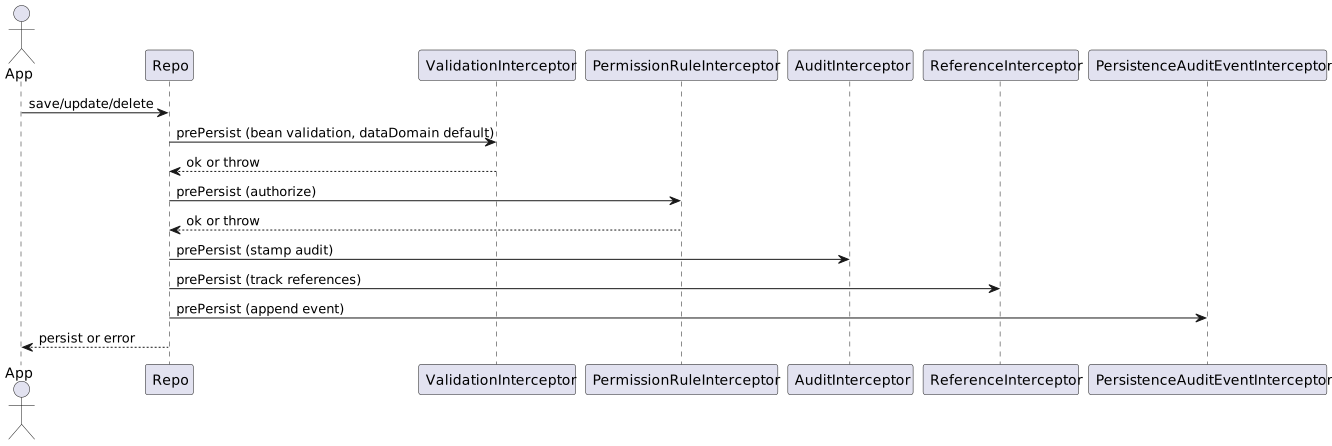
Morphia interceptors enhance and enforce behavior during persistence. Quantum registers the following for each realm-specific datastore:
Order of registration (see MorphiaDataStore): 1) ValidationInterceptor 2) PermissionRuleInterceptor 3) AuditInterceptor 4) ReferenceInterceptor 5) PersistenceAuditEventInterceptor
High-level responsibilities:
-
ValidationInterceptor (prePersist):
-
Defaults DataDomain from SecurityContext if missing.
-
Runs bean validation and throws E2eqValidationException on violations unless the entity supports saving invalid states (InvalidSavable).
-
PermissionRuleInterceptor (prePersist):
-
Evaluates RuleContext with PrincipalContext and ResourceContext from SecurityContext.
-
Throws SecurityCheckException if the rule decision is not ALLOW (enforcing write permissions for save/update/delete).
-
AuditInterceptor (prePersist):
-
Sets AuditInfo on creation and updates lastUpdate fields on modification; captures impersonation details if present.
-
ReferenceInterceptor (prePersist):
-
For @Reference fields annotated with @TrackReferences, maintains back-references on the parent entities via ReferenceEntry and persists the parent when needed.
-
PersistenceAuditEventInterceptor (prePersist when @AuditPersistence is present):
-
Appends a PersistentEvent with type PERSIST, date, userId, and version to the model’s persistentEvents before saving.
When does validation occur?
-
On every save/update path that hits persistence, prePersist triggers validation (and permission/audit/reference processing) before the document is written to MongoDB, guaranteeing constraints and policies are enforced consistently across all repositories.
13.4. Functional Area/Domain in RuleContext Permission Language
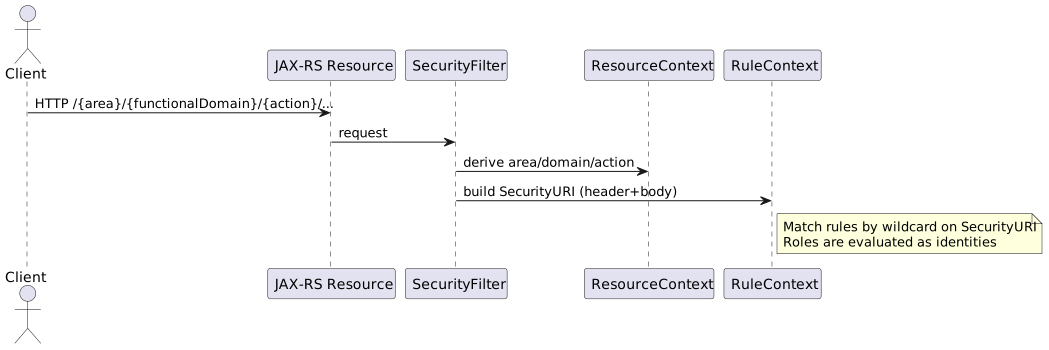
Models express their placement in the business model via: - bmFunctionalArea(): returns a broad capability area (e.g., Catalog, Collaboration, Identity) - bmFunctionalDomain(): returns the specific domain within that area (e.g., Product, Shipment, Partner)
How these map into authorization and rules:
-
ResourceContext/DomainContext: When a request operates on a model, the framework derives the functional area and domain from the model type (or resource) and places them on the current context alongside the action (CREATE, UPDATE, VIEW, DELETE, ARCHIVE). RuleContext consumes these to evaluate policies.
-
Permission language (SecurityURI-based matching): The framework derives area and functionalDomain from REST path segments using the convention: /{area}/{functionalDomain}/{action}/… . These values, together with action and identity, form the SecurityURI (header + body) used by the rule engine. Rules match on SecurityURI fields using wildcard string comparison; there is no HTTP method/URL pattern matching.
-
Permission language (query variables): The ANTLR-based query language exposes variables that can be referenced in filters:
-
${area} corresponds to bmFunctionalArea()
-
${functionalDomain} corresponds to bmFunctionalDomain() These can be used to author reusable filters or to record audit decisions by area/domain.
-
Repository filters: RuleContext can contribute additional predicates that are area/domain-specific, enabling fine-grained sharing. For example, a shared Catalog area may allow cross-tenant VIEW, while a Collaboration.Shipment domain remains tenant-strict.
Examples
1) SecurityURI-based rule matching (Permissions)
- name: allow-catalog-product-reads
  description: Allow USER and ADMIN to view products in the Catalog area
  securityURI:
    header:
      identity: USER            # role treated as identity; author a second rule for ADMIN if needed
      area: Catalog
      functionalDomain: Product
      action: view
    body:
      realm: system-com
      accountNumber: '*'
      tenantId: '*'
      dataSegment: '*'
      ownerId: '*'
      resourceId: '*'
  effect: ALLOW
  priority: 300
  finalRule: false
2) Query variable usage (Filters)
You can reference the active area/domain in filter expressions (e.g., for auditing or conditional branching in custom rule evaluators):
# Constrain reads differently when operating in the Catalog area
(${area}:"Catalog" && dataDomain.orgRefName:"PUBLIC") ||
(${area}:!"Catalog" && dataDomain.tenantId:${pTenantId})
3) Model-driven mapping
Given a model like:
@Override public String bmFunctionalArea()  { return "Collaboration"; }
@Override public String bmFunctionalDomain(){ return "Shipment"; }-
Incoming REST requests that operate on Shipment resources set area=Collaboration and functionalDomain=Shipment in the ResourceContext.
-
RuleContext evaluates policies considering action + area + domain, e.g., deny cross-tenant UPDATE in Collaboration.Shipment, but allow cross-tenant VIEW in Collaboration.Partner if marked shared.
Notes
-
Path convention: Use leading segments /{area}/{functionalDomain}/{action}/… so the framework can derive ResourceContext reliably. Extra segments after the first three are allowed; only the first three are used to compute area, domain, and action.
-
Nonconformant paths: If the path has fewer than three segments, the framework sets an anonymous/default ResourceContext. In practice, rules will typically evaluate to DENY unless there is an explicit allowance for anonymous contexts.
-
See also: the Permissions section for rule-base matching and priorities, and the DomainContext/RuleContext section for end-to-end flow.
13.5. StateGraphs on Models
StateGraphs let you restrict valid values and transitions of String state fields. They are declared on model fields with @StateGraph and enforced during save/update when the model class is annotated with @Stateful.
Key pieces: - @StateGraph(graphName="…"): mark a String field as governed by a named state graph. - @Stateful: mark the entity type as participating in state validation. - StateGraphManager: runtime registry that holds graphs and validates transitions. - StringState and StateNode: define the graph (states, initial/final flags, transitions).
Defining a state graph at startup:
@Startup
@ApplicationScoped
public class StateGraphInitializer {
  @Inject StateGraphManager stateGraphManager;
  @PostConstruct void init() {
    StringState order = new StringState();
    order.setFieldName("orderStringState");

    Map<String, StateNode> states = new HashMap<>();
    states.put("PENDING",    StateNode.builder().state("PENDING").initialState(true).finalState(false).build());
    states.put("PROCESSING", StateNode.builder().state("PROCESSING").initialState(false).finalState(false).build());
    states.put("SHIPPED",    StateNode.builder().state("SHIPPED").initialState(false).finalState(false).build());
    states.put("DELIVERED",  StateNode.builder().state("DELIVERED").initialState(false).finalState(true).build());
    states.put("CANCELLED",  StateNode.builder().state("CANCELLED").initialState(false).finalState(true).build());
    order.setStates(states);

    Map<String, List<StateNode>> transitions = new HashMap<>();
    transitions.put("PENDING",    List.of(states.get("PROCESSING"), states.get("CANCELLED")));
    transitions.put("PROCESSING", List.of(states.get("SHIPPED"), states.get("CANCELLED")));
    transitions.put("SHIPPED",    List.of(states.get("DELIVERED"), states.get("CANCELLED")));
    transitions.put("DELIVERED",  null);
    transitions.put("CANCELLED",  null);
    order.setTransitions(transitions);

    stateGraphManager.defineStateGraph(order);
  }
}
13.6. State Graph (DOT)
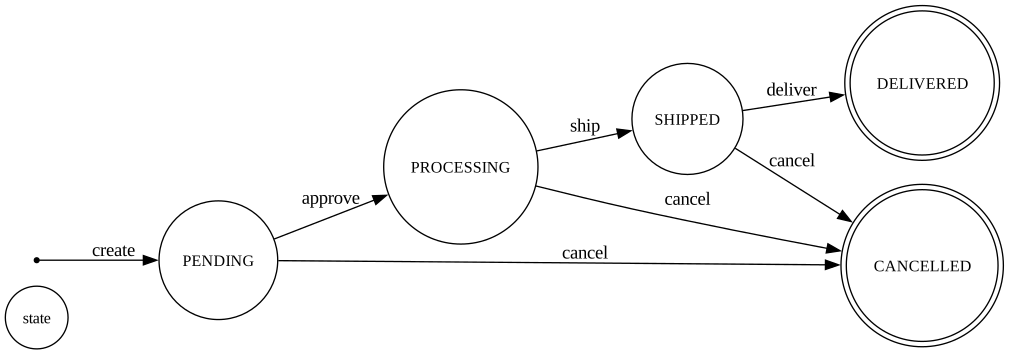
Using the graph in a model:
@Stateful
@Entity
@EqualsAndHashCode(callSuper = true)
public class Order extends BaseModel {
  @StateGraph(graphName = "orderStringState")
  private String status;

  @Override public String bmFunctionalArea()  { return "Orders"; }
  @Override public String bmFunctionalDomain(){ return "Order"; }
}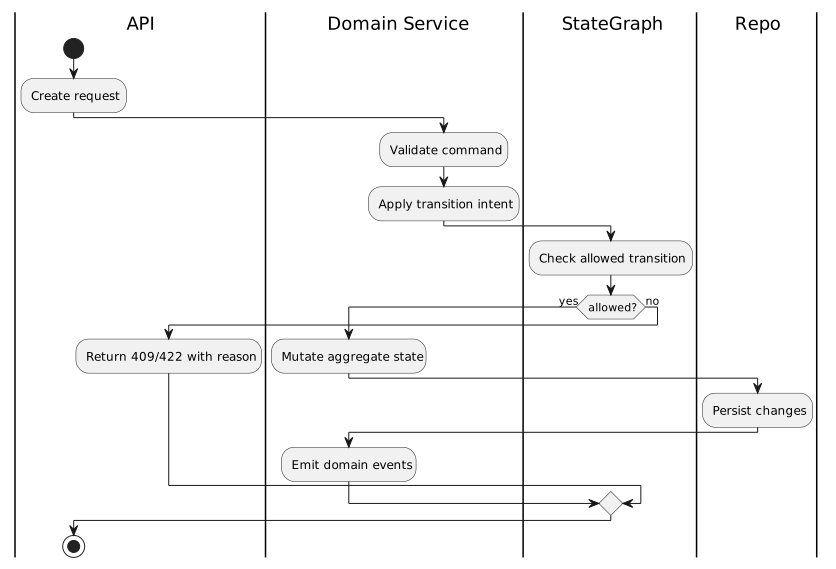
How it affects save/update:
-
On create: validateInitialStates ensures the field value is one of the configured initial states. Otherwise, InvalidStateTransitionException is thrown.
-
On update: validateStateTransitions checks each @StateGraph field’s old→new transition against the graph via StateGraphManager.validateTransition(). If invalid, save/update fails with InvalidStateTransitionException. This applies to full-entity saves and to partial updates via repo.update(…pairs) on that field.
-
Utilities: StateGraphManager.getNextPossibleStates(graphName, current) and printStateGraph(…) can aid UIs.
13.7. CompletionTasks and CompletionTaskGroups
CompletionTasks and CompletionTaskGroups provide a small persistence-backed contract for tracking work that finishes later. They are useful when a request starts work immediately but the actual completion happens in a worker, another service, or a human-in-the-loop integration.
This section documents the concrete structures and runtime behavior, because other guides reference "completion tasks" as a pattern but do not define the payloads and lifecycle precisely.
13.7.1. When to use them
Use CompletionTasks when you need:
-
A durable record of work that may outlive the initiating HTTP request
-
A simple per-item status model with timestamps and outcome text
-
A way to group related tasks under one business operation
-
A lightweight event stream so clients can react when a task completes
Do not treat them as a workflow engine. The framework does not infer dependencies, retries, compensation rules, or aggregate group state transitions for you.
13.7.2. Core entities
Both entities extend BaseModel, so they inherit the common Quantum fields such as id, refName, displayName, dataDomain, activeStatus, auditInfo, and version.
The inherited fields matter here in two ways:
-
idis the record identifier used by the REST endpoints and emitted in completion events. -
refName,displayName, anddataDomainare still available for your application-level correlation and multi-tenant scoping, even though they are not task-specific.
CompletionTask
@Entity("completionTask")
public class CompletionTask extends BaseModel {
  public enum Status { PENDING, RUNNING, SUCCESS, FAILED }

  @Reference
  CompletionTaskGroup group;

  String details;
  Status status;
  Date createdDate;
  Date completedDate;
  String result;
}| Field | Meaning | Set by |
|---|---|---|
|
Optional Morphia reference to the parent |
Client on create, or the |
|
Human-readable explanation of the unit of work, usually "what this task is doing" |
Client/application |
|
Task execution state: |
Server sets |
|
Timestamp when the task record was created |
Server |
|
Timestamp written when the task is completed through the completion endpoint |
Server |
|
Outcome text, response summary, or error message |
Application or completion endpoint caller |
CompletionTaskGroup
@Entity("completionTaskGroup")
public class CompletionTaskGroup extends BaseModel {
  public enum Status { NEW, RUNNING, COMPLETE }

  String description;
  Status status;
  Date createdDate;
  Date completedDate;
}| Field | Meaning | Set by |
|---|---|---|
|
Human-readable summary of the batch, workflow, or request that owns the tasks |
Client/application |
|
Coarse aggregate state: |
Server sets |
|
Timestamp when the group was created |
Server |
|
Timestamp for when your application considers the group finished |
Application |
13.7.3. What the framework manages vs. what your application manages
The code-level behavior is intentionally small:
-
CompletionTaskGroupRepo.createGroup(…)always setsstatus=NEWandcreatedDate=now. -
CompletionTaskRepo.createTask(…)always setsstatus=PENDINGandcreatedDate=now. -
CompletionTaskRepo.completeTask(…)setsstatus,completedDate=now, andresult. -
If the task belongs to a group, task completion emits an SSE message for that group.
The framework does not automatically:
-
Change a group from
NEWtoRUNNING -
Mark a group
COMPLETEwhen all child tasks finish -
Count completed tasks or calculate percentages
-
Retry failed tasks
-
Validate that only terminal states are used with the completion endpoint
That means group rollup is application-owned. If you want CompletionTaskGroup.status to represent aggregate progress, update it explicitly from your worker or orchestration layer.
13.7.4. State model
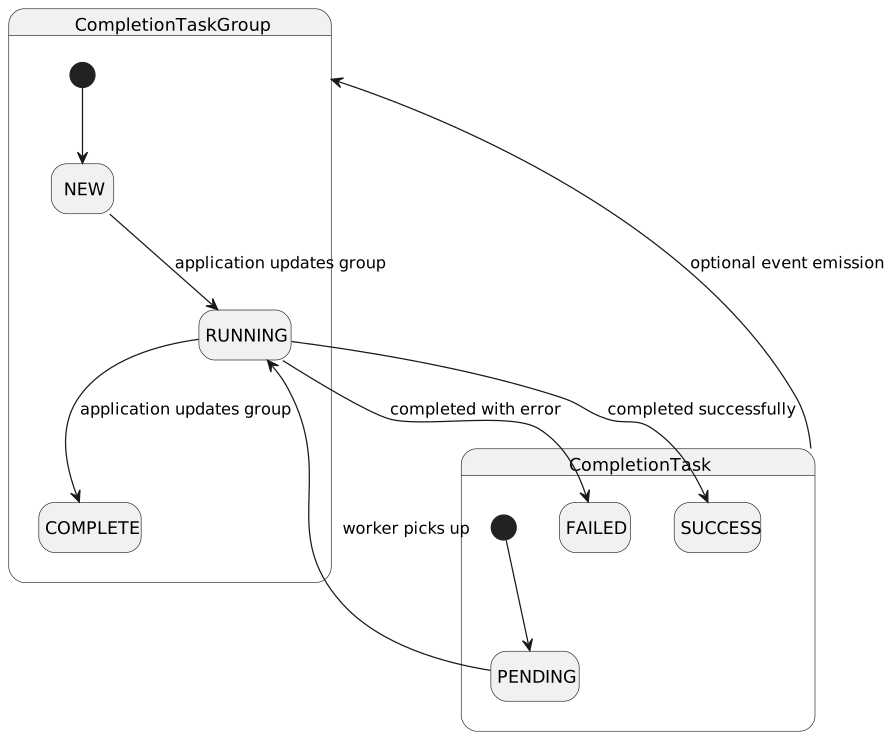
Recommended conventions:
-
Set a task to
RUNNINGwhen a worker begins processing it. -
Use
SUCCESSandFAILEDas the terminal task states. -
Set a group to
RUNNINGonce at least one child task has begun. -
Set a group to
COMPLETEonly when your own aggregation logic decides the batch is finished.
13.7.5. REST API surface
The completion-task resources are small wrappers on top of the generic BaseResource, so they expose both task-specific endpoints and inherited read endpoints.
Task group endpoints
| Method and path | Purpose | Notes |
|---|---|---|
|
Create a new task group |
Server forces |
|
Fetch a group by Mongo |
Inherited from |
|
Fetch a group by |
Inherited from |
|
Subscribe to completion events for tasks in the group |
Returns server-sent events |
Task endpoints
| Method and path | Purpose | Notes |
|---|---|---|
|
Create a task and attempt to attach it to the given group |
Server forces |
|
Update a task status, set |
Despite the method name, the code accepts any |
|
Fetch a task by Mongo |
Inherited from |
|
Fetch a task by |
Inherited from |
13.7.6. Request and response payloads
Creating a group
Minimal request:
{
  "refName": "catalog-import-20260327",
  "displayName": "Catalog Import 2026-03-27",
  "description": "Nightly catalog import for 250 SKUs"
}
Representative response:
{
  "id": "67e51d7c9d0f1d6df2f8ab12",
  "refName": "catalog-import-20260327",
  "displayName": "Catalog Import 2026-03-27",
  "description": "Nightly catalog import for 250 SKUs",
  "status": "NEW",
  "createdDate": "2026-03-27T04:12:14.118Z",
  "completedDate": null
}
Creating a task in a group
Minimal request:
{
  "refName": "sku-100045",
  "displayName": "Import SKU 100045",
  "details": "Import SKU 100045 from supplier feed"
}
Representative response:
{
  "id": "67e51df49d0f1d6df2f8ab13",
  "refName": "sku-100045",
  "displayName": "Import SKU 100045",
  "details": "Import SKU 100045 from supplier feed",
  "status": "PENDING",
  "createdDate": "2026-03-27T04:14:12.091Z",
  "completedDate": null,
  "result": null,
  "group": {
    "id": "67e51d7c9d0f1d6df2f8ab12"
  }
}
Notes:
-
The endpoint path requires a
groupId. -
If the
groupIddoes not resolve to an existing group, the current repository implementation still creates the task, but leavesgroupunset. -
The server ignores any client-supplied
statusorcreatedDateduring creation and overwrites them.
Completing a task
Example:
curl -X PUT \
  "http://localhost:8080/integration/completionTask/complete/67e51df49d0f1d6df2f8ab13?status=SUCCESS&result=Imported%20successfully"
Representative response:
{
  "id": "67e51df49d0f1d6df2f8ab13",
  "status": "SUCCESS",
  "completedDate": "2026-03-27T04:16:08.501Z",
  "result": "Imported successfully"
}
Important behavior:
-
completedDateis always set by the completion endpoint. -
The endpoint name says "complete", but the implementation accepts any value in
CompletionTask.Status. -
Updating the task does not automatically update the parent group status.
13.7.7. Completion event stream
GET /integration/completionTaskGroup/subscribe/{groupId} returns server-sent events. Each event is emitted when CompletionTaskRepo.completeTask(…) is called for a task in that group.
The event payload is plain text, not JSON. The current format is:
task:{taskId}:{status}Example event data:
task:67e51df49d0f1d6df2f8ab13:SUCCESSIf you need richer event payloads, build that in your own orchestration layer or extend the resource.
13.7.8. Typical orchestration flow
Example creation flow:
CompletionTaskGroup group = completionTaskGroupRepo.createGroup(
  CompletionTaskGroup.builder()
    .refName("catalog-import-20260327")
    .displayName("Catalog Import 2026-03-27")
    .description("Nightly catalog import for 250 SKUs")
    .build()
);

for (Sku s : skus) {
  completionTaskRepo.createTask(
    CompletionTask.builder()
      .refName("sku-" + s.code())
      .displayName("Import SKU " + s.code())
      .details("Import SKU " + s.code() + " from supplier feed")
      .build(),
    group.getId().toString()
  );
}
Example worker progression:
CompletionTask task = completionTaskRepo.findOneByStatus(CompletionTask.Status.PENDING);
if (task != null) {
  completionTaskRepo.update(task.getId(), "status", CompletionTask.Status.RUNNING);
  completionTaskGroupRepo.update(task.getGroup().getId(), "status", CompletionTaskGroup.Status.RUNNING);

  try {
    // ... do work ...
    completionTaskRepo.completeTask(
      task.getId().toString(),
      CompletionTask.Status.SUCCESS,
      "Imported successfully"
    );
  } catch (Exception e) {
    completionTaskRepo.completeTask(
      task.getId().toString(),
      CompletionTask.Status.FAILED,
      e.getMessage()
    );
  }
}
Example aggregate rollup owned by the application:
List<CompletionTask> tasks = completionTaskRepo.findByGroup(group);

boolean allTerminal = tasks.stream().allMatch(t ->
  t.getStatus() == CompletionTask.Status.SUCCESS ||
  t.getStatus() == CompletionTask.Status.FAILED
);
boolean anyRunning = tasks.stream().anyMatch(t ->
  t.getStatus() == CompletionTask.Status.RUNNING
);

if (allTerminal) {
  completionTaskGroupRepo.update(
    group.getId(),
    "status", CompletionTaskGroup.Status.COMPLETE,
    "completedDate", new Date()
  );
} else if (anyRunning) {
  completionTaskGroupRepo.update(
    group.getId(),
    "status", CompletionTaskGroup.Status.RUNNING
  );
}
13.7.9. Best practices
-
Keep
detailsshort and stable so operators can quickly scan task lists. -
Use
resultfor outcome summaries, error messages, or external correlation identifiers. -
Populate
refNamewith a meaningful business key so tasks can be found without raw Mongo ids. -
Use
dataDomainconsistently so task and group records stay tenant-scoped. -
Treat group status as a denormalized summary owned by your orchestration code.
-
Purge or archive old completed groups to avoid unbounded growth.
13.8. References and EntityReference
Morphia @Reference establishes relationships between entities: - One-to-one: a BaseModel field annotated with @Reference. - One-to-many: a Collection<BaseModel> field annotated with @Reference.
Example:
@Entity
public class Shipment extends BaseModel {
  @Reference(ignoreMissing = false)
  @TrackReferences
  private Partner partner;   // parent entity
}
EntityReference is a lightweight reference object used across the framework to avoid DBRef loading when only identity info is needed. Any model can produce one:
EntityReference ref = shipment.createEntityReference();
// contains: entityId, entityType, entityRefName, entityDisplayName (and optional realm)
REST convenience:
-
BaseResource exposes GET /entityref to list EntityReference for a model with optional filter/sort.
-
Repositories expose getEntityReferenceListByQuery(…), and utilities exist to convert lists of EntityReference back to entities when needed.
When to use which:
-
Use @Reference for strong persistence-level links where Morphia should maintain foreign references.
-
Use EntityReference for UI lists, foreign-key-like pointers in other documents, events/audit logs, or cross-module decoupling without DBRef behavior.
13.9. Tracking References with @TrackReferences and Delete Semantics
@TrackReferences on a @Reference field tells the framework to maintain a back-reference set on the parent entity. The back-reference field is UnversionedBaseModel.references (a Set<ReferenceEntry>), which is calculated/maintained by the framework and should not be set by clients.
What references contains:
-
Each ReferenceEntry holds: referencedId (ObjectId of the child), type (fully-qualified class name of the child’s entity), and refName (child’s stable reference name).
-
It indicates that the parent is being referenced by the given child entity. The set is used for fast checks and to enforce referential integrity.
How tracking works (save/update):
-
ReferenceInterceptor inspects @Reference fields annotated with @TrackReferences during prePersist.
-
When a child references a parent, a ReferenceEntry for the child is added to the parent’s references set and the parent is saved to persist the back-reference.
-
For @Reference collections, entries are added for each child-parent pair.
-
If a @Reference is null but ignoreMissing=false, a save will fail with an IllegalStateException since the parent is required.
How it affects delete:
-
During delete in MorphiaRepo.delete(…):
-
If obj.references is empty, the object can be deleted directly (after removing any references it holds to parents).
-
If obj.references is not empty, the repo checks each ReferenceEntry. If any referring parent still exists, a ReferentialIntegrityViolationException is thrown to prevent breaking relationships.
-
If all references are stale (referring objects no longer exist), the repo removes stale entries, removes this object’s own reference constraints from parents, and performs the delete within a transaction.
-
removeReferenceConstraint(…) ensures that, when deleting a child, its ReferenceEntry is removed from parent.references and the parent is saved, keeping back-references consistent.
Practical guidance:
-
Annotate parent links with both @Reference and @TrackReferences when you need strong integrity guarantees and easy “who references me?” queries.
-
Use ignoreMissing=true only for optional references; you still get back-reference tracking when not null.
-
Expect HTTP delete to fail with a meaningful error if there are live references; remove or update those references first, or design cascading behavior explicitly in your domain logic.
13.9.1. Ontologies in Quantum: Modeling Relationships That Are Resilient and Fast
| Looking for the short implementation plan? See PROPOSAL.md at the repository root for a concise module-by-module checklist. |
This section explains what an ontology is, how it differs from a traditional object model, and how the Quantum Ontology modules make it practical to apply ontology ideas to your domain models and queries. It also contrasts ontology-driven relationships with direct object references (for example, using @Reference or EntityReference).
What is an Ontology?
In software terms, an ontology is a formal, explicit specification of concepts and their relationships.
-
Concepts (Classes): Named categories/types in your domain. Concepts can form taxonomies (is-a hierarchies), be declared disjoint, or be equivalent.
-
Relationships (Properties): Named relationships between entities. Properties can have a domain (applies to X) and a range (points to Y). They may be inverse or transitive.
-
Axioms (Rules): Constraints and entailment rules, including property chains such as: if (A --p-→ B) and (B --q-→ C) then we infer (A --r-→ C).
-
Inference: The process of deriving new facts (types, labels, edges) that were not explicitly stored but follow from axioms and known facts.
An ontology is not the data; it is the schema plus logic that gives your data additional meaning and enables consistent, automated inferences.
Ontology vs. Object Model
A conventional object model focuses on concrete classes, fields, and direct references between objects at implementation time. An ontology focuses on semantic types and relationships, with explicit rules that can derive new knowledge independent of how objects are instantiated.
Key differences: - Purpose - Object model: Encapsulate data and behavior for application code generation and persistence. - Ontology: Encode shared meaning, constraints, and inference rules that remain stable as implementation details change. - Relationship handling - Object model: Typically uses direct references or foreign keys; traversals are hard-coded and fragile to change. - Ontology: Uses named predicates (properties) and can infer additional relationships by rules (property chains, inverses, transitivity). - Polymorphism and evolution - Object model: Polymorphism requires class inheritance in code; cross-cutting categories are awkward to add later. - Ontology: Entities can have multiple types/labels at once. New concepts and properties can be introduced without breaking existing data. - Querying - Object model: Queries couple to concrete classes and field paths; changes force query rewrites. - Ontology: Queries target semantic relationships; reasoners can materialize edges that queries reuse, decoupling queries from implementation details.
Why prefer Ontology-driven relationships over @Reference/EntityReference
Direct references (@Reference or custom EntityReference) are simple to start but become restrictive as domains grow: - Tight coupling: Code and queries couple to concrete field paths (customer.primaryAddress.id), making refactors risky. - Limited expressivity: Hard to encode and reuse higher-order relationships (e.g., "partners of my supplier’s parent org"). - Poor polymorphism: References point to one collection/type; accommodating multiple target types requires extra code. - Performance pitfalls: Deep traversals cause extra queries, N+1 selects, or complex $lookup joins.
Ontology-driven edges address these issues: - Decoupling via predicates: Use named predicates (e.g., hasAddress, memberOf, supplies) that remain stable while internal object fields change. - Inference for reachability: Property chains can materialize implied links (A --p-→ B & B --q-→ C ⇒ A --r-→ C), avoiding runtime multi-hop traversals. - Polymorphism-first: A predicate can connect heterogeneous types; type inferences (domain/range) remain consistent. - Query performance: Pre-materialized edges allow single-hop, index-friendly queries (in or eq filters) instead of ad-hoc multi-collection traversals. - Resilience to change: You can add or modify rules without rewriting data structures or touching referencing fields across models.
How Quantum supports Ontologies
Quantum provides three cooperating modules that make ontology modeling practical and fast:
-
quantum-ontology-core (package com.e2eq.ontology.core)
-
OntologyRegistry: Holds the TBox (terminology) of your ontology.
-
ClassDef: Concept names and relationships (parents, disjointWith, sameAs).
-
PropertyDef: Property names with optional domain, range, inverse flags, and transitivity.
-
PropertyChainDef: Rules that define multi-hop implications (chains → implied property).
-
TBox: Container for classes, properties, and property chains.
-
Reasoner interface and ForwardChainingReasoner: Given an entity snapshot and the registry, computes inferences:
-
New types/labels to assert on entities.
-
New edges to add (implied by property chains, inverses, or other rules).
-
quantum-ontology-mongo (package com.e2eq.ontology.mongo)
-
EdgeDao: A thin DAO around an edges collection in Mongo. Each edge contains tenantId, src, predicate p, dst, inferred flag, provenance, and timestamp.
-
OntologyMaterializer: Runs the Reasoner for an entity snapshot and upserts the inferred edges, so queries can be rewritten to simple in/in eq filters.
-
quantum-ontology-policy-bridge (package com.e2eq.ontology.policy)
-
ListQueryRewriter: Takes a base query and rewrites it using the EdgeDao to filter by the set of source entity ids that have a specific predicate to a given destination.
-
This integrates ontology edges with RuleContext or policy decisions: policy asks for entities related by a predicate; the rewriter converts that into an efficient Mongo query.
These modules let you define your ontology (core), materialize derived relations (mongo), and leverage them in access and list queries (policy bridge).
Modeling guidance: from object fields to predicates
-
Name relationships explicitly
-
Define clear predicate names (hasAddress, memberOf, supplies, owns, assignedTo). Avoid encoding relationship semantics in field names only.
-
Keep object model minimal and flexible
-
Store lightweight identifiers (ids) as needed, but avoid deeply nested reference graphs that encode traversals in code.
-
Model polymorphic relationships
-
Prefer predicates that naturally connect multiple possible types (e.g., assignedTo can target User, Team, Bot) and rely on ontology type assertions to constrain where needed.
-
Use property chains for common paths
-
If business logic often traverses A → B → C, define a chain p∘q ⇒ r and materialize r for faster queries and simpler policies.
-
Capture inverses and transitivity
-
For natural inverses (parentOf ⇄ childOf) or transitive relations (partOf, locatedIn), define them in the ontology so edges and queries stay consistent.
-
Keep provenance
-
Record why an edge exists (prov.rule, prov.inputs) so you can recompute, audit, or retract when inputs change.
Querying with ontology edges vs direct references
-
Direct reference example (fragile/slow)
-
Query: "Find Orders whose buyer belongs to Org X or its parents."
-
With @Reference: requires joining Order → User → Org and recursing org.parent; costly and tightly coupled to fields.
-
Ontology edge example (resilient/fast)
-
Define predicates: placedBy(order, user), memberOf(user, org), ancestorOf(org, org). Define chain placedBy ∘ memberOf ⇒ placedInOrg.
-
Materialize edges: (order --placedInOrg-→ org). Also make ancestorOf transitive.
-
Query becomes: where order._id in EdgeDao.srcIdsByDst(tenantId, "placedInOrg", orgX).
-
With transitivity, you can precompute ancestor closure or add a chain placedInOrg ∘ ancestorOf ⇒ placedInOrg to include parents automatically.
Migration: from @Reference to ontology edges
-
Start by introducing predicates alongside existing references; do not remove references immediately.
-
Materialize edges for hot read paths; keep provenance so you can reconstruct.
-
Gradually update queries (list screens, policy filters) to use ListQueryRewriter with EdgeDao instead of deep traversals or $lookup.
-
Once stable, you can simplify models by removing rigid reference fields where unnecessary and rely on edges for read-side composition.
Performance and operational notes
-
Indexing: Create compound indexes on edges: (tenantId, p, dst) and (tenantId, src, p) to support both reverse and forward lookups.
-
Write amplification vs read wins: Materialization adds write work, but dramatically improves read latency and simplifies queries.
-
Consistency: Re-materialize edges on relevant entity changes (source, destination, or intermediate) using OntologyMaterializer.
-
Multi-tenancy: Keep tenantId in the edge key and filters; the provided EdgeDao methods include tenant scoping.
How this integrates with Functional Areas/Domains
-
Functional domains often map to concept clusters in the ontology. Use @FunctionalMapping to aid discovery and apply policies per area/domain.
-
Policies can refer to relationships semantically ("hasEdge placedInOrg OrgX") and rely on the policy bridge to turn this into efficient data filters.
Summary
-
Ontology-powered relationships provide a stable, semantic layer over your object model.
-
The Quantum Ontology modules let you define, infer, and query these relationships efficiently on MongoDB.
-
Compared with direct @Reference/EntityReference, ontology edges are more expressive, resilient to change, and typically faster for complex list/policy queries once materialized.
Concrete example: Sales Orders, Shipments, and evolving to Fulfillment/Returns
This example shows how to use an ontology to model relationships around Orders, Customers, and Shipments, and how the model can evolve to include Fulfillment and Returns without breaking existing queries. We will:
-
Define core concepts and predicates.
-
Add property chains that materialize implied relationships for fast queries.
-
Show how queries are rewritten using edges instead of deep object traversals.
-
Evolve the model to support Fulfillment and Returns with minimal changes.
Core concepts (classes)
-
Order, Customer, Organization, Shipment, Address, Region
-
Later evolution: FulfillmentTask, FulfillmentUnit, ReturnRequest, ReturnItem, RMA
Key predicates (relationships)
-
placedBy(order, customer): who placed the order
-
memberOf(customer, org): a customer belongs to an organization (or account)
-
orderHasShipment(order, shipment): outbound shipment for the order
-
shipsTo(shipment, address): shipment destination
-
locatedIn(address, region): address is located in a Region
-
ancestorOf(org, org): organizational ancestry (transitive)
Property chains (implied relationships)
-
placedBy ∘ memberOf ⇒ placedInOrg
-
If (order --placedBy-→ customer) and (customer --memberOf-→ org), then infer (order --placedInOrg-→ org)
-
orderHasShipment ∘ shipsTo ⇒ orderShipsTo
-
If (order --orderHasShipment-→ shipment) and (shipment --shipsTo-→ address), infer (order --orderShipsTo-→ address)
-
orderShipsTo ∘ locatedIn ⇒ orderShipsToRegion
-
If (order --orderShipsTo-→ address) and (address --locatedIn-→ region), infer (order --orderShipsToRegion-→ region)
-
placedInOrg ∘ ancestorOf ⇒ placedInOrg
-
Makes placedInOrg resilient to org hierarchy changes (ancestorOf is transitive). This is a common “closure” trick: re-assert the same predicate via chain to absorb hierarchy.
A minimal Java-style snippet to define this TBox
import java.util.*;
import com.e2eq.ontology.core.OntologyRegistry;
import com.e2eq.ontology.core.OntologyRegistry.*;

Map<String, ClassDef> classes = Map.of(
  "Order", new ClassDef("Order", Set.of(), Set.of(), Set.of()),
  "Customer", new ClassDef("Customer", Set.of(), Set.of(), Set.of()),
  "Organization", new ClassDef("Organization", Set.of(), Set.of(), Set.of()),
  "Shipment", new ClassDef("Shipment", Set.of(), Set.of(), Set.of()),
  "Address", new ClassDef("Address", Set.of(), Set.of(), Set.of()),
  "Region", new ClassDef("Region", Set.of(), Set.of(), Set.of())
);

Map<String, PropertyDef> props = Map.of(
  "placedBy", new PropertyDef("placedBy", Optional.of("Order"), Optional.of("Customer"), false, Optional.empty(), false),
  "memberOf", new PropertyDef("memberOf", Optional.of("Customer"), Optional.of("Organization"), false, Optional.empty(), false),
  "orderHasShipment", new PropertyDef("orderHasShipment", Optional.of("Order"), Optional.of("Shipment"), false, Optional.empty(), false),
  "shipsTo", new PropertyDef("shipsTo", Optional.of("Shipment"), Optional.of("Address"), false, Optional.empty(), false),
  "locatedIn", new PropertyDef("locatedIn", Optional.of("Address"), Optional.of("Region"), false, Optional.empty(), false),
  "ancestorOf", new PropertyDef("ancestorOf", Optional.of("Organization"), Optional.of("Organization"), false, Optional.empty(), true), // transitive
  // implied predicates (no domain/range required, but you may add them for validation)
  "placedInOrg", new PropertyDef("placedInOrg", Optional.of("Order"), Optional.of("Organization"), false, Optional.empty(), false),
  "orderShipsTo", new PropertyDef("orderShipsTo", Optional.of("Order"), Optional.of("Address"), false, Optional.empty(), false),
  "orderShipsToRegion", new PropertyDef("orderShipsToRegion", Optional.of("Order"), Optional.of("Region"), false, Optional.empty(), false)
);

List<PropertyChainDef> chains = List.of(
  new PropertyChainDef(List.of("placedBy", "memberOf"), "placedInOrg"),
  new PropertyChainDef(List.of("orderHasShipment", "shipsTo"), "orderShipsTo"),
  new PropertyChainDef(List.of("orderShipsTo", "locatedIn"), "orderShipsToRegion"),
  new PropertyChainDef(List.of("placedInOrg", "ancestorOf"), "placedInOrg")
);

OntologyRegistry.TBox tbox = new OntologyRegistry.TBox(classes, props, chains);
OntologyRegistry registry = OntologyRegistry.inMemory(tbox);
Materializing edges for an Order
-
Explicit facts for order O1:
-
O1 placedBy C9
-
C9 memberOf OrgA
-
O1 orderHasShipment S17
-
S17 shipsTo Addr42
-
Addr42 locatedIn RegionWest
-
OrgA ancestorOf OrgParent
-
Inferred edges after running the reasoner for O1’s snapshot:
-
O1 placedInOrg OrgA
-
O1 placedInOrg OrgParent (via closure with ancestorOf)
-
O1 orderShipsTo Addr42
-
O1 orderShipsToRegion RegionWest
How queries become simple and fast
-
List Orders for Organization OrgParent (including children):
-
Instead of joining Order → Customer → Org and recursing org.parent, run a single filter using materialized edges.
import com.mongodb.client.model.Filters;
import org.bson.conversions.Bson;
import com.e2eq.ontology.policy.ListQueryRewriter;

Bson base = Filters.eq("status", "OPEN");
Bson rewritten = rewriter.rewriteForHasEdge(base, tenantId, "placedInOrg", "OrgParent");
// Use rewritten in your Mongo find-
List Orders shipping to RegionWest:
Bson rewritten2 = rewriter.rewriteForHasEdge(Filters.empty(), tenantId, "orderShipsToRegion", "RegionWest");Why this is resilient
-
If tomorrow Customer becomes AccountContact and the organization model gains Divisions and multi-parent org graphs, you only adjust predicates and chains.
-
Queries that rely on placedInOrg or orderShipsToRegion remain unchanged and fast, because edges are re-materialized by OntologyMaterializer.
Evolving the model: add Fulfillment
New concepts
-
FulfillmentTask: a unit of work to pick/pack/ship order lines
-
FulfillmentUnit: a logical grouping (e.g., wave, tote, parcel)
New predicates
-
fulfills(task, order)
-
realizedBy(order, fulfillmentUnit)
-
taskProduces(task, shipment)
New chains (implied)
-
fulfills ⇒ derived edge from task to order; combine with taskProduces to connect order to shipment without touching Order fields:
-
fulfills ∘ taskProduces ⇒ orderHasShipment
-
realizedBy ∘ orderHasShipment ⇒ fulfilledByUnit
-
If (order --realizedBy-→ fu) and (order --orderHasShipment-→ s) ⇒ (fu --fulfillsShipment-→ s) or simply (order --fulfilledByUnit-→ fu)
These chains let you introduce warehouse concepts without changing how UI filters orders by organization or ship-to region. Existing queries still operate via placedInOrg and orderShipsToRegion.
Evolving further: add Returns
New concepts
-
ReturnRequest, ReturnItem, RMA
New predicates
-
hasReturn(order, returnRequest)
-
returnFor(returnItem, order)
-
returnRma(returnRequest, rma)
New chains (implied)
-
hasReturn ⇒ openReturnOnOrg via placedInOrg:
-
hasReturn ∘ placedInOrg ⇒ returnPlacedInOrg
-
returnFor ∘ orderShipsToRegion ⇒ returnShipsToRegion
Example queries with new capabilities
-
List Orders with open returns in OrgParent:
Bson r = rewriter.rewriteForHasEdge(Filters.empty(), tenantId, "returnPlacedInOrg", "OrgParent");-
List Returns associated to Orders shipping to RegionWest:
Bson r2 = rewriter.rewriteForHasEdge(Filters.empty(), tenantId, "returnShipsToRegion", "RegionWest");Comparison with direct references (@Reference/EntityReference)
-
With direct references you would encode fields like Order.customer, Order.shipments, Shipment.address, Address.region and then implement multi-hop traversals in code or $lookup pipelines, rewriting them whenever you add Fulfillment or Returns.
-
With ontology edges, you keep predicates stable and add property chains. Existing list and policy queries keep working and typically become faster due to single-hop filters on an indexed edges collection.
Operational tips for this scenario
-
Ensure EdgeDao has indexes on (tenantId, p, dst) and (tenantId, src, p).
-
Use OntologyMaterializer when Order, Shipment, Customer, Address, or org hierarchy changes to keep edges fresh.
-
Keep provenance in edge.prov (rule, inputs) so you can recompute or retract edges when source data changes.
13.9.2. Integrating Ontology with Morphia, Permissions, and Multi-tenancy
This section focuses on integration and developer experience: how ontology edges flow into Morphia-based repositories and the permission rule language, while remaining fully multi-tenant and secure.
Big picture: where ontology fits
-
Write path (materialization):
-
Your domain code persists entities with minimal direct references.
-
An OntologyMaterializer runs when entities change to derive and upsert edges into the edges collection (per tenant).
-
Policy path (authorization and list filters):
-
The permission rule language evaluates the caller’s SecurityContext/RuleContext and produces logical filters.
-
When a rule asks for a semantic relationship (hasEdge), we use ListQueryRewriter + EdgeDao to translate that into efficient Mongo filters over ids.
-
Read path (queries):
-
Morphia repos apply the base data-domain filters and the rewritten ontology constraint to queries, producing fast lists without deep joins.
Rule language: add hasEdge()
We introduce a policy function/operator to reference ontology edges directly from rules:
-
Signature: hasEdge(predicate, dstIdOrVar)
-
predicate: String name of the ontology predicate (e.g., "placedInOrg", "orderShipsToRegion").
-
dstIdOrVar: Either a concrete id/refName or a variable resolved from RuleContext (e.g., principal.orgRefName, request.region).
-
Semantics: The rule grants/filters entities for which an edge (tenantId, src = entity._id, p = predicate, dst = resolvedDst) exists.
-
Composition: hasEdge can be combined with existing rule clauses (and/or/not) and other filters (states, tags, ownerId, etc.).
Example rule snippets (illustrative):
-
Allow viewing Orders in the caller’s org (including ancestors via ontology closure):
-
allow VIEW Order when hasEdge("placedInOrg", principal.orgRefName)
-
Restrict list to Orders shipping to a region chosen in request:
-
allow LIST Order when hasEdge("orderShipsToRegion", request.region)
Under the hood, policy evaluation uses ListQueryRewriter.rewriteForHasEdge(…), which converts hasEdge into a set of source ids and merges that with the base query.
Passing tenantId correctly
-
Always resolve tenantId from RuleContext/SecurityContext (the same source your repos use for realm/database selection).
-
EdgeDao and ListQueryRewriter already accept tenantId; never cross tenant boundaries when reading edges.
-
Index recommendation (per tenant):
-
(tenantId, p, dst)
-
(tenantId, src, p)
Morphia repository integration patterns
The goal is zero-friction usage in existing repos without invasive changes.
Option A: Apply ontology constraints in code paths that already construct BSON filters.
-
If your repo method builds a Bson filter before calling find(), wrap it through rewriter:
Bson base = Filters.and(existingFilters...);
Bson rewritten = hasEdgeRequested
  ? rewriter.rewriteForHasEdge(base, tenantId, predicate, dst)
  : base;
var cursor = datastore.getDatabase().getCollection(coll).find(rewritten);
Option B: Apply ontology constraints to Morphia Filter/Query via ids.
-
When the repo uses Morphia’s typed query API instead of BSON, pre-compute the id set and constrain by _id:
Set<String> ids = edgeDao.srcIdsByDst(tenantId, predicate, dst);
if (ids.isEmpty()) {
  return List.of(); // short-circuit
}
query.filter(Filters.in("_id", ids));
Option C: Centralize in a tiny helper for developer ergonomics.
-
Provide one helper in your application layer, invoked wherever policies inject additional constraints:
public final class OntologyFilterHelper {
  private final ListQueryRewriter rewriter;
  public OntologyFilterHelper(ListQueryRewriter r) { this.rewriter = r; }

  public Bson ensureHasEdge(Bson base, String tenantId, String predicate, String dst) {
    return rewriter.rewriteForHasEdge(base, tenantId, predicate, dst);
  }
}
Where to hook materialization
-
On entity changes that are sources or intermediates for chains:
-
Order (placedBy, orderHasShipment), Customer (memberOf), Shipment (shipsTo), Address (locatedIn), Organization (ancestorOf/parent), and any Fulfillment/Returns entities.
-
Recommended patterns:
-
On-save/on-update hooks in your service layer call OntologyMaterializer.apply(…) with the explicit edges known from the entity snapshot.
-
For intermediates (e.g., Address.region changed), enqueue affected sources for recomputation; use provenance to locate impacted edges.
-
Provide nightly/backfill jobs for recomputing edges across a tenant when ontology rules evolve.
Security and multi-tenant considerations
-
Edge rows include tenantId and should be validated/filtered by tenant on every operation.
-
Never trust a client-supplied predicate or destination id blindly; combine with rule evaluation and whitelist allowed predicates per domain if needed.
-
For shared resources across tenants (rare), model cross-tenant permissions at the policy layer; don’t reuse edges across tenants unless explicitly designed.
Developer workflow and DX checklist
-
When writing a rule: use hasEdge("<predicate>", <rhs>) and rely on RuleContext variables for the destination when possible.
-
When writing a list endpoint: read optional ontology filter hints from the policy layer; if present, apply ensureHasEdge(…) before find().
-
When changing domain relationships: update predicates/chains and re-materialize; list/policy code stays unchanged.
-
When indexing a new tenant: include the edges indexes early and validate via a smoke test query using ListQueryRewriter.
Cookbook: end-to-end example with Orders + Org
-
Policy: allow LIST Order when hasEdge("placedInOrg", principal.orgRefName)
-
Request lifecycle: 1) Security filter builds SecurityContext and RuleContext with tenantId and principal. 2) Policy evaluation returns a directive to constrain by hasEdge("placedInOrg", orgRefName). 3) Repo builds base filter (state != ARCHIVED, etc.). 4) Repo calls OntologyFilterHelper.ensureHasEdge(base, tenantId, "placedInOrg", orgRefName). 5) Mongo executes a single-hop query using materialized edges; results respect both policy and multi-tenancy.
Migration notes for teams using @Reference
-
Keep existing references for write-side integrity and local joins where simple.
-
Introduce ontology edges on hot read paths first; update policy rules to hasEdge and verify results.
-
Gradually replace deep $lookup traversals with hasEdge-based rewrites.
-
Ensure materialization hooks are deployed before removing data fields used as inputs to the ontology.
14. 4. Multi-tenant model and realm separation
Problem: Isolating data per tenant while enabling selective sharing.
Why for SaaS: Security, compliance, and data residency require strong segregation and auditability.
How Quantum helps: Realm/tenant identifiers, context propagation, transforms, and repository filters.
Walkthrough: Configure realms and mark your models for tenancy.
14.1. Multi‑Tenancy Models
Quantum supports multiple multi-tenant models for MongoDB deployments:
14.1.1. One Tenant per Database (in a MongoDB Cluster)
-
Each tenant is mapped to a dedicated MongoDB database within a cluster.
-
Strong isolation at the database level; operational controls via MongoDB roles.
-
Pros: Simplified backup/restore per tenant; reduced risk of data bleed.
-
Cons: More databases to manage (indexes, connections), higher operational overhead.
How Quantum helps:
-
DataDomain carries tenant identifiers (e.g., tenantId, ownerId, orgRefName) on each model.
-
Repositories can resolve connections/DB selection per tenant, enabling routing to the appropriate database.
14.1.2. Many Tenants in One Database (Shared Database)
-
Multiple tenants share a single database and collections.
-
Isolation is enforced at the application layer using DataDomain filters.
-
Pros: Fewer databases to manage; efficient index utilization and connection pooling.
-
Cons: Strict discipline required to enforce filtering and access rules.
How Quantum helps:
-
DataDomain is part of every persisted model, enabling programmatic, rule-based filtering.
-
RuleContext and DomainContext can be used to inject tenant-aware filters into repositories and resources.
-
Cross-tenant sharing can be modeled by specific DataDomain fields and RuleContext logic granting read access across tenants on a per-functional-area basis.
14.1.3. Freemium and Trial Tenants
-
Programmatically create tenants to support self-service onboarding.
-
Attach time-bound or capability-bound policies.
-
Use scheduled jobs to convert/expire trials.
Quantum patterns:
-
Tenant onboarding service creates a DataDomain scope and any default records.
-
Policies are encoded in RuleContext checks to allow or restrict actions based on time, plan, or feature flags.
14.1.4. Tenant Onboarding and Access Invites
Quantum separates tenant creation from user access and from the user-facing onboarding journey. Those are related, but they are not the same thing:
-
Tenant provisioning creates the tenant realm, runs migrations, and establishes the initial admin user.
-
Tenant onboarding workflow defines the steps a tenant user should complete before access is considered fully activated.
-
Access invites bring an individual user into an existing tenant and can attach scoped access metadata.
This split helps teams support both admin-driven setup and self-service onboarding without forcing every tenant into a single path.
1. Tenant provisioning: create the tenant itself
The admin tenant provisioning API is exposed at:
-
POST /admin/tenants -
DELETE /admin/tenants/{realmId}
Provisioning is intended for admin and system roles. The request creates the tenant catalog entry, initializes the tenant database, and ensures an initial admin credential exists.
Request fields:
| Field | Purpose |
|---|---|
|
Human-readable label for the tenant |
|
Source for the realm id; dots are converted to dashes |
|
Organization reference used in the tenant |
|
Initial account number for the tenant |
|
User id for the initial tenant admin |
|
Optional stable subject override; defaults to |
|
Initial password for the admin user |
|
Optional list of seed archetypes to apply during tenant creation |
Representative request:
{
  "tenantDisplayName": "Acme Logistics",
  "tenantEmailDomain": "acme.example",
  "orgRefName": "acme.example",
  "accountId": "1000000001",
  "adminUserId": "admin@acme.example",
  "adminSubject": "admin@acme.example",
  "adminPassword": "change-me-now",
  "seedArchetypes": ["DemoArchetype"]
}
Representative response:
{
  "realmId": "acme-example",
  "realmCreated": true,
  "userCreated": true,
  "appliedSeedArchetypes": ["DemoArchetype"],
  "warnings": []
}
What provisioning does:
-
derives
realmIdfromtenantEmailDomain -
writes a
Realmcatalog record in the system realm -
builds tenant
DomainContextandDataDomain -
runs migrations in the new tenant realm
-
creates or validates the initial admin user
-
applies applicable base seed packs
-
optionally applies requested seed archetypes
-
applies indexes and verifies initialization
Provisioning is designed to be largely idempotent. If the same tenant or admin user already exists with matching attributes, the service proceeds and returns warnings instead of blindly recreating state. If existing state conflicts with the request, the service rejects the operation.
Deleting a tenant removes:
-
the tenant database
-
the tenant’s
Realmcatalog entry -
matching credentials associated with that tenant setup
DELETE /admin/tenants/{realmId} is destructive and is intentionally blocked for the configured system realm.
|
2. Tenant onboarding workflow: define the journey after invite/registration
Tenant onboarding workflow configuration is exposed at:
-
GET /onboarding/workflow/current -
POST /onboarding/workflow/current
This is tenant-scoped configuration. The active realm is derived from the current security context, so the workflow is saved and read per tenant realm.
The persisted model is TenantOnboardingWorkflow, which includes:
-
workflowEnabled -
inviteRequired -
registrationRequired -
surveyRequired -
adminApprovalRequired -
autoAssignSurveyOnInvite -
defaultSurveyRefName -
workflowDefinitionJson -
completionMessage
By default, the workflow steps are generated in this order:
-
invite -
registration -
survey -
approval -
activation
Each step can be enabled or omitted by toggling the corresponding booleans. When no custom workflow JSON is supplied, the framework generates a default workflowDefinitionJson using those flags.
Representative response:
{
  "refName": "default-tenant-onboarding",
  "displayName": "Tenant User Onboarding",
  "activeStatus": true,
  "inviteRequired": true,
  "registrationRequired": true,
  "surveyRequired": true,
  "adminApprovalRequired": true,
  "autoAssignSurveyOnInvite": true,
  "defaultSurveyRefName": "tenant-user-onboarding",
  "completionMessage": "Your tenant onboarding is complete. You can now sign in and begin using the workspace.",
  "steps": [
    { "key": "invite", "type": "access_invite", "required": true },
    { "key": "registration", "type": "registration_request", "required": true },
    { "key": "survey", "type": "survey", "required": true, "surveyRefName": "tenant-user-onboarding" },
    { "key": "approval", "type": "admin_approval", "required": true },
    { "key": "activation", "type": "account_activation", "required": true }
  ]
}
This workflow config answers "what steps should happen?" It does not by itself send invites or create tenant users.
3. Registration requests: capture onboarding data for approval
The registration-request endpoints are exposed at:
-
POST /onboarding/registrationRequest/create -
POST /onboarding/registrationRequest/approve
This API is the registration step that the onboarding workflow can reference through the registration_request step type. It is useful when a tenant wants users or organizations to submit onboarding information before access is approved.
At a high level:
-
createpersists anApplicationRegistration -
approvetransitions an existing registration request through the repository approval logic
This is the structured "please review my onboarding submission" side of the journey, whereas access invites are the "you have been invited into this tenant" side.
4. Access invites: grant a user into an existing tenant
Access invites are exposed at:
-
GET /access/invites -
GET /access/invites/{refName} -
POST /access/invites -
POST /access/invites/{refName}/revoke -
POST /access/invites/accept
The first four require an authenticated caller in the target tenant. Invite acceptance is @PermitAll because the recipient may not yet have tenant access.
The persisted AccessInvite model includes:
-
emailortargetUserId -
invitedByUserId -
scopeRefs -
grantedRoles -
allowedFunctionalAreas -
allowedFunctionalDomains -
allowedActions -
inviteMessage -
expiresAt -
acceptedAt -
acceptedUserId -
statusofPENDING,ACCEPTED,REVOKED, orEXPIRED
Representative invite creation request:
{
  "email": "jane.doe@partner.example",
  "scopeRefNames": ["north-america"],
  "grantedRoles": ["user"],
  "allowedFunctionalAreas": ["integration"],
  "allowedFunctionalDomains": ["exchange", "workflow"],
  "allowedActions": ["view", "create"],
  "expiresInDays": 14,
  "inviteMessage": "Join the tenant workspace for partner onboarding."
}
Representative creation response:
{
  "refName": "invite-1775100000000",
  "email": "jane.doe@partner.example",
  "scopeRefNames": ["north-america"],
  "grantedRoles": ["user"],
  "allowedFunctionalAreas": ["integration"],
  "allowedFunctionalDomains": ["exchange", "workflow"],
  "allowedActions": ["view", "create"],
  "status": "PENDING",
  "inviteToken": "raw-token-returned-at-create-time-only"
}
Important invite behavior:
-
either
emailortargetUserIdis required -
only one active pending invite is allowed for the same email or target user
-
tokens are stored as a hash; the raw token is only returned at invite creation time
-
invites expire automatically based on
expiresAt -
invites can be revoked before acceptance
Representative accept request:
{
  "realm": "acme-example",
  "token": "raw-token-returned-at-create-time-only",
  "email": "jane.doe@partner.example",
  "firstName": "Jane",
  "lastName": "Doe",
  "password": "choose-a-password"
}
Representative accept response:
{
  "userId": "jane.doe@partner.example",
  "email": "jane.doe@partner.example",
  "defaultRealm": "acme-example",
  "inviteRefName": "invite-1775100000000",
  "grantedScopes": ["north-america"]
}
What happens when an invite is accepted:
-
the invite token is validated and checked for expiry
-
the user identity is resolved from the authenticated user, request payload, invite target user, or invite email
-
if the user does not already exist, a new credential is created and a password is required
-
if the user already exists, the service ensures the user is authorized for the tenant realm
-
a
UserProfileis created if needed -
the invite status is changed to
ACCEPTED
Invite extension points
The invite flow is intentionally extensible through two SPIs:
-
AccessInviteProvisioner -
AccessInviteNotificationService
AccessInviteProvisioner can:
-
validate requested scopes when the invite is created
-
perform application-specific provisioning when the invite is accepted
AccessInviteNotificationService can:
-
deliver the invite token through email, messaging, or another notification mechanism
The framework ships with no-op default beans for both, so applications can opt in to deeper behavior without rewriting the invite flow.
How these pieces fit together
A common pattern looks like this:
-
An admin provisions the tenant with
POST /admin/tenants. -
The tenant configures or accepts the default onboarding workflow with
GET/POST /onboarding/workflow/current. -
A tenant admin creates an access invite for a user with
POST /access/invites. -
The invited user accepts the invite with
POST /access/invites/accept. -
If the workflow requires registration, survey, or approval, those steps are completed before the tenant considers onboarding complete.
This separation gives you flexibility:
-
use tenant provisioning for admin-created tenants
-
use registration requests for self-service intake and approval
-
use access invites for controlled user admission into an existing tenant
-
use workflow configuration to decide which of those steps are mandatory in each tenant
15. 5. Domain rule context
Problem: Applying business rules based on user, org, account, and tenant context.
Why for SaaS: Entitlements and behavior vary by tenant, role, and plan.
How Quantum helps: Built-in domain rule context to consistently pass identity and policy inputs.
Walkthrough: Inject and use the context in services and repositories.
16. DomainContext, RuleContext, and DataDomain
Quantum enforces multi-tenant isolation and sharing through contextual data carried on models and evaluated at runtime.
16.1. DataDomain
Every persisted model includes a DataDomain that describes ownership and scope, commonly including fields such as:
-
tenantId: Identifies the tenant
-
orgRefName: Organization unit reference within a tenant
-
ownerId: Owning user or system entity
-
realm: Optional runtime override for partitioning
These fields enable filtering, authorization, and controlled sharing of data between tenants or org units.
16.2. DomainContext
DomainContext represents the current execution context for a request or operation, typically capturing:
-
current tenant/org/user identity
-
functional area / functional domain
-
the action being executed (e.g., CREATE, UPDATE, VIEW, DELETE, ARCHIVE)
It feeds downstream components (repositories, resources) to consistently apply filtering and policy decisions.
16.3. RuleContext
RuleContext encapsulates policy evaluation. It can:
-
Enforce whether an action is allowed for a given model and DataDomain
-
Produce additional filters and projections used by repositories
-
Grant cross-tenant read access for specific functional areas (e.g., shared catalogs) while keeping others strictly isolated
16.4. End-to-End Flow
-
A REST request enters a BaseResource-derived endpoint.
-
The resource builds a DomainContext from the security principal and request parameters.
-
RuleContext evaluates permissions and returns effective filters.
-
Repository applies filters (DataDomain-aware) to find/get/list/update/delete.
-
The model’s UIActionList can be computed to reflect what the caller can do next.
This pattern ensures consistent enforcement across all CRUD operations, independent of the specific model or repository.
16.5. Resolvers and Variables in Rule Filters
RuleContext can attach FILTERs (not only ALLOW/DENY) to repository queries using rule fields and filter strings. Variables inside those filter strings are populated from:
-
PrincipalContext and ResourceContext standard variables: principalId, pAccountId, pTenantId, ownerId, orgRefName, resourceId, action, functionalDomain, area
-
AccessListResolver SPI implementations: per-request computed Collections (e.g., customer IDs the caller can access)
Implementation highlights: - AccessListResolver has methods key(), supports(…), resolve(…). Resolvers are injected and invoked for each request; results are published as variables by key. - MorphiaUtils.VariableBundle carries both string variables and object variables (including collections) to the query listener. - The QueryToFilterListener supports IN clauses using a single ${var} inside brackets, expanding Collections/arrays and coercing types (ObjectId, numbers, booleans, dates).
Authoring examples: - Constrain by principal domain:
+
orgRefName:${orgRefName} && dataDomain.tenantId:${pTenantId}-
Access list resolver for customer visibility:
customerId:^[${accessibleCustomerIds}]
For the complete query language reference, see Query Language.
16.6. Concrete example: building and using a resolver
This section shows how to implement a resolver that restricts access to orders by the set of customerIds the current user is allowed to see.
16.6.1. 1) Implement the SPI
Create a CDI bean that implements AccessListResolver. It decides when it applies and returns a Collection of values. The collection can be ObjectId, String, numbers, etc.
import com.e2eq.framework.securityrules.AccessListResolver;
import com.e2eq.framework.model.persistent.base.UnversionedBaseModel;
import com.e2eq.framework.model.securityrules.PrincipalContext;
import com.e2eq.framework.model.securityrules.ResourceContext;
import jakarta.enterprise.context.ApplicationScoped;
import jakarta.inject.Inject;
import org.bson.types.ObjectId;
import java.util.*;

@ApplicationScoped
public class CustomerAccessResolver implements AccessListResolver {

    @Inject CustomerAccessService service; // your app-specific service

    @Override
    public String key() {
        // This becomes the variable name available to rules: ${accessibleCustomerIds}
        return "accessibleCustomerIds";
    }

    @Override
    public boolean supports(PrincipalContext pctx, ResourceContext rctx,
                            Class<? extends UnversionedBaseModel> modelClass) {
        // Optionally narrow by area/domain/action/model
        return rctx != null && "sales".equalsIgnoreCase(rctx.getArea())
               && "order".equalsIgnoreCase(rctx.getFunctionalDomain());
    }

    @Override
    public Collection<?> resolve(PrincipalContext pctx, ResourceContext rctx,
                                 Class<? extends UnversionedBaseModel> modelClass) {
        // Return the set of customer ids for this user; could be ObjectId or String.
        // Example returns strings; the query listener will coerce 24-hex to ObjectId.
        return service.findCustomerIdsForUser(pctx.getUserId());
    }
}
Notes: - You can return List<ObjectId> directly if you prefer; no coercion needed then. - The resolver runs per request. Cache internally if the computation is expensive.
16.6.2. 2) How RuleContext uses resolvers
At query time, RuleContext discovers all AccessListResolver beans and calls supports(…). For those that apply, it invokes resolve(…) and publishes the result into the variable bundle under the provided key(). Variables are available to the BIAPI query via ${…}.
Internally this uses MorphiaUtils.VariableBundle and QueryToFilterListener to carry both strings and typed objects/collections.
Starting with this release you can reuse the exact same variable bundle for custom evaluation paths. The
RuleContext.resolveVariableBundle(…) helper runs all matching AccessListResolver beans and returns the
maps you can feed directly into QueryPredicates (for in-memory rules) or any other component that understands
${var} tokens.
PrincipalContext pc = ...; // build from request
ResourceContext rc = ...;

MorphiaUtils.VariableBundle vars = ruleContext.resolveVariableBundle(pc, rc, UserProfile.class);

Predicate<JsonNode> predicate = QueryPredicates.compilePredicate(
    "customerId:^[${accessibleCustomerIds}]",
    vars.strings,
    vars.objects
);

JsonNode order = QueryPredicates.toJsonNode(Map.of("customerId", "5f1e1a5e5e5e5e5e5e5e5e51"));
boolean allowed = predicate.test(order); // true when resolver returned that ObjectId
This allows the same resolver outputs to drive Morphia queries and client-side predicate checks without duplicating resolver logic.
16.6.3. 3) Author a rule that consumes the variable
Given the resolver above, a rule can attach an IN filter to constrain queries:
// andFilterString (example)
customerId:^[${accessibleCustomerIds}]
When executed: - If accessibleCustomerIds is a Collection/array, each element is type-coerced (ObjectId, number, date, boolean, or string) and used in $in. - If accessibleCustomerIds is a comma-separated string, it is split and each token is coerced similarly. - An empty collection results in an empty $in (matches none), effectively denying access via filtering, not via ALLOW/DENY.
16.6.4. 4) End-to-end behavior
-
SecurityFilter sets ResourceContext (area/domain/action) per request.
-
RuleContext evaluates rules for the principal and resource and gathers resolvers.
-
The repository composes filters including the rule-provided IN clause with the access list.
-
Only documents whose customerId is in the caller’s resolved set are returned.
16.6.5. String literals vs. typed values in resolver variables
When an AccessListResolver returns a list of values that will be used in an IN clause (for example, field:^[${var}]), the engine attempts to coerce each element to an appropriate type so Mongo/Morphia filters are typed correctly:
-
24‑hex string → ObjectId
-
true/false→ Boolean -
integer → Long
-
decimal → Double
-
ISO‑8601 datetime →
java.util.Date -
yyyy-MM-dd→java.time.LocalDate -
otherwise → String
This works well when your target field is an ObjectId, number, or date. However, string fields can contain values that look like other types (for example, a 24‑hex string that resembles an ObjectId). In those cases you must force "treat as plain string" so no coercion occurs.
To do this, the framework provides a small wrapper type StringLiteral. If a resolver returns StringLiteral instances, the listener unwraps them to plain String values and skips coercion entirely.
Example A: Resolver returns ObjectIds (typed)
@ApplicationScoped
public class CustomerAccessResolver implements AccessListResolver {
    public static final ObjectId ID1 = new ObjectId("5f1e1a5e5e5e5e5e5e5e5e51");
    public static final ObjectId ID2 = new ObjectId("5f1e1a5e5e5e5e5e5e5e5e52");

    @Override public String key() { return "accessibleCustomerIds"; }
    @Override public boolean supports(PrincipalContext p, ResourceContext r, Class<? extends UnversionedBaseModel> m) {
        return r != null && "sales".equalsIgnoreCase(r.getArea()) && "order".equalsIgnoreCase(r.getFunctionalDomain()) && "view".equalsIgnoreCase(r.getAction());
    }
    @Override public Collection<?> resolve(PrincipalContext p, ResourceContext r, Class<? extends UnversionedBaseModel> m) {
        return java.util.List.of(ID1, ID2); // typed values pass through as-is
    }
}
Rule:
customerId:^[${accessibleCustomerIds}]Result: $in with List<ObjectId> on customerId.
Example B: Resolver returns String literals (force raw strings)
@ApplicationScoped
public class CustomerCodeResolver implements AccessListResolver {
    @Override public String key() { return "accessibleCustomerCodes"; }
    @Override public boolean supports(PrincipalContext p, ResourceContext r, Class<? extends UnversionedBaseModel> m) {
        return r != null && "sales".equalsIgnoreCase(r.getArea()) && "order".equalsIgnoreCase(r.getFunctionalDomain()) && "view".equalsIgnoreCase(r.getAction());
    }
    @Override public Collection<?> resolve(PrincipalContext p, ResourceContext r, Class<? extends UnversionedBaseModel> m) {
        return java.util.List.of(
            com.e2eq.framework.model.persistent.morphia.StringLiteral.of("5f1e1a5e5e5e5e5e5e5e5e51"),
            com.e2eq.framework.model.persistent.morphia.StringLiteral.of("CUST-42")
        );
    }
}
Rule:
customerCode:^[${accessibleCustomerCodes}]Result: $in with List<String> on customerCode (even for hex-like strings).
Other types supported
Resolvers can also return numbers, booleans, and dates/datetimes. Already-typed elements (Number, Boolean, java.util.Date, java.time.LocalDate, ObjectId) are preserved. String elements are heuristically parsed into those types unless wrapped with StringLiteral.
Authoring tips:
-
Prefer returning already-typed values when you know the target field type.
-
Use
StringLiteralwhen a value might be misinterpreted (for example, 24‑hex or numeric-looking strings). -
For CSV strings published under a variable, the engine splits by comma and applies the same per-element coercion.
16.6.6. Using AccessListResolver with Ontology (optional)
When ontology is enabled, an AccessListResolver can compute ID lists from semantic edges (materialized in Mongo) and publish them as variables for use in rule filters.
Example resolver (conceptual)
@ApplicationScoped
public class OrdersByOrgResolver implements AccessListResolver {
  @Inject EdgeDao edgeDao; // from quantum-ontology-mongo
  @Override public String key() { return "idsByPlacedInOrg"; }
  @Override public boolean supports(PrincipalContext p, ResourceContext r, Class<? extends UnversionedBaseModel> model) {
    return model.getSimpleName().equals("Order");
  }
  @Override public Collection<?> resolve(PrincipalContext p, ResourceContext r, Class<? extends UnversionedBaseModel> model) {
    String tenantId = p.getDataDomain().getTenantId();
    String org = p.getDataDomain().getOrgRefName();
    return edgeDao.srcIdsByDst(tenantId, "placedInOrg", org);
  }
}
Rule filter usage
id:^${idsByPlacedInOrg}Notes
-
Always scope by tenantId from RuleContext/PrincipalContext.
-
This is optional and only active if you wire ontology components. For a deeper integration path, see Integrating Ontology.
17. 6. Building RESTful CRUD APIs
Problem: Exposing standardized CRUD endpoints with minimal boilerplate.
Why for SaaS: Consistency across services reduces cognitive load and accelerates delivery.
How Quantum helps: Resource scaffolding, conventions, and helpers for common CRUD.
Walkthrough: Create controllers/resources for your model and wire persistence.
17.1. REST: Find, Get, List, Save, Update, Delete
Quantum provides consistent REST resources backed by repositories. Extend BaseResource to expose CRUD quickly and consistently.
17.1.1. Base Concepts
-
BaseResource<T, R extends Repo<T>> provides endpoints for:
-
find: query by criteria (filters, pagination)
-
get: fetch by id or refName
-
list: list all within scope with paging
-
save: create
-
update: modify existing
-
delete: delete or soft-delete/archival depending on model
-
UIActionList: derive available actions based on current model state.
-
DataDomain filtering is applied across all operations to enforce multi-tenancy.
17.1.2. Example Resource
import com.e2eq.framework.rest.resources.BaseResource;
import jakarta.ws.rs.Path;

@Path("/products")
public class ProductResource extends BaseResource<Product, ProductRepo> {
}
17.1.3. Authorization Layers in REST CRUD
Quantum combines static, identity-based checks with dynamic, domain-aware policy evaluation. In practice you will often use both:
1) Hard-coded permissions via annotations
-
Use standard Jakarta annotations like @RolesAllowed (or the framework’s @RoleAllow if present) on resource classes or methods to declare role-based checks that must pass before executing an endpoint.
-
These checks are fast and decisive. They rely on the caller’s roles as established by the current SecurityIdentity.
Example:
import jakarta.annotation.security.RolesAllowed;

@RolesAllowed({"ADMIN", "CATALOG_EDITOR"})
@Path("/products")
public class ProductResource extends BaseResource<Product, ProductRepo> {
    // Only ADMIN or CATALOG_EDITOR can access all inherited CRUD endpoints
}
2) JWT groups and role mapping
-
When using the JWT provider, the token’s groups/roles claims are mapped into the Quarkus SecurityIdentity (see the Authentication guide).
-
Groups in JWT typically become roles on SecurityIdentity; these roles are what @RolesAllowed/@RoleAllow checks evaluate.
-
You can augment or transform roles using a SecurityIdentityAugmentor (see RolesAugmentor in the framework) to add derived roles based on claims or external lookups.
3) RuleContext layered authorization (dynamic policies)
-
After annotation checks pass, RuleContext evaluates domain-aware permissions. This layer can:
-
Enforce DataDomain scoping (tenant/org/owner)
-
Allow cross-tenant reads for specific functional areas when policy permits
-
Contribute query predicates and projections to repositories
-
Think of @RolesAllowed/@RoleAllow as the coarse-grained gate, and RuleContext as the fine-grained, context-sensitive policy engine.
4) Quarkus SecurityIdentity and SecurityFilter
-
Quarkus produces a SecurityIdentity for each request containing principal name and roles.
-
The framework’s SecurityFilter inspects the incoming request (e.g., JWT) and populates/augments the SecurityIdentity and the derived DomainContext used by RuleContext and repositories.
-
BaseResource and underlying repos (e.g., MorphiaRepo) consume SecurityIdentity/DomainContext to apply permissions and filters consistently.
For detailed rule-base matching (URL, headers, body predicates, priorities), see the Permissions section.
17.1.4. Querying
-
Use query parameters or a request body (depending on your API convention) to express filters.
-
RuleContext contributes tenant-aware filters and projections automatically.
-
See Query Language for the full BIAPIQuery syntax, including array filtering with elemMatch and IN‑clause enhancements that accept resolver‑provided lists.
17.1.5. Responses and Schemas
-
Models are returned with calculated fields (e.g., actionList) when appropriate.
-
OpenAPI annotations in your models/resources integrate with MicroProfile OpenAPI for schema docs.
17.1.6. Error Handling
-
Validation errors (e.g., ImportRequiredField, Size) return helpful messages.
-
Rule-based denials return appropriate HTTP statuses (403/404) without leaking cross-tenant metadata.
Query Language (ANTLR‑based)
The find/list endpoints accept a filter string parsed by an ANTLR grammar (BIAPIQuery.g4). Use the filter query parameter to express predicates; combine them with logical operators and grouping. Sorting and projection are separate query parameters.
-
Operators:
-
Equals: ':'
-
Not equals: ':!'
-
Less than/Greater than: ':<' / ':>'
-
Less‑than‑or‑equal/Greater‑than‑or‑equal: ':⇐' / ':>='
-
Exists (field present): ':~' (no value)
-
In list: ':^' followed by [v1,v2,…]
-
Boolean literals: true/false
-
Null literal: null
-
Logical:
-
AND: '&&'
-
OR: '||'
-
NOT: '!!' (applies to a single allowed expression)
-
Grouping: parentheses '(' and ')'
-
Values by type:
-
Strings: unquoted or quoted with "…"; quotes allow spaces and punctuation
-
Whole numbers: prefix with '#' (e.g., #10)
-
Decimals: prefix with '' (e.g., 19.99)
-
Date: yyyy-MM-dd (e.g., 2025-09-10)
-
DateTime (ISO‑8601): 2025-09-10T12:30:00Z (timezone supported)
-
ObjectId (Mongo 24‑hex): 5f1e9b9c8a0b0c0d1e2f3a4b
-
Reference by ObjectId: @@5f1e9b9c8a0b0c0d1e2f3a4b
-
Variables: ${ownerId|principalId|resourceId|action|functionalDomain|pTenantId|pAccountId|rTenantId|rAccountId|realm|area}
17.1.7. Simple filters (equals)
# string equality
name:"Acme Widget"
# whole number
quantity:#10
# decimal number
price:##19.99
# date and datetime
shipDate:2025-09-12
updatedAt:2025-09-12T10:15:00Z
# boolean
active:true
# null checks
description:null
# field exists
lastLogin:~
# object id equality
id:5f1e9b9c8a0b0c0d1e2f3a4b
# variable usage (e.g., tenant scoping)
dataDomain.tenantId:${pTenantId}
17.1.8. Advanced filters: grouping and AND/OR/NOT
# Products that are active and (name contains widget OR gizmo), excluding discontinued
active:true && (name:*widget* || name:*gizmo*) && status:!"DISCONTINUED"

# Shipments updated after a date AND (destination NY OR CA)
updatedAt:>=2025-09-01 && (destination:"NY" || destination:"CA")

# NOT example: items where category is not null and not (price < 10)
category:!null && !!(price:<##10)
Notes: - Wildcard matching uses '': name:*widget (prefix/suffix/contains). '?' matches a single character. - Use parentheses to enforce precedence; otherwise AND/OR follow standard left‑to‑right with explicit operators.
17.1.9. IN lists
status:^["OPEN","CLOSED","ON_HOLD"]
ownerId:^["u1","u2","u3"]
referenceId:^[@@5f1e9b9c8a0b0c0d1e2f3a4b, @@6a7b8c9d0e1f2a3b4c5d6e7f]
17.1.10. Sorting
Provide a sort query parameter (comma‑separated fields): - '-' prefix = descending, '+' or no prefix = ascending.
Examples:
# single field descending
?sort=-createdAt

# multiple fields: createdAt desc, refName asc
?sort=-createdAt,refName
17.1.11. Projections
Limit returned fields with the projection parameter (comma‑separated): - '+' prefix = include, '-' prefix = exclude.
Examples:
# include only id and refName, exclude heavy fields
?projection=+id,+refName,-auditInfo,-persistentEvents
17.1.12. End‑to‑end examples
-
GET /products/list?skip=0&limit=50&filter=active:true&&name:*widget*&sort=-updatedAt&projection=+id,+name,-auditInfo
-
GET /shipments/list?filter=(destination:"NY"||destination:"CA")&&updatedAt:>=2025-09-01&sort=origin
These features integrate with RuleContext and DataDomain: your filter runs within the tenant/org scope derived from the security context; RuleContext may add further predicates or projections automatically.
17.2. CSV Export and Import
These endpoints are inherited by every resource that extends BaseResource. They are mounted under the resource’s base path. For example, PolicyResource at /security/permission/policies exposes:
-
GET /security/permission/policies/csv
-
POST /security/permission/policies/csv
-
POST /security/permission/policies/csv/session
-
POST /security/permission/policies/csv/session/{sessionId}/commit
-
DELETE /security/permission/policies/csv/session/{sessionId}
-
GET /security/permission/policies/csv/session/{sessionId}/rows
Authorization and scoping:
-
All CSV endpoints are protected by the same @RolesAllowed("user", "admin") checks as other CRUD operations.
-
RuleContext filters and DataDomain scoping apply the same way as list/find; exports stream only what the caller may see, and imports are saved under the same permissions.
-
In multi‑realm deployments, include your X-Realm header as you do for CRUD; underlying repos resolve realm and domain context consistently.
17.2.1. Export: GET /csv
Produces a streamed CSV download of the current resource collection.
Query parameters and behavior:
- fieldSeparator (default
") -
Single character used to separate fields. Typical values:
,,;,\t. - requestedColumns (default refName)
-
Comma‑separated list of model field names to include, in output order. If omitted, BaseResource defaults to refName. Nested list extraction is supported with the
[0]notation on a single nested property across all requested columns (e.g.,addresses[0].city,addresses[0].zip). Indices other than[0]are rejected. If the nested list has multiple items, multiple rows are emitted per record (one per list element), preserving other column values. - quotingStrategy (default QUOTE_WHERE_ESSENTIAL)
-
-
QUOTE_WHERE_ESSENTIAL: quote only when needed (when a value contains the separator or quoteChar).
-
QUOTE_ALL_COLUMNS: quote every column in every row.
-
- quoteChar (default
") -
The character used to surround quoted values.
- decimalSeparator (default
.) -
Reserved for decimal formatting. Note: current implementation ignores this value; decimals are rendered using the locale‑independent dot.
- charsetEncoding (default UTF-8-without-BOM)
-
One of:
US-ASCII,UTF-8-without-BOM,UTF-8-with-BOM,UTF-16-with-BOM,UTF-16BE,UTF-16LE. “with‑BOM” values write a Byte Order Mark at the beginning of the file (UTF‑8:EF BB BF; UTF‑16:FE FF). - filter (optional)
-
ANTLR DSL filter applied server‑side before streaming (see Query Language section). Reduces rows and can improve performance.
- filename (default downloaded.csv)
-
Suggested download filename returned via Content‑Disposition header.
- offset (default 0)
-
Zero‑based index of the first record to stream.
- length (default 1000, use
-1for all) -
Maximum number of records to stream from offset. Use
-1to stream all (be mindful of client memory/time). - prependHeaderRow (optional boolean, default false)
-
When true, the first row contains column headers. Requires requestedColumns to be set (the default refName satisfies this requirement).
- preferredColumnNames (optional list)
-
Overrides header names positionally when
prependHeaderRow=true. The list length must be ≤ requestedColumns; an empty string entry means “use default field name” for that column.
Response:
-
200 OK with Content-Type: text/csv and Content-Disposition: attachment; filename="…".
-
On validation/processing errors, the response status is 400/500 and the body contains a single text line describing the problem (e.g., “Incorrect information supplied: …”). Unrecognized query parameters are rejected with 400.
Examples:
-
Export selected fields with header, custom filename and filter
curl -H "Authorization: Bearer $JWT" \
     -H "X-Realm: system-com" \
"https://host/api/products/csv?requestedColumns=id,refName,price&prependHeaderRow=true&filename=products.csv&filter=active:true&sort=+refName"-
Export nested list’s first element across columns
# emits one row per address entry when more than one is present
curl -H "Authorization: Bearer $JWT" \
     "https://host/api/customers/csv?requestedColumns=refName,addresses[0].city,addresses[0].zip&prependHeaderRow=true"
17.2.2. Import: POST /csv (multipart)
Consumes a CSV file (multipart/form‑data) and imports records in batches. The form field name for the file is file.
Query parameters and behavior:
- fieldSeparator (default
") -
Single character expected between fields.
- quotingStrategy (default QUOTE_WHERE_ESSENTIAL)
-
Same values as export; controls how embedded quotes are recognized.
- quoteChar (default
") -
The expected quote character in the file.
- skipHeaderRow (default true)
-
When true, the first row is treated as a header and skipped. Mapping is positional, not by header names.
- charsetEncoding (default UTF-8-without-BOM)
-
The file encoding. “with‑BOM” variants allow consuming a BOM at the start.
- requestedColumns (required)
-
Comma‑separated list of model field names in the same order as the CSV columns. This positional mapping drives parsing and validation. Nested list syntax
[0]is allowed with the same constraints as export.
Behavior:
-
Each row is parsed into a model instance using type‑aware processors (ints, longs, decimals, enums, etc.).
-
Bean Validation is applied; rows with violations are collected as errors and not saved; valid rows are batched and saved.
-
For each saved batch, insert vs update is determined by refName presence in the repository.
-
Response entity includes counts (importedCount, failedCount) and per‑row results when available.
-
Response headers:
-
X-Import-Success-Count: number of rows successfully imported.
-
X-Import-Failed-Count: number of rows that failed validation or DB write.
-
X-Import-Message: summary message.
-
Example (direct import):
curl -X POST \
-H "Authorization: Bearer $JWT" \
-H "X-Realm: system-com" \
-F "file=@policies.csv" \
"https://host/api/security/permission/policies/csv?requestedColumns=refName,principalId,description&skipHeaderRow=true&fieldSeparator=,"eChar=\""ingStrategy=QUOTE_WHERE_ESSENTIAL&charsetEncoding=UTF-8-without-BOM"17.2.3. Import with preview sessions
Use a two‑step flow to analyze first, then commit only valid rows.
-
POST /csv/session (multipart): analyzes the file and creates a session
-
Same parameters as POST /csv (fieldSeparator, quotingStrategy, quoteChar, skipHeaderRow, charsetEncoding, requestedColumns).
-
Returns a preview ImportResult including sessionId, totals (totalRows, validRows, errorRows), and row‑level findings. No data is saved yet.
-
-
POST /csv/session/{sessionId}/commit: imports only error‑free rows from the analyzed session
-
Returns CommitResult with inserted/updated counts.
-
DELETE /csv/session/{sessionId}: cancels and discards session state (idempotent; always returns 204).
-
-
GET /csv/session/{sessionId}/rows: page through analyzed rows
-
Query params:
-
skip (default 0), limit (default 50)
-
onlyErrors (default false): when true, returns only rows with errors
-
intent (optional): filter rows by intended action: INSERT, UPDATE, or SKIP
-
Notes and constraints:
-
requestedColumns must reference actual model fields. Unknown fields or multiple different nested properties are rejected (only one nested property across requestedColumns is allowed when using [0]).
-
Unrecognized query parameters are rejected with HTTP 400 to prevent silent misconfiguration.
-
Very large exports should prefer streaming with sensible length settings or server‑side filters to reduce memory and time.
-
Imports run under the same security rules as POST / (save). Ensure the caller has permission to create/update the target entities in the chosen realm.
17.2.4. Enhanced Import with ImportProfile
ImportProfile provides reusable, configurable transformation and mapping rules for CSV imports. Profiles are persistent entities that can be created via REST and referenced during imports.
Key Features
-
Value Mapping: Transform CSV values before type conversion (e.g., "Y" →
true, "Active" →ACTIVE) -
Lookup Resolution: Resolve foreign references by looking up values in other collections
-
String Transformations: Trim, case conversion, regex replacement
-
Intent Control: Specify INSERT vs UPDATE per row via an intent column
-
Header Modifiers: Mark fields as required (*), optional (?), calculated (~), or key (#)
Using a Profile
Create a profile first, then reference it during import:
# Create profile
curl -X POST \
  -H "Authorization: Bearer $JWT" \
  -H "Content-Type: application/json" \
  "https://host/api/integration/import-profiles" \
  -d @product-import-profile.json

# Import using profile
curl -X POST \
  -H "Authorization: Bearer $JWT" \
  -F "file=@products.csv" \
  "https://host/api/products/csv/session/profile?profileRefName=product-import-v1"
Profile with Session Flow
-
POST /{entity}/csv/session/profile (multipart): analyzes the file using the specified profile
-
Query param:
profileRefName- reference to an existing ImportProfile -
Returns preview ImportResult including sessionId, totals, and row-level findings
-
-
POST /{entity}/csv/session/{sessionId}/commit: imports valid rows (same as basic flow)
Example ImportProfile (JSON)
{
  "refName": "product-import-v1",
  "displayName": "Product Import Profile",
  "targetType": "com.example.Product",
  "columnMappings": [
    {
      "sourceColumn": "Status",
      "targetField": "status",
      "valueMappings": {
        "A": "ACTIVE",
        "I": "INACTIVE",
        "D": "DISCONTINUED"
      },
      "unmappedValueBehavior": "FAIL"
    },
    {
      "sourceColumn": "Category",
      "targetField": "categoryRefName",
      "lookup": {
        "lookupCollection": "Category",
        "lookupMatchField": "displayName",
        "lookupReturnField": "refName",
        "onNotFound": "FAIL"
      }
    }
  ],
  "intentColumn": "_action",
  "defaultIntent": "UPSERT"
}
Intent Column
When intentColumn is configured, each row can specify its own intent:
| Intent | Behavior |
|---|---|
|
Insert new record. Fails if refName already exists. |
|
Update existing record. Fails if refName does not exist. |
|
Auto-detect: INSERT if new, UPDATE if exists. |
|
Skip this row entirely. |
MERGE and DELETE are intentionally not supported for safety reasons.
|
For complete ImportProfile documentation, see CSV Import Enhancements.
17.2.5. RowValueResolver: Custom Per-Row Logic
The RowValueResolver SPI allows arbitrary code execution for each row during import. Unlike static lookups, RowValueResolvers have access to all columns in the row and can invoke external services.
Key Features
-
Arc CDI Beans: Full dependency injection support
-
Multi-Collection Updates: Update multiple collections from a single CSV row
-
Full Row Access: Read any column value, not just the mapped column
-
Context Awareness: Access to realm, session, row number, and profile
Example Implementation
@ApplicationScoped
public class GeocodeResolver implements RowValueResolver {

    @Inject
    GeocodingService geocodingService;

    @Override
    public String getName() {
        return "geocodeResolver";
    }

    @Override
    public ResolveResult resolve(String inputValue, Map<String, Object> rowData, ImportContext context) {
        String street = (String) rowData.get("street");
        String city = (String) rowData.get("city");
        String state = (String) rowData.get("state");

        GeocodingResult result = geocodingService.geocode(
            String.format("%s, %s, %s", street, city, state));

        if (result != null && result.isValid()) {
            return ResolveResult.success(new GeoPoint(result.getLatitude(), result.getLongitude()));
        }
        return ResolveResult.nullValue();
    }
}
Configuration in ImportProfile
{
  "columnMappings": [
    {
      "sourceColumn": "street",
      "targetField": "location",
      "rowValueResolverName": "geocodeResolver"
    }
  ]
}
Result Types
| Method | Description |
|---|---|
|
Set the field to the resolved value |
|
Keep the original value unchanged |
|
Set the field to null |
|
Skip this row (not an error) |
|
Mark the row as an error |
For complete RowValueResolver documentation, see CSV Import Enhancements.
17.2.6. Dynamic Attribute Import
For entities with dynamic attributes (schema-less, nested key-value structures), Quantum supports multiple import strategies.
Import Strategies
| Strategy | Description |
|---|---|
DOT_NOTATION |
Use |
JSON_COLUMN |
Single JSON column containing all attributes. Best for programmatic imports. |
VERTICAL |
Multiple rows per entity with one attribute per row. Best for attribute-centric workflows. |
HYBRID |
Combines DOT_NOTATION and JSON_COLUMN in the same import. |
DOT_NOTATION Example
name,sku,dyn.logistics.weight:Double,dyn.logistics.hazmat:Boolean,dyn.compliance.ce_mark:Boolean
"Widget Pro","WGT-001",2.5,false,true
"Gadget X","GDG-002",1.2,false,true
JSON_COLUMN Example
name,sku,dynamicAttributes
"Widget Pro","WGT-001","{""logistics"":{""weight"":2.5,""hazmat"":false},""compliance"":{""ce_mark"":true}}"
Configuration in ImportProfile
{
  "refName": "product-import-dynamic",
  "dynamicAttributeStrategy": "DOT_NOTATION",
  "dynamicAttributePrefix": "dyn.",
  "enableDynamicAttributeDiscovery": true,
  "dynamicAttributeMergeStrategy": "MERGE"
}
Merge Strategies
| Strategy | Behavior |
|---|---|
|
Remove all existing attributes, replace with imported |
|
Keep existing attributes, update matching, add new |
|
Keep existing attributes, only add new (no updates) |
For complete dynamic attribute import documentation, see CSV Dynamic Attributes Design.
18. Authentication and Authorization
Quantum integrates with Quarkus security while providing a pluggable approach to authentication. The repository includes a JWT provider module to get started quickly and an extension surface to replace or complement it.
18.1. JWT Provider
-
Module: quantum-jwt-provider
-
Purpose: Validate JWTs on incoming requests, populate the security principal, and surface tenant/org/user claims that feed DomainContext.
-
Configuration: Standard Quarkus/MicroProfile JWT properties plus custom claim mappings as needed for DataDomain.
18.2. Pluggable Authentication
You can introduce alternative authentication mechanisms (e.g., API keys, SAML/OIDC front-channel tokens exchanged for back-end JWTs, HMAC signatures) by providing CDI beans that integrate with the security layer and emit the same normalized context consumed by DomainContext/RuleContext.
Typical steps:
-
Implement a request filter or identity provider that validates the token/credential.
-
Map identity and tenant claims into a principal model (tenantId, orgRefName, userId, roles).
-
Ensure BaseResource (and other entry points) can derive DomainContext from that principal.
18.3. Creating an Auth Plugin (using the Custom JWT provider as a reference)
An auth plugin is typically a CDI bean that:
-
Extends BaseAuthProvider to inherit user-management helpers and persistence utilities.
-
Implements AuthProvider to integrate with request-time authentication flows.
-
Implements UserManagement to expose CRUD-style operations for users, passwords, and roles.
A concrete provider should:
-
Be annotated as a CDI bean (e.g., @ApplicationScoped).
-
Provide a stable getName() identifier (e.g., "custom", "oidc", "apikey").
-
Use config properties for secrets, issuers, token durations, and any external identity provider details.
-
Build a Quarkus SecurityIdentity with the authenticated principal and roles.
18.4. AuthProvider interface (what a provider must implement)
Core methods:
-
SecurityIdentity validateAccessToken(String token)
-
Parse and validate the incoming credential (JWT, API key, signature).
-
Return a SecurityIdentity with principal name and roles; throw a security exception for invalid tokens.
-
-
String getName()
-
A short identifier for the provider; persisted alongside credentials and used in logs/metrics.
-
-
LoginResponse login(String userId, String password)
-
Credential-based login. Return a structured response:
-
positiveResponse: includes SecurityIdentity, roles, accessToken, refreshToken, expirationTime, and realm/mongodbUrl if applicable.
-
negativeResponse: includes error codes/reason/message for clients to act on (e.g., password change required).
-
-
-
LoginResponse refreshTokens(String refreshToken)
-
Validate the refresh token, mint a new access token (and optionally a new refresh token), and return a positive response.
-
Notes:
-
Login flow should check force-change-password or equivalent flags and return a negative response when user interaction is required before issuing tokens.
-
validateAccessToken should only accept valid, non-expired tokens and construct SecurityIdentity consistently with role mappings used across the platform.
18.5. UserManagement interface (operations your plugin must support)
Typical responsibilities include:
-
User lifecycle
-
String createUser(String userId, String password, Set<String> roles, DomainContext domainContext, [optional] DataDomain)
-
void changePassword(String userId, String oldPassword, String newPassword, Boolean forceChangePassword)
-
boolean removeUserWithUserId(String userId)
-
boolean removeUserWithSubject(String subject)
-
-
Role management
-
void assignRolesForUserId(String userId, Set<String> roles)
-
void assignRolesForSubject(String subject, Set<String> roles)
-
void removeRolesForUserId(String userId, Set<String> roles)
-
void removeRolesForSubject(String subject, Set<String> roles)
-
Set<String> getUserRolesForUserId(String userId)
-
Set<String> getUserRolesForSubject(String subject)
-
-
Lookups and existence checks
-
Optional<String> getSubjectForUserId(String userId)
-
Optional<String> getUserIdForSubject(String subject)
-
boolean userIdExists(String userId)
-
boolean subjectExists(String subject)
-
Return values and exceptions:
-
Throw SecurityException or domain-specific exceptions for invalid states (duplicate users, bad password, unsupported hashing).
-
Return Optional for lookups that may not find a result.
-
For removals, return boolean to communicate whether a record was deleted.
18.6. Leveraging BaseAuthProvider in your plugin
When you extend BaseAuthProvider, you inherit ready-to-use capabilities that reduce boilerplate:
-
Impersonation controls
-
enableImpersonationWithUserId / enableImpersonationWithSubject
-
disableImpersonationWithUserId / disableImpersonationWithSubject
-
These set or clear an impersonation filter script and realm regex that downstream services can honor to act on behalf of another identity under controlled scope.
-
-
Realm override helpers
-
enableRealmOverrideWithUserId / enableRealmOverrideWithSubject
-
disableRealmOverrideWithUserId / disableRealmOverrideWithSubject
-
Useful for multi-realm/tenant scenarios, enabling scoped cross-realm behavior.
-
-
Persistence utilities
-
Built-in use of the credential repository to save, update, and delete credentials.
-
Consistent validation of inputs (non-null checks, non-blank checks).
-
Hashing algorithm guardrails to ensure only supported algorithms are used.
-
Best practices when deriving:
-
Always set the auth provider name in stored credentials so records can be traced to the correct provider.
-
Reuse the role merge/remove patterns to avoid accidental role loss.
-
Prefer emitting precise exceptions (e.g., NotFound for missing users, SecurityException for access violations).
18.7. Implementing your own provider
Checklist:
-
Class design
-
@ApplicationScoped bean
-
extends BaseAuthProvider
-
implements AuthProvider and UserManagement
-
return a stable getName()
-
-
Configuration
-
Externalize secrets (signing keys), issuers, token durations, and realm details via MicroProfile Config.
-
-
SecurityIdentity
-
Consistently build identities with principal and roles; include useful attributes for auditing/telemetry.
-
-
Tokens/credentials
-
For JWT-like tokens, implement robust parsing, signature verification, expiration checks, and claim validation.
-
For non-JWT credentials (API keys, HMAC), ensure replay protection and scope binding.
-
-
Responses and errors
-
Use structured LoginResponse for both success and error paths.
-
Prefer idempotent user/role operations; validate inputs and surface actionable messages.
-
18.8. CredentialUserIdPassword model and DomainContext
This section explains how user credentials are represented, how those records tie to tenancy and realms, and how the server chooses the database (“realm”) for REST calls.
What the credential model represents
- userId
-
The human-friendly login handle that users type. Must be unique within the applicable tenancy/realm scope.
- subject
-
A stable, system-generated identifier for the principal. Tokens and internal references favor subject over userId because subjects do not change.
- description, emailOfResponsibleParty
-
Optional metadata to describe the credential and provide an owner contact.
- domainContext
-
The tenancy and organization placement of the principal. It contains:
-
tenantId: Logical tenant partition.
-
orgRefName: Organization/business unit within the tenant.
-
accountId: Account or billing identifier.
-
defaultRealm: The default database/realm used for this identity’s operations.
-
dataSegment: Optional partitioning segment for advanced sharding or data slicing.
-
- roles
-
The set of authorities granted (e.g., USER, ADMIN). These become groups/roles on the SecurityIdentity.
- issuer
-
An identifier for who issued the credential or tokens (useful for auditing and multi-provider setups).
- passwordHash, hashingAlgorithm
-
The stored password hash and declared algorithm. Not exposed over REST. Providers verify passwords against this.
- forceChangePassword
-
Flag that forces a password reset on next login; the login flow returns a structured negative response instead of tokens.
- lastUpdate
-
Timestamp for auditing and token invalidation strategies.
- area2RealmOverrides
-
Optional map to route specific functional areas to different realms than the default (e.g., “Reporting” → analytics-realm).
- realmRegEx
-
Optional regex to limit or override which realms this identity may act in; also used by impersonation/override flows.
- impersonateFilterScript
-
Optional script indicating the filter/scope applied during impersonation so actions are constrained.
- authProviderName
-
The name of the provider that owns this credential (e.g., “custom”, “oidc”), enabling multi-provider operations and audits.
How DomainContext selects the realm for REST calls
-
For each authenticated request, the server derives or retrieves a DomainContext associated with the principal.
-
The DomainContext.defaultRealm indicates which backing MongoDB database (“realm”) should be used by repositories for that request.
-
If realm override features are enabled (e.g., through provider helpers or per-credential overrides), the system may route certain functional areas to alternate realms using area2RealmOverrides or validated by realmRegEx.
-
The remainder of DomainContext (tenantId, orgRefName, accountId, dataSegment) is applied as scope constraints through permission rules and repository filters so reads and writes are automatically restricted to the correct tenant/org segment.
18.9. Quarkus OIDC out-of-the-box and integrating with common IdPs
Quarkus ships with first-class OpenID Connect (OIDC) support, enabling both service-to-service and browser-based logins.
What the Quarkus OIDC extension provides
-
OIDC client and server-side adapters:
-
Authorization Code flow with PKCE for browser sign-in.
-
Bearer token authentication for APIs (validating access tokens on incoming requests).
-
Token propagation for downstream calls (forwarding or exchanging tokens).
-
-
Token verification and claim mapping:
-
Validates issuer, audience, signature, expiration, and scopes.
-
Maps standard claims (sub, email, groups/roles) into the security identity.
-
-
Multi-tenancy and configuration:
-
Supports multiple OIDC tenants via configuration, each with its own issuer, client id/secret, and flows.
-
-
Logout and session support:
-
Front-channel and back-channel logout hooks depending on provider capabilities.
-
Integrating with common providers
-
Works with providers like Keycloak, Auth0, Okta, Azure AD, Cognito, and enterprise IdPs exposing OIDC.
-
Configure the issuer URL and client credentials. Quarkus discovers endpoints via the provider’s .well-known/openid-configuration.
-
For roles/permissions, map provider groups/roles claims to your platform roles in the identity.
OIDC vs OAuth vs OpenID (terminology and evolution)
- OAuth 2.0
-
Authorization framework for delegated access (scopes), not authentication. Defines flows to obtain access tokens for APIs.
- OpenID (OpenID 1.x/2.0)
-
Older federated identity protocol that preceded OIDC. It has been superseded by OpenID Connect.
- OpenID Connect (OIDC)
-
An identity layer on top of OAuth 2.0. Adds standardized authentication, user info endpoints, ID tokens (JWT) with subject and profile claims, and discovery metadata. In practice, OIDC is the modern standard for SSO and user authentication; OAuth remains the authorization substrate underneath.
- Summary
-
-
OpenID → historical, replaced by OIDC.
-
OAuth 2.0 → authorization framework.
-
OIDC → authentication (identity) layer built on OAuth 2.0.
-
OIDC and SAML in relation to SSO
- SAML (Security Assertion Markup Language)
-
XML-based federation protocol widely used in enterprises for browser SSO; uses signed XML assertions transported through browser redirects/posts.
- OIDC
-
JSON/REST-oriented, uses JWTs, and is well-suited for modern SPAs and APIs.
Relationship: * Both enable SSO and federation across identity providers and service providers. * Many enterprise IdPs support both; OIDC is generally simpler for APIs and modern web stacks, while SAML is entrenched in legacy/enterprise SSO.
Bridging: * Gateways or identity brokers can translate SAML assertions to OIDC tokens and vice versa, allowing gradual migration.
Common customer IdP models and OIDC integration patterns
-
Centralized IdP (single-tenant)
-
One organization-wide IdP issues tokens for all users.
-
Configure a single OIDC tenant in Quarkus; map groups/roles to application roles.
-
-
Multi-tenant SaaS with per-tenant IdP (BYOID)
-
Each customer brings their own IdP.
-
Configure Quarkus OIDC multitenancy with per-tenant issuer discovery and client credentials.
-
Tenant selection can be based on domain, request header, or path; the selected OIDC tenant performs login and token validation.
-
-
Brokered identity
-
Use a broker that federates to multiple upstream IdPs (OIDC, SAML).
-
Quarkus integrates with the broker as a single OIDC client; the broker handles IdP routing and protocol translation.
-
-
Hybrid API and web flows
-
Browser apps use Authorization Code flow with sessions; APIs use bearer token authentication.
-
The OIDC extension can handle both in the same application when properly configured.
-
18.10. Authorization via RuleContext
Authentication establishes identity; RuleContext enforces what the identity can do. For each action (CREATE, UPDATE, VIEW, DELETE, ARCHIVE), RuleContext can:
-
Allow or deny the action
-
Contribute additional filters (e.g., org scoping, functional-area specific sharing)
-
Adjust UIActionList to reflect permitted next steps
This division of responsibilities keeps providers focused on identity while policies remain centralized in RuleContext.
18.10.1. Using Ontology Edges in List Endpoints (optional)
When ontology is enabled and edges are materialized, list endpoints can avoid deep joins or multi-collection traversals by rewriting queries based on semantic relationships.
Pattern A: Wrap BSON with ListQueryRewriter
Bson base = Filters.and(existingFilters...);
Bson rewritten = rewriter.rewriteForHasEdge(base, tenantId, "placedInOrg", orgRefName);
collection.find(rewritten).iterator();
Pattern B: Constrain Morphia query by IDs
Set<String> ids = edgeDao.srcIdsByDst(tenantId, "orderShipsToRegion", region);
if (!ids.isEmpty()) {
  query.filter(dev.morphia.query.filters.Filters.in("_id", ids));
}
Notes
-
Always scope by tenantId from DomainContext/RuleContext.
-
Index edges on (tenantId, p, dst) and (tenantId, src, p) to keep queries fast.
-
See Integrating Ontology for more integration options.
OntologyAwareResource
OntologyAwareResource is an abstract base class in the framework (package com.e2eq.ontology.policy.rest, quantum-ontology-policy-bridge) that extends BaseResource to add ontology-aware list and detail endpoints. Resources extending it expose standard CRUD plus:
-
Ontology list endpoint:
GET /{basePath}/ontology— lists entities with optional ontology-based filtering (e.g. filter by related customer, project, or timesheet IDs via the ontology graph) -
Ontology context endpoint:
GET /{basePath}/id/{id}/ontology— returns ontology edges for a single entity -
Optional aggregation and expand: when
feature.ontologyList.aggregation.enabled=true, supports theexpandquery param to return combined attributes spanning collections (via MongoDB$lookup)
Extending OntologyAwareResource
-
Extend
OntologyAwareResource<T, R>instead ofBaseResource<T, R>. -
Add
GET @Path("ontology")— callgetOntologyList(headers, skip, limit, filter, sort, projection, expand?, constraints…). -
Add
GET @Path("id/{id}/ontology")— callbuildOntologyContextResponse(headers, id). -
For ontology filters, pass
constraint(predicate, ids)wherepredicateis the ontology property (e.g.invoicesCustomer) andidsare destination entity IDs. -
Override
supportsExpandInOntologyList()to returntrueif the entity has expandable references (e.g.customerReference,projectReference).
Configuration
Property |
Default |
Description |
|
|
When |
Dependencies
OntologyAwareResource uses ListQueryRewriter, OntologyContextEnricherMongo (quantum-ontology-mongo), and MorphiaDataStoreWrapper (quantum-morphia-repos). It is provided by quantum-ontology-policy-bridge; applications must include that module (and thus quantum-ontology-mongo transitively) when using this base class.
19. 7. Query language and filtering
Problem: Powerful, safe, and consistent querying across collections.
Why for SaaS: Tenants need flexible reporting and filtration without bespoke endpoints.
How Quantum helps: A uniform query language layer with server-side enforcement.
Walkthrough: Add query endpoints and test filters/security.
19.1. Query Language Reference
Quantum uses an ANTLR-based query language (BIAPIQuery.g4) for filtering, searching, and constraining data across all REST endpoints. This single, consistent syntax works everywhere: list APIs, permission rules, and access resolvers.
19.1.1. Basic Syntax
Operators
| Operator | Symbol | Example |
|---|---|---|
Equals |
|
|
Not equals |
|
|
Less than |
|
|
Greater than |
|
|
Less than or equal |
|
|
Greater than or equal |
|
|
Field exists |
|
|
In list |
|
|
Not in list |
|
|
Value Types
| Type | Prefix | Example |
|---|---|---|
String |
none or |
|
Number (integer) |
|
|
Number (decimal) |
|
|
Date |
none |
|
DateTime |
none |
|
Boolean |
none |
|
Null |
none |
|
ObjectId |
none |
|
Reference |
|
|
Variable |
|
|
Logical Operators
| Operator | Symbol | Example |
|---|---|---|
AND |
|
|
OR |
|
|
NOT |
|
|
Grouping |
|
|
19.1.2. Common Patterns
String Matching
# Exact match
name:"Super Widget"

# Wildcard matching
name:*widget*        # contains "widget"
name:widget*         # starts with "widget"
name:*widget         # ends with "widget"
name:w?dget          # single character wildcard

# Case sensitivity (depends on database collation)
name:"WIDGET"        # may or may not match "widget"
Text Search
# Full-text search (requires MongoDB text index)
text("priority escalation")

# Combine text search with other filters
text("priority escalation") && status:"OPEN"
Notes:
-
text(…)maps to MongoDB$textqueries and is case-insensitive by default. -
MongoDB allows only one
text(…)clause per query. -
Text search must be backed by a text index on the target collection.
MongoDB requires $text to be a top-level query operator. The following usages are not allowed and will be rejected at parse time:
|
| Invalid Usage | Example | Reason |
|---|---|---|
Inside NOT |
|
MongoDB does not support |
Inside OR |
|
MongoDB does not allow |
Inside elemMatch |
|
MongoDB does not support |
Multiple text clauses |
|
Only one |
Valid usage: text(…) combined with && (AND) at the top level is supported because MongoDB allows $text alongside other top-level conditions.
Numeric Ranges
# Price between 10 and 100
price:>=##10 && price:<=##100

# Quantity greater than 0
quantity:>#0

# Exact count
itemCount:#5
Date and Time Queries
# Orders from today
createdDate:>=2024-12-25

# Orders from last week
createdDate:>=2024-12-18 && createdDate:<2024-12-25

# Specific timestamp
updatedAt:2024-12-25T14:30:00Z

# Orders modified this year
updatedAt:>=2024-01-01T00:00:00Z
List Membership
# Status in specific values (IN)
status:^["ACTIVE","PENDING","PROCESSING"]

# Exclude statuses (NOT IN)
status:!^["DELETED","ARCHIVED"]

# User IDs from a list (IN)
ownerId:^["user1","user2","user3"]

# Exclude specific users (NOT IN)
ownerId:!^["user1","user2"]

# ObjectId list (IN)
categoryId:^[@@507f1f77bcf86cd799439011, @@507f1f77bcf86cd799439012]

# ObjectId list (NOT IN)
categoryId:!^[@@507f1f77bcf86cd799439011, @@507f1f77bcf86cd799439012]

# Mixed types (coerced automatically)
priority:^[#1,#2,#3]

# Using variables (CSV expansion supported by access resolvers)
customerId:!^[${accessibleCustomerIds}]
Null and Existence Checks
# Field has any value (not null)
description:~

# Field is null
description:null

# Field is not null
description:!null

# Field exists and is not empty string
description:~ && description:!""
19.1.3. Querying Dynamic Attributes
Models that implement DynamicAttributeSupport can store flexible, user-defined attributes organized into named sets. These can be queried using the elemMatch syntax for array fields.
Dynamic Attribute Structure
Dynamic attributes are stored as:
{
  "dynamicAttributeSets": [
    {
      "name": "logistics",
      "attributes": [
        { "id": "uuid-1", "name": "weight", "value": 25.5, "type": "NUMBER" },
        { "id": "uuid-2", "name": "hazmat", "value": false, "type": "BOOLEAN" }
      ]
    },
    {
      "name": "compliance",
      "attributes": [
        { "id": "uuid-3", "name": "certNumber", "value": "CERT-123", "type": "STRING" }
      ]
    }
  ]
}
Querying by Attribute ID and Value
Use elemMatch syntax {…} to query attributes within the array:
# Find records where a specific attribute (by ID) has a specific value
dynamicAttributeSets.attributes:{id:21f63b90-08b4-4280-a28d-f003f9c114b3 && value:"Conference hall"}

# Find records with a numeric attribute value
dynamicAttributeSets.attributes:{id:94138c39-2115-4681-8c18-aa0c0596b065 && value:#99}

# Find records with a decimal attribute value
dynamicAttributeSets.attributes:{id:uuid-1 && value:##25.5}
Querying by Attribute Name and Value
# Find records where an attribute named "weight" has value > 10
dynamicAttributeSets.attributes:{name:"weight" && value:>##10}

# Find records with a specific attribute name and string value
dynamicAttributeSets.attributes:{name:"certNumber" && value:"CERT-123"}

# Boolean attribute query
dynamicAttributeSets.attributes:{name:"hazmat" && value:true}
Combining Multiple Dynamic Attribute Conditions
# Multiple attributes must match (separate elemMatch conditions)
dynamicAttributeSets.attributes:{name:"weight" && value:>##10} &&
dynamicAttributeSets.attributes:{name:"hazmat" && value:false}

# OR within a single attribute query
dynamicAttributeSets.attributes:{value:"A" || value:"B"}

# Combined with regular field queries
status:"ACTIVE" && dynamicAttributeSets.attributes:{name:"priority" && value:"HIGH"}
Querying by Set Name
To filter by the set name itself:
# Records that have a "logistics" attribute set
dynamicAttributeSets:{name:"logistics"}

# Combine set name with attribute value
dynamicAttributeSets:{name:"logistics"} &&
dynamicAttributeSets.attributes:{name:"weight" && value:>##50}
Advanced Tags (Simple Key-Value)
For simpler tag-based filtering, use advancedTags:
# Find by tag name and value
advancedTags:{name:"priority" && value:"urgent"}

# Multiple tag conditions
advancedTags:{name:"region" && value:"US"} && advancedTags:{name:"tier" && value:"premium"}
Advanced Examples
Complex Business Logic
# Active products under $50 OR featured products at any price
(active:true && price:<##50) || featured:true

# Orders needing attention: overdue OR high-value pending
(dueDate:<2024-12-25 && status:!"COMPLETED") ||
(status:"PENDING" && totalAmount:>##1000)

# Products with inventory issues
(quantity:<=#5 && reorderPoint:>#5) || stockStatus:"OUT_OF_STOCK"
Multi-tenant Filtering
# User's own records
dataDomain.ownerId:${principalId}

# Organization-wide access
dataDomain.orgRefName:${orgRefName}

# Tenant-scoped with public sharing
dataDomain.tenantId:${pTenantId} || dataDomain.orgRefName:"PUBLIC"
Audit and Compliance
# Records modified by specific user
auditInfo.lastUpdatedBy:"john.doe"

# Changes in date range
auditInfo.lastUpdatedDate:>=2024-12-01 &&
auditInfo.lastUpdatedDate:<2024-12-31

# Created vs modified
auditInfo.createdDate:auditInfo.lastUpdatedDate  # never modified
auditInfo.createdDate:!auditInfo.lastUpdatedDate # has been modified
Variables in Filters
Variables are resolved from the current security context and can be used in permission rules and access resolvers.
Standard Variables
| Variable | Description |
|---|---|
|
Current user’s ID |
|
Principal’s tenant ID |
|
Principal’s account ID |
|
Principal’s organization |
|
Current realm/database |
|
Current functional area |
|
Current functional domain |
|
Current action (CREATE, UPDATE, etc.) |
Custom Variables from Access Resolvers
// In your AccessListResolver
@Override
public String key() {
    return "accessibleCustomerIds";  // becomes ${accessibleCustomerIds}
}

@Override
public Collection<?> resolve(...) {
    return Arrays.asList("CUST001", "CUST002", "CUST003");
}
# Use in filter
customerId:^[${accessibleCustomerIds}]Performance Tips
Efficient Queries
# Good: Use indexed fields first
status:"ACTIVE" && createdDate:>=2024-01-01

# Better: Combine with specific values
status:"ACTIVE" && ownerId:${principalId} && createdDate:>=2024-01-01

# Avoid: Leading wildcards on large collections
name:*widget  # can be slow on millions of records
Projection for Large Objects
# In REST calls, limit returned fields
GET /products/list?filter=active:true&projection=+id,+name,+price,-description
Integration with REST APIs
List Endpoints
# Basic filtering
GET /products/list?filter=active:true

# With sorting and pagination
GET /products/list?filter=price:>##10&sort=-createdDate&skip=20&limit=10

# Complex filter with projection
GET /orders/list?filter=(status:"PENDING"||status:"PROCESSING")&&totalAmount:>##100&projection=+id,+status,+totalAmount,+customerName
Permission Rules
- name: user-own-records
  priority: 300
  match:
    method: [GET]
    url: /api/**
  effect: ALLOW
  andFilterString: "dataDomain.ownerId:${principalId}"
Access Resolvers
// Resolver returns customer IDs user can access
public Collection<?> resolve(...) {
    return customerService.getAccessibleIds(principalId);
}

// Used in permission rule
andFilterString: "customerId:^[${accessibleCustomerIds}]"
Error Handling
Common syntax errors and solutions:
# Wrong: Missing quotes for multi-word strings
name:Super Widget
# Right:
name:"Super Widget"

# Wrong: Incorrect number prefix
price:19.99
# Right:
price:##19.99

# Wrong: Invalid date format
createdDate:12/25/2024
# Right:
createdDate:2024-12-25

# Wrong: Unbalanced parentheses
(active:true && price:>##10
# Right:
(active:true && price:>##10)

# Wrong: text() inside NOT
!!text("search")
# Right: Use text() at top level only
text("search") && status:!"DELETED"

# Wrong: text() inside OR
text("search") || status:"ACTIVE"
# Right: Use text() with AND only
text("search") && (status:"ACTIVE" || status:"PENDING")

# Wrong: Multiple text() clauses
text("foo") && text("bar")
# Right: Combine search terms in a single text()
text("foo bar")Execution engines and listeners
The BIAPI query syntax is parsed once (via ANTLR) and can be executed by different "listeners" depending on the use case. Quantum ships with two primary implementations that share the same grammar and semantics:
-
Morphia listener: converts a query into Mongo/Morphia Filters for database-side execution
-
In-memory listener: converts a query into a Java Predicate over JSON data for Quarkus/GraalVM-friendly in-memory execution
Morphia: QueryToFilterListener
Use this when you want the database to perform the filtering. The listener walks the parse tree and produces a dev.morphia.query.filters.Filter which you can apply to Morphia queries. This is ideal for repository APIs and any endpoint where you want to leverage MongoDB indexes and avoid loading large data sets into memory.
Key characteristics:
- Output type: Morphia Filter
- Execution: database-side (MongoDB)
- Semantics: identical to grammar (comparisons, IN/NIN, exists, null, regex with wildcards, elemMatch, boolean &&/||/!!)
- Text search: text("…") is supported when a collection has a text index; only one text clause is allowed per query, and it must be at the top level (cannot be inside OR, NOT, or elemMatch).
- Variable expansion: supports ${vars} and single-variable IN list expansion (e.g., [${ids}] can expand to a collection/array or a comma-separated string)
Example:
import com.e2eq.framework.grammar.*;
import com.e2eq.framework.model.persistent.morphia.QueryToFilterListener;
import dev.morphia.query.filters.Filter;
import dev.morphia.query.filters.Filters;
import org.antlr.v4.runtime.*;
import org.antlr.v4.runtime.tree.ParseTreeWalker;
import org.apache.commons.text.StringSubstitutor;

String query = "(status:Assigned||status:Pending)&&displayName:*Route*";
var vars = java.util.Map.<String,String>of();

// Parse
CharStream cs = CharStreams.fromString(query);
BIAPIQueryLexer lexer = new BIAPIQueryLexer(cs);
CommonTokenStream tokens = new CommonTokenStream(lexer);
BIAPIQueryParser parser = new BIAPIQueryParser(tokens);
BIAPIQueryParser.QueryContext tree = parser.query();

// Build Morphia filter
QueryToFilterListener listener = new QueryToFilterListener(vars, new StringSubstitutor(vars), /* modelClass */ null);
ParseTreeWalker.DEFAULT.walk(listener, tree);
Filter morphiaFilter = listener.getFilter();

// Use with Morphia query (example)
// datastore.find(MyEntity.class).filter(morphiaFilter).iterator().toList();
A few query examples (taken from testQueryStrings.txt):
-
Equality: field:"quotedString"
-
Comparisons: field:>##12.56, field:⇐#123
-
IN/NIN: field:^[value1,value2], field:!^[value1,value2]
-
Exists/Null: field:~, field:null
-
elemMatch: arrayField:{(subField:<#12)||(subField:>#15)}
In-memory (JsonNode): QueryToPredicateJsonListener
Use this when you need to evaluate queries in memory without reflection on POJOs. This implementation compiles a query into a java.util.function.Predicate over a Jackson JsonNode. It is Quarkus/GraalVM friendly, useful for: - Unit tests where you want to validate query behavior without a database - Post-filtering or pre-filtering of already-fetched data - Evaluating access rules or business logic against transient objects
Key characteristics: - Output type: Predicate<JsonNode> - Execution: in-memory - No runtime reflection: operates on JsonNode - Semantics and variable expansion match the Morphia listener
Convenience helpers exist in QueryPredicates:
import com.e2eq.framework.query.QueryPredicates;
import com.fasterxml.jackson.databind.JsonNode;
import java.util.function.Predicate;
import java.util.Map;

String query = "(status:Assigned||status:Pending)&&displayName:*Route*";
Predicate<JsonNode> p = QueryPredicates.compilePredicate(query, Map.of(), Map.of());

// Example data as a POJO or Map -> convert to JsonNode
record Ticket(String status, String displayName) {}
Ticket ticket = new Ticket("Assigned", "Route Exception in Route:To[http://com.xxx/update]");
JsonNode node = QueryPredicates.toJsonNode(ticket);

boolean include = p.test(node); // true
Additional examples
-
Equality and comparisons
var vars = Map.<String,String>of();
var objVars = Map.<String,Object>of();
Predicate<JsonNode> eq = QueryPredicates.compilePredicate("quantity:#42", vars, objVars);
Predicate<JsonNode> gt = QueryPredicates.compilePredicate("price:>##19.99", vars, objVars);

JsonNode product = QueryPredicates.toJsonNode(Map.of("quantity", 42, "price", 25.00));
assert eq.test(product);
assert gt.test(product);
-
IN / NIN with variable expansion
var vars = Map.of("principalId", "66d1f1ab452b94674bbd934a");
Predicate<JsonNode> in = QueryPredicates.compilePredicate("ownerId:^[${principalId},value2]", vars, Map.of());
JsonNode doc = QueryPredicates.toJsonNode(Map.of("ownerId", "66d1f1ab452b94674bbd934a"));
assert in.test(doc);
-
elemMatch over arrays of objects
String q = "items:{(sku:abc||qty:>#10)&&price:<=##9.99}";
Predicate<JsonNode> em = QueryPredicates.compilePredicate(q, Map.of(), Map.of());
JsonNode order = QueryPredicates.toJsonNode(Map.of(
  "items", java.util.List.of(
     Map.of("sku","abc","qty", 5,  "price", 9.99),
     Map.of("sku","xyz","qty", 12, "price", 8.50)
)));
// Matches: first item by sku OR second item by qty with price cap
assert em.test(order);
-
Regex with wildcards
Predicate<JsonNode> rx = QueryPredicates.compilePredicate("displayName:*Route*", Map.of(), Map.of());
JsonNode ticket = QueryPredicates.toJsonNode(Map.of("displayName", "Route Exception in Route:To[...]"));
assert rx.test(ticket);
Choosing the right listener
-
Use Morphia (QueryToFilterListener) when:
-
You are filtering MongoDB collections and want the DB to do the work (indexing, pagination, scalability)
-
You need server-side performance and minimal memory footprint
-
-
Use In-memory (QueryToPredicateJsonListener) when:
-
You run in Quarkus native image and want to avoid reflection on POJOs
-
You are writing unit tests or applying rules to transient/aggregated data
-
You need to evaluate a query over already materialized objects without another database round-trip
-
Both listeners aim to maintain parity with the grammar. If you observe mismatches, please file an issue with the query string, the evaluated data sample, and the expected vs actual results.
Query Field Validation
Quantum provides validation capabilities to detect references to non-existent fields before query execution, preventing runtime errors and providing early feedback.
Two validating listener implementations extend the standard listeners:
-
ValidatingQueryToFilterListener: extends QueryToFilterListener for Morphia queries
-
ValidatingQueryToPredicateJsonListener: extends QueryToPredicateJsonListener for in-memory predicates
Both validate field references against a model class during parsing and accumulate errors.
Example usage:
import com.e2eq.framework.model.persistent.morphia.ValidatingQueryToFilterListener;
import com.e2eq.framework.grammar.*;
import org.antlr.v4.runtime.*;
import org.antlr.v4.runtime.tree.ParseTreeWalker;

String query = "name:John AND invalidField:test";

BIAPIQueryLexer lexer = new BIAPIQueryLexer(CharStreams.fromString(query));
CommonTokenStream tokens = new CommonTokenStream(lexer);
BIAPIQueryParser parser = new BIAPIQueryParser(tokens);

ValidatingQueryToFilterListener listener =
    new ValidatingQueryToFilterListener(UserProfile.class);
ParseTreeWalker.DEFAULT.walk(listener, parser.query());

if (listener.hasValidationErrors()) {
    List<String> errors = listener.getValidationErrors();
    throw new IllegalArgumentException("Invalid query: " + errors);
}

Filter filter = listener.getFilter();For automatic validation in DTOs and models, use the @ValidQueryFilter annotation:
import com.e2eq.framework.annotations.ValidQueryFilter;
import jakarta.validation.constraints.NotNull;

public class SearchRequest {
    @NotNull
    @ValidQueryFilter(modelClass = UserProfile.class)
    private String filterQuery;

    // getters/setters
}
The annotation integrates with Jakarta Bean Validation and is automatically enforced by the ValidationInterceptor during entity persistence.
REST endpoint example:
@Path("/users")
public class UserResource {

    @GET
    public Response searchUsers(@Valid @BeanParam SearchParams params) {
        // filterQuery is validated before this method executes
        return Response.ok(userService.search(params.getFilterQuery())).build();
    }
}

public class SearchParams {
    @QueryParam("filter")
    @ValidQueryFilter(modelClass = UserProfile.class)
    private String filterQuery;
}
Persisted filter example:
public class SavedSearch extends BaseModel {
    private String name;

    @ValidQueryFilter(modelClass = Order.class)
    private String filterExpression;

    // When saved, ValidationInterceptor validates the filter
}For programmatic validation without listeners:
import com.e2eq.framework.query.QueryFieldValidator;

// Validate against a model class
QueryFieldValidator validator = QueryFieldValidator.forModelClass(UserProfile.class);

boolean isValid = validator.validateField("email");  // true
boolean isInvalid = validator.validateField("nonExistentField");  // false

if (validator.hasErrors()) {
    List<String> errors = validator.getErrors();
    // Handle validation errors
}

// Validate against aggregation pipeline schema
Map<String, Class<?>> schema = Map.of(
    "totalAmount", Double.class,
    "orderCount", Long.class,
    "customerName", String.class
);

QueryFieldValidator aggValidator = QueryFieldValidator.forAggregationSchema(schema);
aggValidator.validateField("totalAmount");  // true
aggValidator.validateField("invalidField"); // false-
Early error detection: catch field reference errors before query execution
-
Better error messages: specific feedback about which fields are invalid
-
Development safety: prevent typos and refactoring issues
-
API validation: validate user-provided query strings in REST endpoints
-
Data integrity: prevent saving invalid filter expressions to the database
Expressing Ontology Constraints in Queries (optional)
The BIAPI query language primarily targets fields on documents. When using the ontology modules, there are two ways to incorporate ontology relationships into queries:
Option A: Variable from an AccessListResolver
-
A resolver computes the set of IDs using EdgeDao (e.g., orders related by placedInOrg to the caller’s org).
-
Use an IN clause over id in your filter string:
# idsByPlacedInOrg is published by an AccessListResolver
id:^${idsByPlacedInOrg}
Ontology operators: hasEdge and hasIncomingEdge
When the ontology module is enabled and edges are materialized, you can constrain results by semantic relationships using hasEdge and hasIncomingEdge.
-
Syntax:
hasEdge(predicate, dst) -
Finds entities (sources) that have an edge with the specified
predicatepointing TO thedst. -
Syntax:
hasIncomingEdge(predicate, src) -
Finds entities (targets) that have an edge with the specified
predicatecoming FROM thesrc.
Arguments:
- predicate can be an unquoted string, a quoted string, or a ${var} placeholder.
- dst / src can be a literal id, a variable like ${principalId}, an ObjectId, or a reference literal @@….
Examples:
# Orders placed in a specific organization (find sources)
hasEdge("placedInOrg", ${orgRefName})

# Tickets routed to a region by id
hasEdge(routedToRegion, @@507f1f77bcf86cd799439011)

# Find locations that an associate can access (find targets)
# assumes an edge exists: Associate --canAccessLocation--> Location
hasIncomingEdge(canAccessLocation, ${principalId})
Semantics:
-
These operators narrow the result set based on the existence of edges in the ontology edges collection.
-
They compose with other filters using
&&,||, and!!. -
Tenancy: edge resolution is always scoped by tenant/realm.
Root projection recap: fields:[+…,-…]
To include or exclude fields from the root documents:
-
Syntax:
fields:[+f1,+f2,-f3] -
Include mode: if any
+is present, only the listed fields are included (with explicit-carving out exceptions). -
Exclude mode: if only
-entries exist, all fields are included except those. -
Default
_id: preserved unless explicitly specified (+_id/-_id).
Examples
# Include a few fields from the root and drop one
fields:[+_id,+total,-internalNotes]

# Combine with expansion (planner chooses aggregation mode)
expand(customer) && fields:[+_id,+customer,+total]
For per-expansion projections and advanced traversal filters, see Query Expansion.
19.2. Hands-on: Relationships and Ontology-aware queries
In addition to basic filters, the query layer supports relationship hydration and ontology-aware constraints. These features are MongoDB-first in this release and remain backward compatible: - If you don’t use them, behavior is unchanged. - When you do, the planner may choose a Mongo aggregation under the hood.
19.2.1. Hydrate related data with expand(path)
Use expand(path) to materialize related entities referenced by your root documents. Paths are dotted and can include array wildcards [*].
Examples:
# Single reference
expand(customer)

# Array of references in an items array
expand(items[*].product)

# Nested arrays (bounded by the first non-reference boundary)
expand(patient.visits[*].diagnoses[*])
Combine with normal filters and projection:
q = "realm:acme && expand(customer, fields:[+name,+tier]) && fields:[+_id,+total,+customer.name]"Notes: - Depth on mixed arrays/objects stops at the first non-reference boundary. - Unknown projection paths are hard errors.
See: Query Expansion for more patterns and semantics.
19.2.2. Ontology: constrain by relationships with hasEdge(predicate, dst)
When the ontology module is enabled and edges are materialized, you can filter by semantic relationships using hasEdge.
Examples:
# Orders placed in a specific organization
hasEdge("placedInOrg", ${orgRefName})

# Tickets routed to a region by id
hasEdge("routedToRegion", 507f1f77bcf86cd799439011)
Tenancy is always applied when resolving edges. See: - Permissions: hasEdge rule - Ontology in queries
19.2.3. Inspect the planner with QueryGateway
You can inspect how a query will execute (FILTER vs AGGREGATION) using the new QueryGateway facade.
import com.e2eq.framework.model.persistent.morphia.query.QueryGateway;
import com.e2eq.framework.model.persistent.morphia.query.QueryGatewayImpl;
import com.e2eq.framework.model.persistent.morphia.planner.PlannerResult;

QueryGateway gateway = new QueryGatewayImpl();
PlannerResult pr = gateway.plan("expand(customer) && status:active", Order.class);
// pr.getMode() == PlannerResult.Mode.AGGREGATION
// pr.getExpandPaths() == ["customer"]
For lower-level control, use MorphiaUtils.convertToPlannedQuery(…). See: Planner and QueryGateway.
20. 8. Authentication, permissions, and annotations
Problem: Securely authenticating users and enforcing fine-grained authorization.
Why for SaaS: Multi-tenant apps must ensure tenant isolation and principle-of-least-privilege.
How Quantum helps: JWT integration, permissions model, and security annotations.
Walkthrough: Protect your APIs and add role/permission checks.
21. Authentication and Authorization
Quantum integrates with Quarkus security while providing a pluggable approach to authentication. The repository includes a JWT provider module to get started quickly and an extension surface to replace or complement it.
21.1. JWT Provider
-
Module: quantum-jwt-provider
-
Purpose: Validate JWTs on incoming requests, populate the security principal, and surface tenant/org/user claims that feed DomainContext.
-
Configuration: Standard Quarkus/MicroProfile JWT properties plus custom claim mappings as needed for DataDomain.
21.2. Pluggable Authentication
You can introduce alternative authentication mechanisms (e.g., API keys, SAML/OIDC front-channel tokens exchanged for back-end JWTs, HMAC signatures) by providing CDI beans that integrate with the security layer and emit the same normalized context consumed by DomainContext/RuleContext.
Typical steps:
-
Implement a request filter or identity provider that validates the token/credential.
-
Map identity and tenant claims into a principal model (tenantId, orgRefName, userId, roles).
-
Ensure BaseResource (and other entry points) can derive DomainContext from that principal.
21.3. Creating an Auth Plugin (using the Custom JWT provider as a reference)
An auth plugin is typically a CDI bean that:
-
Extends BaseAuthProvider to inherit user-management helpers and persistence utilities.
-
Implements AuthProvider to integrate with request-time authentication flows.
-
Implements UserManagement to expose CRUD-style operations for users, passwords, and roles.
A concrete provider should:
-
Be annotated as a CDI bean (e.g., @ApplicationScoped).
-
Provide a stable getName() identifier (e.g., "custom", "oidc", "apikey").
-
Use config properties for secrets, issuers, token durations, and any external identity provider details.
-
Build a Quarkus SecurityIdentity with the authenticated principal and roles.
21.4. AuthProvider interface (what a provider must implement)
Core methods:
-
SecurityIdentity validateAccessToken(String token)
-
Parse and validate the incoming credential (JWT, API key, signature).
-
Return a SecurityIdentity with principal name and roles. Throw a security exception for invalid tokens.
-
-
String getName()
-
A short identifier for the provider. Persisted alongside credentials and used in logs/metrics.
-
-
LoginResponse login(String userId, String password)
-
Credential-based login. Return a structured response:
-
positiveResponse: includes SecurityIdentity, roles, accessToken, refreshToken, expirationTime, and realm/mongodbUrl if applicable.
-
negativeResponse: includes error codes/reason/message for clients to act on (e.g., password change required).
-
-
LoginResponse refreshTokens(String refreshToken)
-
Validate the refresh token, mint a new access token (and optionally a new refresh token), and return a positive response.
-
Notes:
-
Login flow should check force-change-password or equivalent flags and return a negative response when user interaction is required before issuing tokens.
-
validateAccessToken should only accept valid, non-expired tokens and construct SecurityIdentity consistently with role mappings used across the platform.
21.5. UserManagement interface (operations your plugin must support)
Typical responsibilities include:
-
User lifecycle
-
String createUser(String userId, String password, Set<String> roles, DomainContext domainContext, [optional] DataDomain)
-
void changePassword(String userId, String oldPassword, String newPassword, Boolean forceChangePassword)
-
boolean removeUserWithUserId(String userId)
-
boolean removeUserWithSubject(String subject)
-
-
Role management
-
void assignRolesForUserId(String userId, Set<String> roles)
-
void assignRolesForSubject(String subject, Set<String> roles)
-
void removeRolesForUserId(String userId, Set<String> roles)
-
void removeRolesForSubject(String subject, Set<String> roles)
-
Set<String> getUserRolesForUserId(String userId)
-
Set<String> getUserRolesForSubject(String subject)
-
-
Lookups and existence checks
-
Optional<String> getSubjectForUserId(String userId)
-
Optional<String> getUserIdForSubject(String subject)
-
boolean userIdExists(String userId)
-
boolean subjectExists(String subject)
-
Return values and exceptions:
-
Throw SecurityException or domain-specific exceptions for invalid states (duplicate users, bad password, unsupported hashing).
-
Return Optional for lookups that may not find a result.
-
For removals, return boolean to communicate whether a record was deleted.
21.6. Leveraging BaseAuthProvider in your plugin
When you extend BaseAuthProvider, you inherit ready-to-use capabilities that reduce boilerplate:
-
Impersonation controls
-
enableImpersonationWithUserId / enableImpersonationWithSubject
-
disableImpersonationWithUserId / disableImpersonationWithSubject
-
These set or clear an impersonation filter script and realm regex that downstream services can honor to act on behalf of another identity under controlled scope.
-
-
Realm override helpers
-
enableRealmOverrideWithUserId / enableRealmOverrideWithSubject
-
disableRealmOverrideWithUserId / disableRealmOverrideWithSubject
-
Useful for multi-realm/tenant scenarios, enabling scoped cross-realm behavior.
-
-
Persistence utilities
-
Built-in use of the credential repository to save, update, and delete credentials.
-
Consistent validation of inputs (non-null checks, non-blank checks).
-
Hashing algorithm guardrails to ensure only supported algorithms are used.
-
Best practices when deriving:
-
Always set the auth provider name in stored credentials so records can be traced to the correct provider.
-
Reuse the role merge/remove patterns to avoid accidental role loss.
-
Prefer emitting precise exceptions (e.g., NotFound for missing users, SecurityException for access violations).
21.7. Implementing your own provider
Checklist:
-
Class design
-
@ApplicationScoped bean
-
extends BaseAuthProvider
-
implements AuthProvider and UserManagement
-
return a stable getName()
-
-
Configuration
-
Externalize secrets (signing keys), issuers, token durations, and realm details via MicroProfile Config.
-
-
SecurityIdentity
-
Consistently build identities with principal and roles; include useful attributes for auditing/telemetry.
-
-
Tokens/credentials
-
For JWT-like tokens, implement robust parsing, signature verification, expiration checks, and claim validation.
-
For non-JWT credentials (API keys, HMAC), ensure replay protection and scope binding.
-
-
Responses and errors
-
Use structured LoginResponse for both success and error paths.
-
Prefer idempotent user/role operations; validate inputs and surface actionable messages.
-
21.8. CredentialUserIdPassword model and DomainContext
This section explains how user credentials are represented, how those records tie to tenancy and realms, and how the server chooses the database (“realm”) for REST calls.
What the credential model represents
- userId
-
The human-friendly login handle that users type. Must be unique within the applicable tenancy/realm scope.
- subject
-
A stable, system-generated identifier for the principal. Tokens and internal references favor subject over userId because subjects do not change.
- description, emailOfResponsibleParty
-
Optional metadata to describe the credential and provide an owner contact.
- domainContext
-
The tenancy and organization placement of the principal. It contains:
-
tenantId: Logical tenant partition.
-
orgRefName: Organization/business unit within the tenant.
-
accountId: Account or billing identifier.
-
defaultRealm: The default database/realm used for this identity’s operations.
-
dataSegment: Optional partitioning segment for advanced sharding or data slicing.
-
- roles
-
The set of authorities granted (e.g., USER, ADMIN). These become groups/roles on the SecurityIdentity.
- issuer
-
An identifier for who issued the credential or tokens (useful for auditing and multi-provider setups).
- passwordHash, hashingAlgorithm
-
The stored password hash and declared algorithm. Not exposed over REST. Providers verify passwords against this.
- forceChangePassword
-
Flag that forces a password reset on next login; the login flow returns a structured negative response instead of tokens.
- lastUpdate
-
Timestamp for auditing and token invalidation strategies.
- area2RealmOverrides
-
Optional map to route specific functional areas to different realms than the default (e.g., “Reporting” → analytics-realm).
- realmRegEx
-
Optional regex to limit or override which realms this identity may act in; also used by impersonation/override flows.
- impersonateFilterScript
-
Optional script indicating the filter/scope applied during impersonation so actions are constrained.
- authProviderName
-
The name of the provider that owns this credential (e.g., “custom”, “oidc”), enabling multi-provider operations and audits.
How DomainContext selects the realm for REST calls
-
For each authenticated request, the server derives or retrieves a DomainContext associated with the principal.
-
The DomainContext.defaultRealm indicates which backing MongoDB database (“realm”) should be used by repositories for that request.
-
If realm override features are enabled (e.g., through provider helpers or per-credential overrides), the system may route certain functional areas to alternate realms using area2RealmOverrides or validated by realmRegEx.
-
The remainder of DomainContext (tenantId, orgRefName, accountId, dataSegment) is applied as scope constraints through permission rules and repository filters so reads and writes are automatically restricted to the correct tenant/org segment.
Typical flow
-
Login
-
A user authenticates with userId/password (or other mechanism).
-
On success, a token is returned alongside role information; the principal is associated with a DomainContext that includes the defaultRealm.
-
-
Subsequent REST calls
-
The token is validated; the server reconstructs SecurityIdentity and DomainContext.
-
Repositories choose the datastore for defaultRealm and enforce tenant/org filters using the DomainContext values.
-
If the request targets a functional area with a defined override, the operation may route to a different realm for that area alone.
-
-
UI implications
-
The client does not need to know which realm is selected; it simply calls the API. The server ensures the correct database is used based on DomainContext and any configured overrides.
-
Best practices
-
Keep userId immutable once established; use subject for internal joins and token subjects.
-
Always attach the correct DomainContext when creating users to avoid cross-tenant leakage.
-
Use realm overrides deliberately for well-isolated areas (e.g., analytics, archiving) and document them for operators.
21.9. Quarkus OIDC out-of-the-box and integrating with common IdPs
Quarkus ships with first-class OpenID Connect (OIDC) support, enabling both service-to-service and browser-based logins.
What the Quarkus OIDC extension provides
-
OIDC client and server-side adapters:
-
Authorization Code flow with PKCE for browser sign-in.
-
Bearer token authentication for APIs (validating access tokens on incoming requests).
-
Token propagation for downstream calls (forwarding or exchanging tokens).
-
-
Token verification and claim mapping:
-
Validates issuer, audience, signature, expiration, and scopes.
-
Maps standard claims (sub, email, groups/roles) into the security identity.
-
-
Multi-tenancy and configuration:
-
Supports multiple OIDC tenants via configuration, each with its own issuer, client id/secret, and flows.
-
-
Logout and session support:
-
Front-channel and back-channel logout hooks depending on provider capabilities.
-
Integrating with common providers
-
Works with providers like Keycloak, Auth0, Okta, Azure AD, Cognito, and enterprise IdPs exposing OIDC.
-
Configure the issuer URL and client credentials. Quarkus discovers endpoints via the provider’s .well-known/openid-configuration.
-
For roles/permissions, map provider groups/roles claims to your platform roles in the identity.
OIDC vs OAuth vs OpenID (terminology and evolution)
- OAuth 2.0
-
-
Authorization framework for delegated access (scopes), not authentication. Defines flows to obtain access tokens for APIs.
-
- OpenID (OpenID 1.x/2.0)
-
-
Older federated identity protocol that preceded OIDC. It has been superseded by OpenID Connect.
-
- OpenID Connect (OIDC)
-
-
An identity layer on top of OAuth 2.0. Adds standardized authentication, user info endpoints, ID tokens (JWT) with subject and profile claims, and discovery metadata.
-
In practice, OIDC is the modern standard for SSO and user authentication; OAuth remains the authorization substrate underneath.
-
- Summary
-
-
OpenID → historical, replaced by OIDC.
-
OAuth 2.0 → authorization framework.
-
OIDC → authentication (identity) layer built on OAuth 2.0.
-
OIDC and SAML in relation to SSO SAML (Security Assertion Markup Language)::
-
XML-based federation protocol widely used in enterprises for browser SSO.
-
Uses signed XML assertions transported through browser redirects/posts.
- OIDC
-
JSON/REST-oriented, uses JWTs, and is well-suited for modern SPAs and APIs.
-
Relationship:
-
Both enable SSO and federation across identity providers and service providers.
-
Many enterprise IdPs support both; OIDC is generally simpler for APIs and modern web stacks, while SAML is entrenched in legacy/enterprise SSO.
-
Bridging:
-
Gateways or identity brokers can translate SAML assertions to OIDC tokens and vice versa, allowing gradual migration.
Common customer IdP models and OIDC integration patterns
-
Centralized IdP (single-tenant):
-
One organization-wide IdP issues tokens for all users.
-
Configure a single OIDC tenant in Quarkus; map groups/roles to application roles.
-
-
Multi-tenant SaaS with per-tenant IdP:
-
Each customer brings their own IdP (BYOID).
-
Configure Quarkus OIDC multitenancy with per-tenant issuer discovery and client credentials.
-
Tenant selection can be based on domain, request header, or path; the selected OIDC tenant performs login and token validation.
-
-
Brokered identity:
-
Use a broker (e.g., a central identity layer) that federates to multiple upstream IdPs (OIDC, SAML).
-
Quarkus integrates with the broker as a single OIDC client; the broker handles IdP routing and protocol translation.
-
-
Hybrid API and web flows:
-
Browser apps use Authorization Code flow with sessions; APIs use bearer token authentication.
-
Quarkus OIDC extension can handle both in the same application when properly configured.
-
Best practices
-
Prefer OIDC for new integrations; use SAML through a broker if enterprise constraints require it.
-
Normalize roles/claims server-side so downstream authorization (RuleContext, repositories) sees consistent group names regardless of IdP.
-
Use token exchange or client credentials for service-to-service calls; do not reuse end-user tokens where not appropriate.
-
For multi-tenant OIDC, secure tenant resolution logic and validate issuer/tenant binding to prevent mix-ups.
21.10. Authorization via RuleContext
Authentication establishes identity; RuleContext enforces what the identity can do. For each action (CREATE, UPDATE, VIEW, DELETE, ARCHIVE), RuleContext can:
-
Allow or deny the action
-
Contribute additional filters (e.g., org scoping, functional-area specific sharing)
-
Adjust UIActionList to reflect permitted next steps
This division of responsibilities keeps providers focused on identity while policies remain centralized in RuleContext.
21.11. Generating JWT Tokens for API Access
Applications frequently need machine-to-machine access that does not go through an interactive login flow.
The framework provides two mechanisms: short-lived user tokens generated via the login endpoint, and long-lived service tokens generated via the dedicated service-token endpoint.
Both produce standard RS256-signed JWTs that carry identity, roles, and scope claims consumed by the SecurityFilter and the permission system.
21.11.1. Token Anatomy
Every JWT produced by the framework contains the following claims:
| Claim | Example | Purpose |
|---|---|---|
|
|
The subject — a stable identifier for the principal. For user tokens, this is the user’s |
|
Issuer — must match |
|
|
|
Audience — the intended recipient. Auth tokens use |
|
|
Roles embedded in the token. These are merged with roles from the credential store and user group membership at validation time. |
|
|
Distinguishes auth tokens ( |
|
|
Issued-at timestamp (seconds since epoch). |
|
|
Expiration timestamp (seconds since epoch). |
The token is signed with the application’s RSA private key using the RS256 algorithm.
By default, the key is loaded from privateKey.pem on the classpath (provided by the quantum-default-keys module during development).
In production, configure quantum.jwt.private-key-location to point at an externally managed key.
Consumers validate the signature using the corresponding public key (publicKey.pem or the configured quantum.jwt.public-key-location).
21.11.2. Generating User Tokens via Login
The standard way to obtain a token is through the login endpoint:
curl -sS -X POST \
  'http://localhost:8080/auth/login?userId=admin@example.com&password=secret'
Response:
{
  "accessToken": "eyJhbGciOiJSUzI1NiIsInR5cCI6...",
  "refreshToken": "eyJhbGciOiJSUzI1NiIsInR5cCI6..."
}
The access token expires after the configured duration (com.b2bi.jwt.duration in seconds).
Use the refresh token to obtain a new access token without re-authenticating:
curl -sS -X POST \
  -H 'Authorization: Bearer <refresh-token>' \
  'http://localhost:8080/auth/refresh'
This flow is appropriate for interactive clients (UIs, CLI tools) that can handle periodic token refresh.
21.11.3. Service Tokens for System-to-System Integration
For integrations that cannot perform interactive login — MCP servers, cron jobs, webhook handlers, CI/CD pipelines, partner APIs — the framework provides service tokens: long-lived JWTs with a dedicated credential record.
Generating a Service Token
curl -sS -X POST \
  -H 'Authorization: Bearer <admin-access-token>' \
  -H 'Content-Type: application/json' \
  http://localhost:8080/auth/service-token \
  -d '{
    "roles": ["user"],
    "expirationSeconds": 31536000,
    "description": "MCP server integration token"
  }'
Alternatively, you can use the Quantum CLI tool to generate service tokens interactively or via command-line arguments.
Using the Quantum CLI
The Quantum CLI (quantum-cli module) provides a generate-token command that handles authentication and token generation in a single step.
Build the CLI:
mvn clean package -pl quantum-cli -amThe executable JAR is located at quantum-cli/target/quarkus-app/quarkus-run.jar.
Usage:
java -jar quantum-cli/target/quarkus-app/quarkus-run.jar \
  --user admin@company.com \
  --roles admin,system \
  --expires -1 \
  --description "MCP Server Token" \
  --url http://localhost:8080
Command Options:
-
-u, --user: (Required) The User ID to authenticate as. -
-p, --password: (Required) The password for authentication. You will be prompted for it if not provided. -
-r, --roles: Comma-separated list of roles to embed in the token. -
-e, --expires: Expiration in seconds. Use-1for a non-expiring token. -
-d, --description: Optional description for the service token. -
--url: The base URL of the Quantum API (defaults tohttp://localhost:8080).
Response:
{
  "accessToken": "eyJhbGciOiJSUzI1NiIsInR5cCI6...",
  "issuer": "https://myapp.example.com/issuer",
  "subject": "a1b2c3d4-e5f6-7890-abcd-ef1234567890",
  "credentialType": "SERVICE_TOKEN"
}
Request Parameters
| Field | Type | Required | Description |
|---|---|---|---|
|
string array |
Yes |
Roles to embed in the token and store on the credential (e.g., |
|
long |
No |
Seconds until expiry. When |
|
string |
No |
Human-readable label for the credential (e.g., |
What Happens on the Backend
When you call POST /auth/service-token, the framework:
-
Validates the caller — the endpoint requires
adminorsystemrole (@RolesAllowed({"admin", "system"})). Only administrators can create service tokens. -
Looks up the caller’s credential — from the JWT
subclaim, the framework finds the caller’sCredentialUserIdPasswordin the system realm. -
Creates a new
SERVICE_TOKENcredential with:-
userId:svc:<uuid>(auto-generated, not user-controlled) -
subject: A new UUID -
credentialType:SERVICE_TOKEN -
parentCredentialSubject: The caller’s subject (for audit trail) -
roles: From the request -
domainContext: Inherited from the caller’s credential (same realm, tenant, org) -
issuer: The configuredmp.jwt.verify.issuer
-
-
Saves the credential to MongoDB.
-
Links it to the caller’s UserProfile via
additionalCredentialRefsso the token can be traced to its creator. -
Signs and returns the JWT.
Using a Service Token
The service token is used like any other JWT — pass it in the Authorization header:
curl -sS -X GET \
  -H 'Authorization: Bearer <service-token>' \
  http://localhost:8080/api/query/rootTypes
The SecurityFilter validates the token, looks up the SERVICE_TOKEN credential by its sub claim, and builds a PrincipalContext with the credential’s DomainContext, roles, and realm — exactly as it would for a user token.
Example: Configuring an MCP Server with a Service Token
Generate a token for your MCP integration:
# Login as admin first
ACCESS_TOKEN=$(curl -sS -X POST \
  'http://localhost:8080/auth/login?userId=admin@mycompany.com&password=admin-secret' \
  | jq -r '.accessToken')

# Generate a service token with read-only roles
SERVICE_TOKEN=$(curl -sS -X POST \
  -H "Authorization: Bearer $ACCESS_TOKEN" \
  -H 'Content-Type: application/json' \
  http://localhost:8080/auth/service-token \
  -d '{
    "roles": ["user"],
    "expirationSeconds": 31536000,
    "description": "Claude MCP integration - read-only"
  }' | jq -r '.accessToken')

echo "Service token: $SERVICE_TOKEN"
Then configure Claude Desktop to use it via a bridge that includes the token:
{
  "mcpServers": {
    "quantum": {
      "command": "node",
      "args": ["/path/to/quantum-mcp-bridge/dist/index.js"],
      "env": {
        "QUANTUM_BASE_URL": "https://api.mycompany.com",
        "QUANTUM_AUTH_TOKEN": "<paste-service-token-here>"
      }
    }
  }
}
For the native MCP server (when the Quantum app itself serves /mcp), authentication depends on your deployment.
In development, the MCP endpoint may be accessible without a token if you configure it appropriately.
In production, configure your MCP client or reverse proxy to include the service token as a Bearer header.
21.11.4. How Tokens Scope to Security Policies
A token does not grant unlimited access. Every API call passes through the same security pipeline regardless of whether it was made by a human user, an MCP client, or a service integration.
Token-to-Policy Flow
JWT arrives in Authorization header
    |
    v
SecurityFilter parses JWT
    |
    v
Extract "sub" claim -> look up CredentialUserIdPassword in system realm
    |
    v
Build PrincipalContext:
    - userId (from credential)
    - roles (merged from TOKEN + CREDENTIAL + USERGROUP)
    - dataDomain (tenantId, orgRefName, accountNum, ownerId)
    - defaultRealm (from credential's DomainContext)
    - area2RealmOverrides (optional per-area realm routing)
    |
    v
Determine ResourceContext:
    - area (from @FunctionalMapping, e.g., "integration")
    - functionalDomain (e.g., "query")
    - action (from @FunctionalAction or HTTP method, e.g., "find")
    |
    v
RuleContext.checkRules(principalContext, resourceContext):
    - Match rules by identity (role or userId)
    - Match by area, functionalDomain, action
    - Apply DataDomain constraints (tenantId, orgRefName, etc.)
    - Return ALLOW / DENY with winning rule name
    |
    v
If DENY -> HTTP 403 with decision details
If ALLOW (EXACT) -> proceed, no data filters
If ALLOW (SCOPED) -> proceed with data-level filters applied at repo layer
Role Merging
When a token is validated, the effective roles come from three sources:
-
TOKEN: The
groupsclaim in the JWT itself. -
CREDENTIAL: The
rolesarray stored on theCredentialUserIdPassworddocument in MongoDB. -
USERGROUP: Roles inherited from
UserGroupmembership, resolved via the user’sUserProfilein the target realm.
The union of all three sources becomes the effective role set for the request.
Data Scoping via DataDomain
The credential’s DomainContext determines which tenant, organization, and account the token operates within.
This translates to a DataDomain that is applied as query filters at the repository layer:
-
tenantId: Isolates data by tenant. A service token created by an
acme-corpadmin can only accessacme-corpdata. -
orgRefName: Scopes to an organization within the tenant.
-
accountNum: Scopes to an account.
-
ownerId: Set to the credential’s userId; used for owner-based access rules.
These constraints are enforced automatically by Morphia repositories and cannot be bypassed by the token holder.
Realm Override with X-Realm
If the service token’s credential has authorizedRealms or a matching realmRegEx, the caller can pass X-Realm: <target-realm> to operate in a different realm.
The SecurityFilter validates that the credential is authorized for the target realm, then rebuilds the PrincipalContext with the target realm’s DomainContext.
curl -sS -X POST \
  -H 'Authorization: Bearer <service-token>' \
  -H 'X-Realm: acme-corp-staging' \
  -H 'Content-Type: application/json' \
  http://localhost:8080/api/agent/execute \
  -d '{"tool": "query_find", "arguments": {"rootType": "Order", "query": "status:OPEN"}}'
Limiting Service Token Scope
To follow the principle of least privilege:
-
Assign minimal roles — give the service token only the roles it needs. If it only reads data, do not include
admin. -
Use per-tenant agent configuration — configure
quantum.agent.tenant.<realm>.enabledToolsto restrict which gateway tools the agent can call. -
Set
maxFindLimit— cap query results withquantum.agent.tenant.<realm>.maxFindLimit. -
Use
expirationSeconds— even for long-lived tokens, set an expiration. A 1-year token (31536000seconds) is preferable to an effectively infinite one. -
Monitor and audit — the
parentCredentialSubjectonSERVICE_TOKENcredentials links every service token to the admin who created it. Token validation logs include the userId and realm for each request.
21.11.5. Generating RSA Key Pairs
The framework signs tokens with an RSA key pair. To generate a new key pair:
# Generate a 2048-bit RSA private key in PKCS#8 format
openssl genpkey -algorithm RSA -out privateKey.pem -pkeyopt rsa_keygen_bits:2048

# Extract the public key
openssl rsa -pubout -in privateKey.pem -out publicKey.pem
The private key must be in PKCS#8 PEM format (begins with -----BEGIN PRIVATE KEY-----). PKCS#1 format (-----BEGIN RSA PRIVATE KEY-----) is not supported. If you have a PKCS#1 key, convert it:
|
openssl pkcs8 -topk8 -inform PEM -outform PEM -nocrypt -in rsa_private.pem -out privateKey.pemWhere to Place the Keys
There are three options, from simplest to most production-ready:
Option 1: Use the default keys (development only)
Add the quantum-default-keys module to your application POM.
This places a pre-generated key pair on the classpath automatically — no files to copy.
<dependency>
    <groupId>com.end2endlogic</groupId>
    <artifactId>quantum-default-keys</artifactId>
    <version>${quantum.version}</version>
</dependency>| The default keys are published in the open-source repository. Never use them in production. |
Option 2: Classpath keys (simple deployments)
Place privateKey.pem and publicKey.pem in src/main/resources/ of your application module.
The framework loads them from the classpath at startup and caches them in memory.
Option 3: External keys via configuration (recommended for production)
Store the keys outside the application artifact and configure their locations in application.properties:
quantum.jwt.private-key-location=file:/etc/quantum/keys/privateKey.pem
quantum.jwt.public-key-location=file:/etc/quantum/keys/publicKey.pem

# SmallRye JWT validation also needs the public key path
mp.jwt.verify.publickey.location=/etc/quantum/keys/publicKey.pem
This approach allows key rotation without rebuilding or redeploying the application. See Key Pair Management for the full configuration reference.
21.11.6. Configuration Reference
| Property | Default | Description |
|---|---|---|
|
(required) |
Comma-separated list of provider names (e.g., |
|
(required) |
Classpath location of the RSA public key PEM file (e.g., |
|
(required) |
Expected issuer claim in JWTs. Must match the issuer used during token generation. |
|
(required) |
Comma-separated list of accepted audience values (e.g., |
|
|
Access token duration in seconds for the custom JWT provider. |
|
(required) |
Secret for HMAC-based operations. Use an environment variable: |
|
|
Fallback access token expiration in minutes. |
|
|
Refresh token expiration in minutes. |
|
(unset — defaults to classpath |
Path to the RSA private key for token signing. Supports |
|
(unset — defaults to classpath |
Path to the RSA public key for token verification. Same prefix conventions as the private key property. NOTE: also update |
22. Permissions: Rule Bases, SecurityURIHeader, and SecurityURIBody
This section explains how Quantum evaluates permissions for REST requests using rule bases that match on a SecurityURI composed of a header and a body. The header includes identity, area, functionalDomain, and action. The body includes realm, accountNumber, tenantId, dataSegment, ownerId, and resourceId. It also covers how identities and roles (as found on userProfile or credentialUserIdPassword) are matched, how priority works, and how multiple matching rule bases are evaluated.
22.1. Introduction: Layered Enforcement Overview
Quantum evaluates "can this identity do X?" through three complementary layers. Understanding them in order helps you pick the right tool for the job and combine them safely:
-
REST API annotations (top layer, code-level)
-
What: JAX-RS/Jakarta Security annotations on resource methods, for example,
@RolesAllowed("ADMIN"),@PermitAll,@DenyAll,@Authenticated. -
Purpose: Coarse-grained, immediate gates right at the endpoint. Ideal for baseline protections (for example, only ADMIN may call
/admin/**) and for non-dynamic constraints that rarely change. -
Pros: Simple, fast, visible in code reviews.
-
Cons: Hard-coded; changing access requires a code change, build, and deploy. No data-aware scoping (for example, cannot express tenant/domain filters).
-
-
Feature flags (exposure and variants)
-
What: Turn capabilities on/off per environment or cohort and select variants (A/B, multivariate). See "Feature Flags, Variants, and Target Rules" below.
-
Purpose: Control who even sees or can reach a capability during rollout (by tenant, role, geography, plan), independently of authorization. Flags answer "is the feature ON and which variant?"; they do not by themselves prove the caller is authorized.
-
Pros: Reversible, environment-aware, safe rollout and experimentation.
-
Cons: Not a substitute for authorization; must be paired with roles/permission rules for enforcement.
-
-
Permission Rules with SecurityURI (fine-grained, dynamic)
-
What: Declarative rule bases authored against a SecurityURI composed of header (identity, area, functionalDomain, action) and body (realm, accountNumber, tenantId, dataSegment, ownerId, resourceId). Rules decide ALLOW or DENY and may use an optional postconditionScript for additional checks. See sections "Key Concepts", "Matching Algorithm", and examples below.
-
Purpose: Express least-privilege, data-aware policies that evolve without code changes (data-driven authoring).
-
Pros: Dynamic, auditable, supports role-based matching and simple attribute scoping via the SecurityURI body.
-
Cons: Requires governance of rulebases and careful priority management.
-
How roles, Functional Areas, and Functional Domains fit in
-
Roles: Used by both layers (1) and (3). Annotations directly reference roles. In the rule engine, roles are evaluated by treating each role as an identity: rules authored for a role name (for example, "ADMIN") are considered alongside rules authored for the user’s own userId. Effective roles are resolved by merging IdP roles with roles on the user record; see "How roles are defined for an identity" below.
-
Functional Area/Domain: Derived from the URL convention
/{area}/{functionalDomain}/{action}as parsed bySecurityFilter.determineResourceContext. Author policies using these fields to target business capabilities rather than raw URLs or ad‑hoc headers. -
DataDomain: When rules ALLOW an action, they can attach data-scope filters (tenant/org/owner) so downstream reads/writes are constrained to the caller’s domain.
Choosing the right approach
-
Use annotations for stable, coarse gates you want visible in code (for example, admin-only endpoints, health endpoints with
@PermitAll). -
Use feature flags to manage rollout/exposure and variants across environments and cohorts.
-
Use permission rules to encode fine-grained, data-aware authorization and to evolve policy without redeploying.
Compare and contrast
-
Annotation-based controls are compile-time and hard-code policy into the service; changing them requires code changes.
-
Permission Rules and the Rule Language are data-driven and user-changeable (with proper governance), enabling rapid, auditable policy changes and DataDomain scoping.
-
In practice: apply annotations as the first gate, evaluate feature flags to determine exposure/variant, then evaluate permission rules to decide ALLOW/DENY and attach scopes. This layered approach yields both safety and agility.
| Ontology- and label-aware policy helpers are available to postconditionScript when the optional ontology module is enabled. Helpers include hasEdge, hasAnyEdge, hasAllEdges, relatedIds for graph checks; hasLabel for label checks; and isA/noViolations for type/validation contexts. See the "Script Helpers reference" section for details. When data access must be restricted to lists resolved outside the rule engine (for example, from an external ACL service), use AccessListResolvers (SPI) and reference their outputs from andFilterString/orFilterString. |
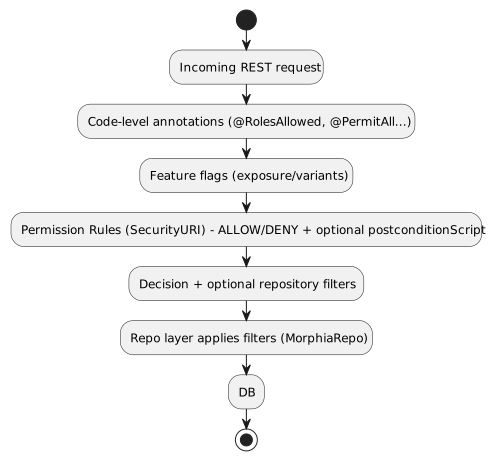
22.2. Key Concepts
-
Identity: The authenticated principal, typically originating from JWT or another provider. It includes:
-
userId (or credentialUserIdPassword username)
-
roles (authorities/groups)
-
tenantId, orgRefName, optional realm, and other claims that contribute to DomainContext
-
-
userProfile: A domain representation of the user that adds human information such as first name, last name, email address, phone number and provides a linkage back to identity, roles, and policy decorations (feature flags, plans, expiration, etc.).
-
Rule Base (Permission Rule): A declarative rule with matching criteria and an effect (ALLOW or DENY). Criteria are authored against SecurityURI and may include:
-
SecurityURIHeader fields: identity (userId or role name), area, functionalDomain, action
-
SecurityURIBody fields: realm, accountNumber, tenantId, dataSegment, ownerId, resourceId
-
Optional postconditionScript evaluated with pcontext/rcontext for additional checks
-
Priority: integer used to sort rule evaluation (lower numbers evaluated first)
-
Effect: ALLOW or DENY; ALLOWs may be paired with repository-level scoping using the SecurityURI body (e.g., DataDomain constraints)
-
22.3. Rule Structure (Illustrative)
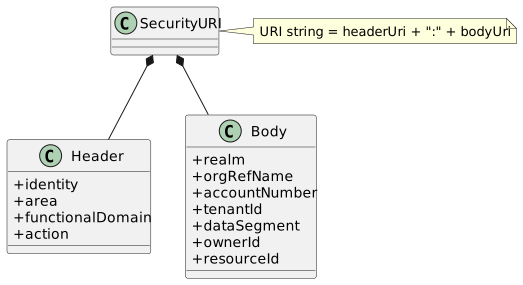
- name: allow-catalog-product-reads
  description: Allow USER and ADMIN to view products in the Catalog area
  securityURI:
    header:
      identity: USER            # or a specific userId; roles are treated as identities
      area: Catalog
      functionalDomain: Product
      action: view
    body:
      realm: system-com
      accountNumber: '*'
      tenantId: '*'
      dataSegment: '*'
      ownerId: '*'
      resourceId: '*'
  postconditionScript:
  effect: ALLOW
  priority: 300
  finalRule: false

- name: default-deny
  description: Fallback deny when nothing else matches
  securityURI:
    header:
      identity: '*'
      area: '*'
      functionalDomain: '*'
      action: '*'
    body:
      realm: '*'
      accountNumber: '*'
      tenantId: '*'
      dataSegment: '*'
      ownerId: '*'
      resourceId: '*'
  effect: DENY
  priority: 10000
finalRule: true-
The securityURI.header section corresponds to SecurityURIHeader: identity (userId or role name), area, functionalDomain, and action. Functional area/domain/action are typically derived from the URL convention
/{area}/{functionalDomain}/{action}by SecurityFilter. -
The securityURI.body section corresponds to SecurityURIBody: realm, accountNumber, tenantId, dataSegment, ownerId, and resourceId. These values are matched using simple string equality with support for the wildcard '*'.
-
Optional postconditionScript may be provided and is executed as JavaScript with pcontext and rcontext bindings; the rule only applies if the script evaluates to true.
22.4. Matching Algorithm
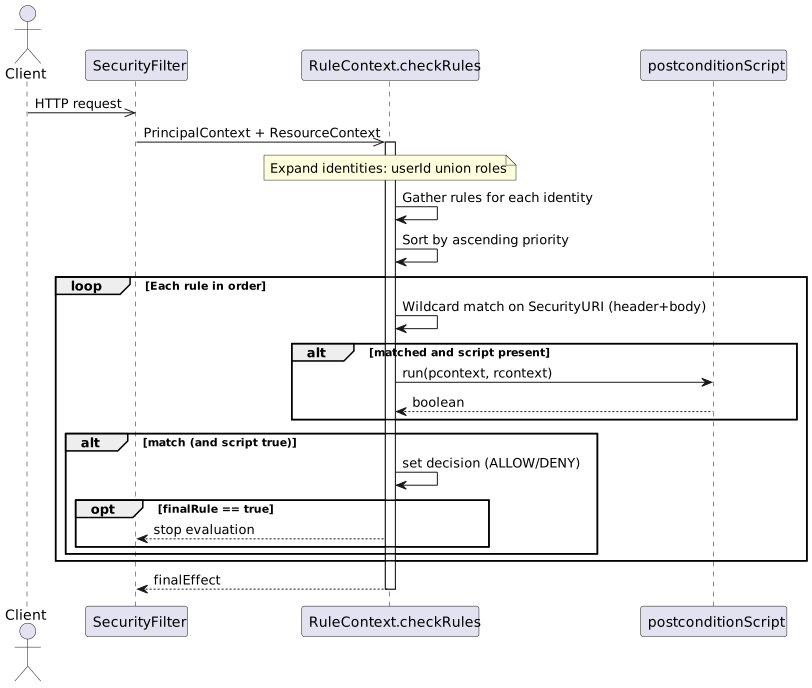
The engine evaluates permission rules using SecurityURI wildcard matching. At a high level:
-
Build ResourceContext
-
SecurityFilter derives area, functionalDomain, and action from the request path (or REST annotations if present) and sets the ResourceContext.
-
-
Expand identities
-
Build a set of identities consisting of the caller’s userId plus each effective role. Each of these identities is treated as a potential match target for rules.
-
-
Gather candidate rules
-
For each identity, collect rules authored for that identity. This forms the candidate set. There is no separate HTTP method/URL or rolesAny/rolesAll matching.
-
-
Sort by priority
-
Order candidates by ascending priority (lower numbers are evaluated first).
-
-
URI wildcard comparison
-
For each rule in priority order, compare the caller’s expanded SecurityURIs to the rule’s securityURI using case‑insensitive wildcard comparison on the full URI string (header + body). Asterisks ('*') in rules match any value.
-
-
Postcondition script (optional)
-
If the rule specifies postconditionScript, execute it as JavaScript with pcontext (principal) and rcontext (resource) variables bound. The rule applies only if the script returns true.
-
-
Apply effect and finalRule
-
When a rule matches (and any script returns true), set the response’s finalEffect to the rule’s effect (ALLOW or DENY). If finalRule is true, stop evaluating further rules; otherwise continue.
-
-
Default decision
-
If no rule determines a decision, the system returns the default final effect configured by the caller of the check (typically DENY).
-
22.5. Priorities
-
Lower integer = higher priority. Example: priority 1 overrides priority 10.
-
Use tight scopes with low priority for critical protections (e.g., denies), and broader ALLOWs with higher numeric priority.
-
Recommended ranges:
-
1–99: global deny rules and emergency blocks
-
100–499: domain/area-specific critical rules
-
500–999: standard ALLOW policies
-
1000+: defaults and catch-alls
22.6. Grant-based vs Deny-based Rule Sets
Grant-based rule sets start with a default decision of DENY and then incrementally add ALLOW scenarios through explicit rules. This model is fail‑safe by default: any URL, action, or functional area that does not have a matching ALLOW rule remains inaccessible. As new endpoints or capabilities are added to the system, users will not gain access until an explicit ALLOW is authored. This is the recommended posture for security‑sensitive systems and multi‑tenant platforms.
Deny-based rule sets start with a default decision of ALLOW and then add DENY scenarios to carve away disallowed cases. In this model, new functionality is exposed by default unless a DENY is added. While convenient during rapid prototyping, this posture risks accidental exposure as the surface area grows.
Practical implications:
-
Change management: Grant-based requires adding ALLOWs when shipping new features; Deny-based requires remembering to add new DENYs.
-
Auditability: Grant-based policies make it easy to enumerate what is permitted; Deny-based requires proving the absence of permissive gaps.
-
Safety: In merge conflicts or partial deployments, Grant-based tends to fail closed (DENY), which is usually safer.
Example defaults:
-
Grant-based (recommended):
- name: default-deny
  priority: 10000
  securityURI:
    header: { identity: '*', area: '*', functionalDomain: '*', action: '*' }
    body:   { realm: '*', accountNumber: '*', tenantId: '*', dataSegment: '*', ownerId: '*', resourceId: '*'}
  effect: DENY
finalRule: true-
Deny-based (use with caution):
- name: default-allow
  priority: 10000
  securityURI:
    header: { identity: '*', area: '*', functionalDomain: '*', action: '*' }
    body:   { realm: '*', accountNumber: '*', tenantId: '*', dataSegment: '*', ownerId: '*', resourceId: '*'}
  effect: ALLOW
  finalRule: true
Tip: Even in a deny-based set, author low‑number DENY rules for critical protections. In most production systems, prefer the grant-based model and layer specific ALLOWs for each capability.
22.7. Feature Flags, Variants, and Target Rules
Feature flags complement permission rules by controlling whether a capability is active for a given principal, cohort, or environment. Permissions answer “may this identity perform this action?”; feature flags answer “is this capability turned on, and which variant applies?” Use them together to achieve safe rollouts and fine‑grained authorization.
Model reference: com.e2eq.framework.model.general.FeatureFlag with key fields:
-
enabled: master on/off
-
type: BOOLEAN or MULTIVARIATE
-
variants: list of variant keys for multivariate experiments
-
targetRules: cohort targeting rules
-
environment: e.g., dev, staging, prod
-
jsonConfiguration: arbitrary configuration for the feature (e.g., rollout %, UI copy, limits)
Example: Boolean flag for a new export API with environment‑specific targeting
{
  "refName": "EXPORT_API",
  "description": "Enable CSV export endpoint",
  "enabled": true,
  "type": "BOOLEAN",
  "environment": "prod",
  "targetRules": [
    { "attribute": "role",     "operator": "equals",  "values": ["BETA"] },
    { "attribute": "tenantId", "operator": "in",      "values": ["T100", "T200"] }
  ],
  "jsonConfiguration": { "rateLimitPerMin": 60 }
}
Example: Multivariate flag to roll out Search v2 to 10% of users and all members of a beta role
{
  "refName": "SEARCH_V2",
  "description": "New search implementation",
  "enabled": true,
  "type": "MULTIVARIATE",
  "variants": ["control", "v2"],
  "environment": "prod",
  "targetRules": [
    { "attribute": "role", "operator": "equals", "values": ["BETA"], "variant": "v2" },
    { "attribute": "userId", "operator": "hashMod", "values": ["10"], "variant": "v2" }
  ],
  "jsonConfiguration": { "defaultVariant": "control" }
}
Notes on TargetRules:
-
attribute: a property from identity/userProfile (e.g., userId, role, tenantId, location, plan).
-
operator: equals, in, contains, startsWith, regex, or domain‑specific operators like hashMod for percentage rollouts.
-
values: comparison values; semantics depend on operator.
-
variant: when type is MULTIVARIATE, selects which variant applies when the rule matches.
How feature flags complement Permission Rule Context:
-
The evaluation of a request can enrich the Rule Context (SecurityURI or userProfile) with resolved feature flags and variants (e.g., userProfile.features["SEARCH_V2"] = "v2").
-
Permission rules can then require a feature to be present before ALLOWing an action:
- name: allow-export-when-flag-on
  description: Allow ADMIN and REPORTER identities to view export when feature flag is on
  securityURI:
    header:
      identity: ADMIN      # treat roles as identities
      area: Reports
      functionalDomain: Export
      action: view
    body:
      realm: system-com
      accountNumber: '*'
      tenantId: '*'
      dataSegment: '*'
      ownerId: '*'
      resourceId: '*'
  postconditionScript: userProfile?.features?.EXPORT_API === true
  effect: ALLOW
  priority: 300
  finalRule: false

- name: allow-export-when-flag-on-reporter
  description: Same as above but for REPORTER role
  securityURI:
    header:
      identity: REPORTER
      area: Reports
      functionalDomain: Export
      action: view
    body:
      realm: system-com
      accountNumber: '*'
      tenantId: '*'
      dataSegment: '*'
      ownerId: '*'
      resourceId: '*'
  postconditionScript: userProfile?.features?.EXPORT_API === true
  effect: ALLOW
  priority: 300
  finalRule: false
Alternatively, systems may surface feature decisions via headers (e.g., X-Feature-SEARCH_V2: v2) so that rules or postconditionScript can read them directly from the request context.
Business usage examples for TargetRules and their correlation to Permission Rules:
-
Progressive rollout by tenant TargetRule tenantId in [T100, T200] → Permission adds ALLOW for endpoints guarded by that flag so only those tenants can call them during rollout.
-
Role‑based beta access: TargetRule role equals BETA → Permission requires both the BETA feature flag and standard role checks (e.g., USER/ADMIN) to ALLOW sensitive actions.
-
Plan/entitlement tiers: TargetRule plan in [Pro, Enterprise] → Permission rules enforce additional data‑domain constraints (e.g., export size limits) while the flag simply turns the feature on for eligible plans.
-
Guidance: Feature Flags vs Permission Rules
-
Put into Feature Flags:
-
Gradual, reversible rollouts; A/B or multivariate experiments; UI/behavior switches.
-
Environment gates (dev/staging/prod) and cohort targeting (tenants, beta users, geography).
-
Non‑security configuration values in jsonConfiguration (limits, thresholds, copy) that do not change who is authorized.
-
-
Put into Permission Rules:
-
Durable authorization logic: roles, identities, functional area/domain/action, and DataDomain constraints.
-
Compliance and least‑privilege decisions where fail‑closed behavior is required.
-
Enforcement that remains valid after a feature is fully launched (even when the flag is removed).
- Recommendation
-
Use a grant‑based permission posture (default DENY) and let feature flags decide which cohorts even see or can reach new capabilities. Then author explicit ALLOW rules for those capabilities, conditioned on both role and feature presence.
-
22.8. Scoped Action Enablement and Dependency Tracking
For the dedicated guide covering the runtime API, manifest model, SPI contracts, and built-in resolver types, see Scoped Action Enablement.
Permission checks answer one important question: "may this identity perform area / functionalDomain / action?" In practice, teams also need to answer a second question: "why is this action still unavailable?"
Typical reasons include:
-
policy denies the action
-
a feature flag exists but is disabled
-
a required setting has not been configured
-
a prerequisite entity or runtime dependency is missing
Quantum now provides a framework-level dependency tracking layer for these cases. The implementation guide for this work lives in docs/design/SCOPED_ACTION_ENABLEMENT_IMPLEMENTATION_GUIDE.md, and the runtime contracts are implemented in the quantum-action-enablement-models and quantum-action-enablement-quarkus modules.
22.8.1. Core idea: the same scoped action tuple stays canonical
The unit of evaluation is still the same tuple already used by the policy engine:
area / functionalDomain / actionExamples:
-
integration / exchange / create -
integration / workflow / create -
system / action-enablement / check
This is intentional. The framework does not introduce a second authorization primitive just to model readiness. Instead, it composes additional dependencies around the same scoped action that policy already understands.
Capabilities are still useful, but at a different level:
-
A scoped action is the atomic framework-level unit.
-
A capability is an application-defined composition over one or more scoped actions.
-
Settings, feature flags, and runtime prerequisites are attached to the scoped action requirement manifest.
That structure is what lets a UI or shell explain "this action is blocked because the policy denies it" versus "this action is allowed, but the required secret or filesystem is not ready yet."
22.8.2. The three answers returned by the framework
Scoped action enablement separates three concerns that are often blurred together:
| Field | Meaning |
|---|---|
|
Whether the existing permission rule stack allows the scoped action for the evaluated identity and data domain |
|
Whether rollout and administrative toggles, especially feature flags, say the action should be exposed |
|
Whether operational prerequisites such as settings, entities, or runtime dependencies are satisfied |
An action is considered usable only when all three are true:
usable = allowed && enabled && readyThis distinction matters because the remediation path is different:
-
allowed=falseusually means a policy or role problem -
enabled=falseusually means a feature flag or administrative rollout problem -
ready=falseusually means setup, configuration, or runtime dependencies are incomplete
22.8.3. Runtime models
The core request and response models are intentionally small:
public class ScopedActionRef {
    String area;
    String functionalDomain;
    String action;
}

public class DependencyCheckRef {
    String type;
    String refName;
    Map<String, Object> config;
}

public class ScopedActionRequirement {
    ScopedActionRef scopedAction;
    String displayName;
    String description;
    List<DependencyCheckRef> dependencies;
}

public class ScopedActionEnablementStatus {
    ScopedActionRef scopedAction;
    boolean allowed;
    boolean enabled;
    boolean ready;
    boolean usable;
    List<EnablementBlocker> blockers;
}
An EnablementBlocker is the machine-readable explanation of why evaluation failed. Each blocker includes:
-
impact: one ofALLOWED,ENABLED, orREADY -
type: the dependency type, such aspermissionorfeature-flag -
code: a stable blocker code, such aspermission-denied -
message: a human-readable explanation -
severity: typicallywarnorerror -
metadata: additional structured context
22.8.4. REST API
The runtime API is exposed at:
-
POST /system/actions/enablement/check -
GET /system/actions/enablement/manifest
This resource itself is annotated as:
-
area=system -
functionalDomain=action-enablement -
action=check|view
Example request:
{
  "identity": "tenant-admin",
  "realm": "acme",
  "orgRefName": "acme-org",
  "tenantId": "acme-tenant",
  "scope": "api",
  "actions": [
    {
      "area": "integration",
      "functionalDomain": "guided_integration",
      "action": "create"
    }
  ]
}
Representative response:
{
  "results": [
    {
      "scopedAction": {
        "area": "integration",
        "functionalDomain": "guided_integration",
        "action": "create"
      },
      "allowed": true,
      "enabled": false,
      "ready": false,
      "usable": false,
      "blockers": [
        {
          "impact": "ENABLED",
          "type": "feature-flag",
          "code": "feature-flag-disabled",
          "message": "Feature flag 'guided-integrations' is disabled.",
          "severity": "warn"
        },
        {
          "impact": "READY",
          "type": "setting-present",
          "code": "setting-missing",
          "message": "Configuration setting 'quantum.integration.shared-storage.root' is not set.",
          "severity": "error"
        }
      ]
    }
  ]
}
This is the key user-facing value: the response tells you whether the action is blocked by authorization, rollout state, or operational readiness, instead of forcing the UI to guess.
22.8.5. Manifest-driven dependency relationships
The relationship from settings and feature flags to functional area/domain/action lives in a manifest of ScopedActionRequirement entries. Each manifest entry says:
-
which scoped action is being described
-
which dependencies must be satisfied for that action to be usable
-
optional display-oriented metadata such as
displayNameanddescription
Applications contribute these manifests via CDI:
public interface ScopedActionRequirementContributor {

    default int priority() {
        return 100;
    }

    Collection<ScopedActionRequirement> requirements();
}
The framework aggregates contributors through ScopedActionRequirementRegistry:
public interface ScopedActionRequirementRegistry {

    Optional<ScopedActionRequirement> find(ScopedActionRef ref);

    List<ScopedActionRequirement> list();
}
This is how you express relationships such as:
-
action
integration / guided_integration / createdepends on feature flagguided-integrations -
action
integration / exchange / createdepends on a tenant filesystem being provisioned -
action
system / some-admin-action / savedepends on a specific config property being present
22.8.6. Resolver SPI
Each dependency type is implemented by an ActionDependencyResolver:
public interface ActionDependencyResolver {

    String supportsType();

    DependencyResolutionResult evaluate(
        DependencyCheckRef dependency,
        EnablementEvaluationContext context
    );
}
EnablementEvaluationContext carries the evaluation inputs:
-
identity
-
realm
-
roles
-
scope
-
DataDomain -
the target
ScopedActionRef
This lets each resolver examine dependencies in the correct tenant, realm, and user context.
22.8.7. Built-in OSS dependency types
The open-source framework currently provides these dependency resolvers:
| Dependency type | Purpose | Typical impact |
|---|---|---|
|
Evaluate the scoped action through the existing |
|
|
Require that a |
|
|
Require that a named configuration property exists and is non-blank |
|
|
Require that a referenced entity exists in the current realm |
|
Representative blocker codes include:
-
permission-denied -
feature-flag-missing -
feature-flag-disabled -
setting-name-missing -
setting-missing -
entity-model-unresolved -
entity-missing
22.8.8. Missing manifests and unsupported dependency types
The framework intentionally does not fail open here.
If no manifest entry is registered for a scoped action:
-
evaluation falls back to a synthetic requirement that checks
permission -
the response also includes a
manifest-missingblocker withimpact=READY
If a manifest references a dependency type for which no resolver is registered:
-
the response includes
unsupported-dependency-type -
the blocker is attached with
impact=READY
This makes incomplete wiring visible instead of silently treating an action as operationally ready.
22.8.9. Example contributor
At the framework level, the built-in manifest contributor registers the enablement API itself with a permission dependency. Application modules then add their own manifests.
A typical application contributor looks like this:
@ApplicationScoped
public class MyActionEnablementManifestContributor
        implements ScopedActionRequirementContributor {

    @Override
    public Collection<ScopedActionRequirement> requirements() {
        return List.of(
            ScopedActionRequirement.builder()
                .scopedAction(ScopedActionRef.builder()
                    .area("integration")
                    .functionalDomain("guided_integration")
                    .action("create")
                    .build())
                .displayName("Generate Guided Integration")
                .description("Requires policy, feature rollout, and baseline setup.")
                .dependencies(List.of(
                    DependencyCheckRef.builder().type("permission").build(),
                    DependencyCheckRef.builder()
                        .type("feature-flag")
                        .refName("guided-integrations")
                        .build(),
                    DependencyCheckRef.builder()
                        .type("setting-present")
                        .refName("quantum.integration.shared-storage.root")
                        .build()
                ))
                .build()
        );
    }
}
This is the mechanism that turns "settings map to capabilities" into something concrete. The requirement manifest records which settings, feature flags, and prerequisites attach to which area / functionalDomain / action tuple.
22.8.10. Relationship to policies, feature flags, and UI actions
Think of the layers this way:
-
@FunctionalMappingand@FunctionalActiondefine the canonical scoped action tuple in code. -
Permission rules answer whether that tuple is authorized.
-
Feature flags answer whether the action is turned on for the current cohort or realm.
-
Scoped action requirements answer what else must be configured or provisioned before the action is actually usable.
This complements, rather than replaces, existing UI action derivation:
-
fillUIActions()still answers what actions are allowed from the permission perspective -
scoped action enablement answers why an action should still be disabled or annotated in the UI
That makes it a better fit for:
-
setup dashboards
-
onboarding flows
-
context-sensitive "why unavailable?" messaging
-
shells or MCP clients that need structured blockers
22.8.11. Enterprise extensions
The framework module is intentionally generic. Enterprise modules can contribute additional dependency resolvers without changing the core contracts.
The current enterprise action-enablement module extends the system with higher-level runtime checks such as:
-
managed-secret-configured -
tenant-filesystem-provisioned -
standard-mounts-present -
workflow-runtime-reachable
Those resolvers support operational questions such as:
-
has the tenant filesystem been provisioned?
-
do the standard mounts exist?
-
is a required managed secret configured?
-
is the workflow runtime reachable?
That deeper operational behavior belongs in the enterprise documentation. The important framework-level point is that enterprise modules plug into the same ActionDependencyResolver SPI and return the same EnablementBlocker structure.
22.8.12. Guidance
-
Keep permission checks canonical. Do not duplicate authorization logic inside custom readiness resolvers.
-
Use
feature-flagdependencies for rollout state, not for durable authorization. -
Use
setting-presentandentity-existsonly for generic prerequisites. Domain-heavy operational checks belong in application or enterprise resolvers. -
Keep blocker codes stable because UIs and automation may key off them.
-
Treat capabilities as documentation and UX groupings over scoped actions, not as a substitute for
area / functionalDomain / action.
22.9. Multiple Matching RuleBases
-
Ordering: rules are evaluated in ascending priority (lower numbers first).
-
Decision: when a rule matches, its effect (ALLOW or DENY) becomes the current decision.
-
finalRule: if the matching rule has finalRule: true, evaluation stops immediately; otherwise, evaluation continues and a later rule may overwrite the decision.
-
Default: if no rule matches decisively, the default effect supplied by the caller (typically DENY) is returned.
22.10. Identity and Role Matching
-
Roles-as-identities: the engine evaluates rules for the caller’s userId and for each effective role by treating each role name as an identity.
-
There are no rolesAny/rolesAll fields in rules; author separate rules for specific roles as needed.
-
Optional postconditionScript can inspect attributes (for example, tenantId) via pcontext and rcontext when additional checks are needed.
-
Time or plan-based conditions can be implemented inside postconditionScript or via feature flags.
22.10.1. How roles are defined for an identity (role sources and resolution)
Quantum composes the effective roles for a request by merging:
-
Roles from the identity provider (JWT/
SecurityIdentity) -
Roles configured on the user record (
CredentialUserIdPassword.roles)
Source details:
-
Identity Provider (JWT): roles commonly arrive via standard claims (for example,
groups,roles, or provider-specific fields). Quarkus maps these intoSecurityIdentity.getRoles(). In multi-realm setups, the realm inX-Realmcan scope lookups but does not alter what the JWT asserts. -
Quantum user record:
com.e2eq.framework.model.security.CredentialUserIdPasswordhas aString[] rolesfield stored per realm. This can be administered by Quantum to grant platform- or tenant-level roles.
Merge semantics (current implementation):
-
Union: the effective role set is the union of JWT roles and
CredentialUserIdPassword.roles. If either source is empty, the other source defines the set. -
Fallback: when neither source yields roles, the framework defaults to
ANONYMOUS. -
Where implemented:
SecurityFilter.determinePrincipalContextbuildsPrincipalContextwith the merged roles.
Realm considerations:
-
The user record is looked up by subject or userId in the active realm (default or
X-Realm). If a realm override is provided, it is validated withCredentialUserIdPassword.realmRegEx. -
Roles stored in a user record are realm-specific; JWT roles are whatever the IdP asserts for the token.
Operating models:
-
Quantum-managed roles:
-
IdP authenticates the user (subject, username). Authorization is primarily driven by roles stored in
CredentialUserIdPassword.roles. -
Use when you want central, auditable role assignment within Quantum, independent of IdP groups.
-
-
IdP-managed roles:
-
IdP carries authoritative roles/groups in the JWT. Keep
CredentialUserIdPassword.rolesminimal or empty. -
Use when enterprises require IdP as the source of truth for access groups.
-
-
Hybrid (recommended in many deployments):
-
Effective roles = JWT roles union
CredentialUserIdPassword.roles. -
Use JWT for enterprise groups (for example,
DEPT_SALES,ORG_ADMIN) and Quantum roles for app-specific grants (for example,REPORT_EXPORTER,BETA). -
This avoids IdP churn for application-local concerns while respecting org policies.
-
Examples:
-
JWT-only:
-
JWT.groups = [USER, REPORTER]; user record roles = []
-
Effective roles = [USER, REPORTER]
-
-
Quantum-only:
-
JWT.groups = []; user record roles = [USER, ADMIN]
-
Effective roles = [USER, ADMIN]
-
-
Hybrid union:
-
JWT.groups = [USER]; user record roles = [BETA, REPORT_EXPORTER]
-
Effective roles = [USER, BETA, REPORT_EXPORTER]
-
Guidance and best practices:
-
Keep role names stable and environment-agnostic; use realms/permissions to scope where needed.
-
Avoid overloading roles for feature rollout; use Feature Flags for rollout and variants, and roles for durable authorization.
-
When IdP is authoritative, ensure consistent claim mapping so
SecurityIdentity.getRoles()contains the expected values; commonly viagroupsclaim in JWT. -
Use grant-based permission rules and require the minimal set of roles (
rolesAny/rolesAll) needed for each capability.
Cross-references:
-
User model:
com.e2eq.framework.model.security.CredentialUserIdPassword.roles -
Context:
com.e2eq.framework.model.securityrules.PrincipalContext.getRoles() -
Filter logic:
com.e2eq.framework.rest.filters.SecurityFilter.determinePrincipalContext
Populating RoleSource and roleAssignments
Quantum exposes structured provenance for each role via:
-
com.e2eq.framework.model.auth.RoleSourceenum with values:USERGROUP,IDP,CREDENTIAL -
com.e2eq.framework.model.auth.RoleAssignmentrecord:role+Set<RoleSource> sources -
Login response model
com.e2eq.framework.model.auth.AuthProvider.LoginPositiveResponsenow includes aroleAssignmentsfield next to plainroles. -
com.e2eq.framework.model.securityrules.SecurityCheckResponsealso includesroleAssignments.
Defaults and compatibility:
-
If you do nothing, both login and security check responses automatically derive
roleAssignmentsfrom the flatrolesset and mark each role withCREDENTIAL. This preserves backward compatibility. -
To provide accurate provenance, populate
roleAssignmentsexplicitly where you already know role sources.
JSON example (login success):
{
  "userId": "alice",
  "roles": ["user", "admin"],
  "roleAssignments": [
    {"role": "user",  "sources": ["idp", "credential"]},
    {"role": "admin", "sources": ["usergroup"]}
  ],
  "accessToken": "...",
  "refreshToken": "...",
  "expirationTime": 1732100000,
  "mongodbUrl": "...",
  "realm": "system"
}
AuthProviders: what you need to do
Auth providers (for example, CustomTokenAuthProvider) should add provenance at two points:
-
During login (
login(userId, password)) -
During token refresh (
refreshTokens(refreshToken))
At each point build three role sets and then compute per-role sources:
-
IDP roles → from
io.quarkus.security.identity.SecurityIdentity.getRoles()for the current access/refresh token -
Credential roles → from
com.e2eq.framework.model.security.CredentialUserIdPassword.getRoles()in the DB -
User group roles → gathered by resolving the user’s
UserProfileand itsUserGroupmemberships
Then build List<RoleAssignment> and pass the full constructor of LoginPositiveResponse.
Example (inside CustomTokenAuthProvider.login(…) after you create identity and locate the credential):
// 1) Collect source role sets
Set<String> idpRoles = (identity != null) ? new java.util.LinkedHashSet<>(identity.getRoles()) : java.util.Set.of();
Set<String> credentialRoles = new java.util.LinkedHashSet<>(java.util.Arrays.asList(credential.getRoles()));
Set<String> userGroupRoles = new java.util.LinkedHashSet<>();
try {
    var userProfileOpt = userProfileRepo.getBySubject(credential.getSubject());
    if (userProfileOpt.isPresent()) {
        var groups = userGroupRepo.findByUserProfileRef(userProfileOpt.get().createEntityReference());
        if (groups != null) {
            for (com.e2eq.framework.model.security.UserGroup g : groups) {
                if (g != null && g.getRoles() != null) {
                    java.util.Collections.addAll(userGroupRoles, g.getRoles());
                }
            }
        }
    }
} catch (Exception e) {
    io.quarkus.logging.Log.warn("Group role expansion failed; continuing without group roles", e);
}

// 2) Union of all roles for the response
java.util.Set<String> allRoles = new java.util.LinkedHashSet<>();
allRoles.addAll(idpRoles);
allRoles.addAll(credentialRoles);
allRoles.addAll(userGroupRoles);

// 3) Build per-role source assignments
java.util.List<com.e2eq.framework.model.auth.RoleAssignment> roleAssignments = allRoles.stream()
    .filter(java.util.Objects::nonNull)
    .map(role -> {
        java.util.EnumSet<com.e2eq.framework.model.auth.RoleSource> src =
            java.util.EnumSet.noneOf(com.e2eq.framework.model.auth.RoleSource.class);
        if (idpRoles.contains(role)) src.add(com.e2eq.framework.model.auth.RoleSource.IDP);
        if (credentialRoles.contains(role)) src.add(com.e2eq.framework.model.auth.RoleSource.CREDENTIAL);
        if (userGroupRoles.contains(role)) src.add(com.e2eq.framework.model.auth.RoleSource.USERGROUP);
        return new com.e2eq.framework.model.auth.RoleAssignment(role, src);
    })
    .toList();

// 4) Use the full constructor that accepts roleAssignments
return new com.e2eq.framework.model.auth.AuthProvider.LoginResponse(
    true,
    new com.e2eq.framework.model.auth.AuthProvider.LoginPositiveResponse(
        userId,
        identity,
        allRoles,               // Set<String>
        roleAssignments,        // List<RoleAssignment>
        accessToken,
        refreshToken,
        expirationTime,
        mongodbUrl,
        realm
    )
);
Notes and tips:
-
You may centralize this logic in
IdentityRoleResolverby adding a method that returnsMap<String, EnumSet<RoleSource>>(role → sources) and reuse it across login and/check. -
If you cannot resolve a user record (for example, token-only identities), populate only
IDPsources. -
Avoid adding synthetic roles like
ANONYMOUStoroleAssignments—the structure should cover actual grants. -
Consider caching group-derived roles per user/request if lookups are expensive.
Security Check responses: enriching roleAssignments
SecurityCheckResponse defaults to marking all roles as CREDENTIAL. To provide accurate provenance during permission checks:
-
Near
PermissionResource.check(…), where roles are resolved, compute the same three source sets as above. -
Build
List<RoleAssignment>from the final role set used forPrincipalContext. -
After calling the rule engine, overwrite the response’s assignments:
SecurityCheckResponse resp = ruleContext.checkRules(pc, rc);
resp.setRoleAssignments(roleAssignments);
return Response.ok(resp).build();
This keeps the default behavior (no breaking changes) while enabling clients to see precisely how each role was granted.
22.11. Example Scenarios
-
Public catalog browsing
-
Request: GET /Catalog/Products/VIEW?search=widgets
-
Identity: anonymous or role USER
-
Rules:
-
allow-public-reads (priority 100) ALLOW + readScope orgRefName=PUBLIC
-
-
Outcome: ALLOW; repository applies DataDomain filter orgRefName=PUBLIC
-
-
Tenant-scoped shipment update
-
Request: PUT /Collaboration/Shipments/UPDATE
-
Headers: x-tenant-id=T1
-
Body: { dataDomain: { tenantId: "T1" }, … }
-
Identity: user in tenant T1 with roles [USER]
-
Rules:
-
allow-collab-update (priority 300) requires body.dataDomain.tenantId == identity.tenantId and rolesAny USER, ADMIN ⇒ ALLOW
-
-
Outcome: ALLOW; Rule contributes writeScope tenantId=T1
-
-
Cross-tenant admin read with higher priority
-
Request: GET /api/partners
-
Identity: role ADMIN (super-admin)
-
Rules:
-
admin-override (priority 50) ALLOW
-
default-tenant-read (priority 600) ALLOW with tenant filter
-
-
Outcome: admin-override wins due to higher precedence (lower number), allowing broader read
-
-
Conflicting ALLOW and DENY at same priority
-
Two rules match with priority 200: one ALLOW, one DENY
-
Resolution: DENY wins unless merge strategy configured to handle explicitly; recommended to avoid same-priority conflicts by policy.
-
22.12. Operational Tips
-
Author specific DENY rules with low numbers to prevent accidental exposure.
-
Author SecurityURI header (area/domain/action) as narrowly as needed for sensitive domains.
-
Prefer SecurityURI body fields and postconditionScript to refine matches without over-broad area/domain/action patterns.
-
Log matched rule names and applied scopes for auditability.
22.13. How UIActions and DefaultUIActions are calculated
When the server returns a collection of entities (for example, userProfiles), each entity may expose two action lists:
-
DefaultUIActions: the full set of actions that conceptually apply to this type of entity (e.g., CREATE, UPDATE, VIEW, DELETE, ARCHIVE). Think of this as the “menu template” for the type.
-
UIActions: the subset of actions the current user is actually permitted to perform on that specific entity instance right now.
Why they can differ per entity:
-
Entity attributes: state or flags (e.g., archived, soft-deleted, immutable) can remove or alter available actions at instance level.
-
Permission rule base: evaluated against the current request, identity, and context to allow or deny actions.
-
DataDomain membership: tenant/org/owner scoping can further restrict actions if the identity is outside the entity’s domain.
How the server computes them:
-
Start with a default action template for the entity type (DefaultUIActions).
-
Apply simple state-based adjustments (for example, suppress CREATE on already-persisted instances).
-
Evaluate the permission rules with the current identity and context:
-
Consider roles, functional area/domain, action intent, SecurityURI body fields, and any rule-contributed scopes.
-
Resolve DataDomain constraints to ensure the identity is permitted to act within the entity’s domain.
-
-
Produce UIActions as the allowed subset for that entity instance.
-
Return both lists with each entity in collection responses.
How the client should use the two lists:
-
Render the full DefaultUIActions as the visible set of possible actions (icons, buttons, menus) so the UI stays consistent.
-
Enable only those actions present in UIActions; gray out or disable the remainder to signal capability but lack of current permission.
-
This approach avoids flicker and keeps affordances discoverable while remaining truthful to the user’s current authorization.
Example:
-
You fetch 25 userProfiles.
-
DefaultUIActions for the type = [CREATE, VIEW, UPDATE, DELETE, ARCHIVE].
-
For a specific profile A (owned by your tenant), UIActions may be [VIEW, UPDATE] based on your roles and domain.
-
For another profile B (in a different tenant), UIActions may be [VIEW] only.
-
The UI renders the same controls for both A and B, but only enables the actions present in each item’s UIActions list.
Operational considerations:
-
Keep action names stable and documented so front-ends can map to icons and tooltips consistently.
-
Prefer small, composable rules that evaluate action permissions explicitly by functional area/domain to avoid surprises.
-
Consider server-side caching of action evaluations for list views to reduce latency, respecting identity and scope.
22.14. How This Integrates End-to-End
-
BaseResource extracts identity and headers to construct DomainContext.
-
Rule evaluation uses SecurityURI (header + body) matching with optional postconditionScript and identity/userProfile to reach a decision and derive scope filters.
-
Repositories (e.g., MorphiaRepo) apply the filters to queries and updates, ensuring DataDomain-respecting access.
22.15. Administering Policies via REST (PolicyResource)
The PolicyResource exposes CRUD-style REST APIs for creating and managing policies (rule bases) that drive authorization decisions. Each Policy targets a principalId (either a specific userId or a role name) and contains an ordered list of Rule objects. Rules match requests using SecurityURIHeader and SecurityURIBody and then contribute an effect (ALLOW/DENY) and optional repository filters.
-
Base path: /security/permission/policies
-
Auth: Bearer JWT (see Authentication); resource methods are guarded by @RolesAllowed("user", "admin") at the BaseResource level and your own realm/role policies.
-
Multi-realm: pass X-Realm header to operate within a specific realm; otherwise the default realm is used.
22.15.1. Model shape (Policy)
A Policy extends FullBaseModel and includes: - id, refName, displayName, dataDomain, archived/expired flags (inherited) - principalId: userId or role name that this policy attaches to - description: human-readable summary - rules: array of Rule entries
Rule fields (key ones):
-
name, description
-
securityURI.header: identity, area, functionalDomain, action (supports wildcard "*")
-
securityURI.body: realm, orgRefName, accountNumber, tenantId, ownerId, dataSegment, resourceId (supports wildcard "*")
-
effect: ALLOW or DENY
-
priority: integer; lower numbers evaluated first
-
finalRule: boolean; stop evaluating when this rule applies
-
andFilterString / orFilterString: ANTLR filter DSL snippets injected into repository queries (see Query Language section)
-
joinOp: how to combine the andFilterString group with the orFilterString group when both are present; defaults to AND
22.15.2. How rule-contributed filters work (andFilterString, orFilterString, joinOp)
When an ALLOW rule matches, it can contribute repository-level filters that restrict which documents are visible or mutable. The fields are:
-
andFilterString: a filter expression added to the AND group.
-
orFilterString: a filter expression added to the OR group.
-
joinOp: when both groups are present, specifies how to join them. Values: AND or OR. Default: AND.
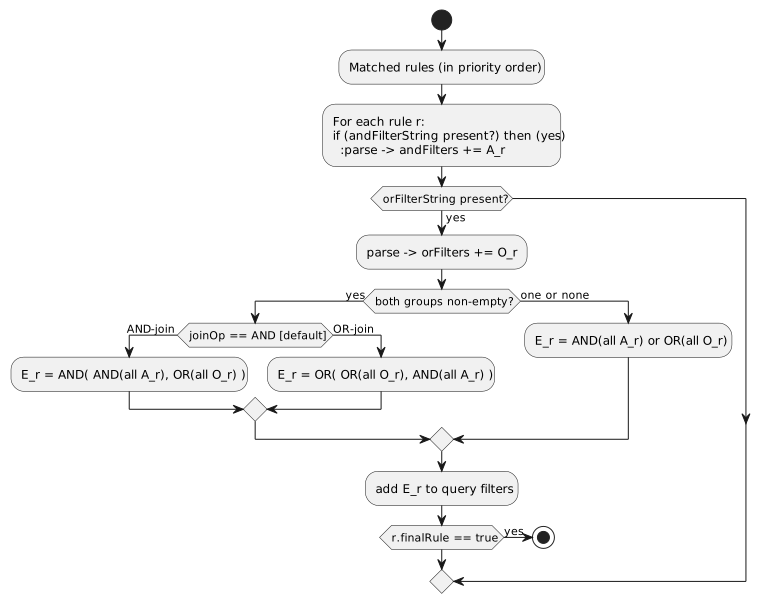
Composition algorithm (implemented in RuleContext.getFilters):
-
Collect all matched rules (in priority order; skipping NOT_APPLICABLE script results). For each rule:
-
If andFilterString is set, parse it into a Morphia Filter and add to the and-group.
-
If orFilterString is set, parse it into a Morphia Filter and add to the or-group.
-
-
If both groups are non-empty for the current rule:
-
If joinOp == AND (default): effective = AND( AND(all and-group), OR(all or-group) ).
-
If joinOp == OR: effective = OR( OR(all or-group), AND(all and-group) ).
-
-
If only one group is non-empty:
-
Use AND(all and-group) or OR(all or-group) as the effective filter.
-
-
Append the effective filter(s) to the query’s filter list. If the rule has finalRule: true, stop accumulating more filters.
-
Deduplicate filters by string form before returning.
Examples:
-
AND only
- name: tenant-scope
  securityURI:
    header: { identity: USER, area: sales, functionalDomain: order, action: view }
    body:   { realm: '*', orgRefName: '*', accountNumber: '*', tenantId: '*', ownerId: '*', dataSegment: '*', resourceId: '*' }
  andFilterString: "dataDomain.tenantId:${pcontext.dataDomain.tenantId}"
  effect: ALLOW
  priority: 200
Resulting Morphia: AND( eq("dataDomain.tenantId", <caller-tenant>) )
-
OR only
- name: visibility-by-segment
  securityURI:
    header: { identity: USER, area: sales, functionalDomain: order, action: view }
    body:   { realm: '*', orgRefName: '*', accountNumber: '*', tenantId: '*', ownerId: '*', dataSegment: '*', resourceId: '*' }
  orFilterString: "dataDomain.dataSegment:^[PUBLIC|INTERNAL]"
  effect: ALLOW
  priority: 210
Resulting Morphia: OR( in("dataDomain.dataSegment", [PUBLIC, INTERNAL]) )
-
AND + OR with joinOp: AND (default)
- name: own-or-public
  securityURI:
    header: { identity: USER, area: security, functionalDomain: userProfile, action: view }
    body:   { realm: '*', orgRefName: '*', accountNumber: '*', tenantId: '*', ownerId: '*', dataSegment: '*', resourceId: '*' }
  andFilterString: "dataDomain.ownerId:${principalId}"
  orFilterString:  "dataDomain.dataSegment:^[PUBLIC]"
  joinOp: AND
  effect: ALLOW
  priority: 220
Effective: AND( eq(ownerId, principalId), OR(eq(dataSegment, 'PUBLIC')) )
-
AND + OR with joinOp: OR
- name: owner-or-segment
  securityURI:
    header: { identity: USER, area: files, functionalDomain: document, action: view }
    body:   { realm: '*', orgRefName: '*', accountNumber: '*', tenantId: '*', ownerId: '*', dataSegment: '*', resourceId: '*' }
  andFilterString: "dataDomain.ownerId:${principalId}"
  orFilterString:  "tags:^[shared]"
  joinOp: OR
  effect: ALLOW
  priority: 230
Effective: OR( eq(ownerId, principalId), AND(eq(tags, 'shared')) )
Placeholders and variables:
The following standard variables are available in andFilterString/orFilterString:
| Variable | Source | Description |
|---|---|---|
|
PrincipalContext.userId |
The authenticated user’s ID |
|
PrincipalContext.dataDomain.accountNum |
The principal’s account number |
|
PrincipalContext.dataDomain.tenantId |
The principal’s tenant ID |
|
PrincipalContext.dataDomain.ownerId |
The data owner ID |
|
PrincipalContext.dataDomain.orgRefName |
The organization reference name |
|
PrincipalContext.defaultRealm |
The current realm (changes with X-Realm override) |
|
ResourceContext.resourceId |
The target resource ID |
|
ResourceContext.action |
The action being performed |
|
ResourceContext.functionalDomain |
The functional domain |
|
ResourceContext.area |
The functional area |
|
DomainContext.tenantId |
Tenant ID from the current domain context |
|
DomainContext.orgRefName |
Organization reference name from domain context |
|
DomainContext.accountId |
Account ID from domain context |
|
DomainContext.dataSegment |
Data segment number from domain context |
X-Realm integration: When X-Realm is used, ${defaultRealm} automatically reflects the target realm. This enables permission filters to dynamically scope data based on the active realm:
- name: scope-by-realm
  securityURI:
    header: { identity: USER, area: '*', functionalDomain: '*', action: view }
    body:   { realm: '*', orgRefName: '*', accountNumber: '*', tenantId: '*', ownerId: '*', dataSegment: '*', resourceId: '*' }
  andFilterString: "dataDomain.tenantId:${defaultRealm}"
  effect: ALLOW
priority: 200-
The filter DSL is described in the Query Language guide; it maps to Morphia dev.morphia.query.filters.Filters under the hood via MorphiaUtils.convertToFilter.
22.15.3. AccessListResolvers (SPI) for list-based access
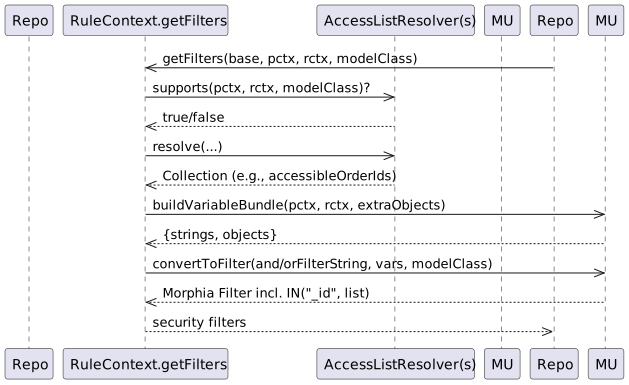
AccessListResolvers let you plug in computed collections (IDs, codes, emails, etc.) at request time and reference them from andFilterString/orFilterString. This is ideal for ACL-style list checks or integrating with external systems that decide which resources a user may access.
How it works (as implemented):
-
SPI: com.e2eq.framework.securityrules.AccessListResolver
-
key(): the variable name published to the filter variable bundle (e.g., "accessibleCustomerIds").
-
supports(pctx, rctx, modelClass): return true when this resolver applies for the current request and repository model type.
-
resolve(pctx, rctx, modelClass): return a Collection<?> which will be available as ${<key>} in filter strings.
-
RuleContext.getFilters discovers all AccessListResolver beans via CDI, calls supports(…), and for those that apply it puts key() → resolve(…) into the "extraObjects" map. MorphiaUtils.buildVariableBundle merges these into the variable set used by convertToFilter.
-
In your filter DSL, use:
-
IN with resolver-provided lists: field:^${key}
-
Equality with resolver-provided scalars: field:${key}
-
You can also reference nested principals: ${pcontext.dataDomain.tenantId}, ${principalId}, etc.
Examples:
-
Restrict Orders to the set of ids returned by a resolver
- name: orders-by-acl
  securityURI:
    header: { identity: USER, area: sales, functionalDomain: order, action: view }
    body:   { realm: '*', orgRefName: '*', accountNumber: '*', tenantId: '*', ownerId: '*', dataSegment: '*', resourceId: '*' }
  andFilterString: "_id:^${accessibleOrderIds}"
  effect: ALLOW
priority: 200-
Use resolver that returns customer codes and OR with a public segment
- name: customer-code-or-public
  securityURI:
    header: { identity: USER, area: crm, functionalDomain: customer, action: view }
    body:   { realm: '*', orgRefName: '*', accountNumber: '*', tenantId: '*', ownerId: '*', dataSegment: '*', resourceId: '*' }
  andFilterString: "code:^${visibleCustomerCodes}"
  orFilterString:  "dataDomain.dataSegment:^[PUBLIC]"
  joinOp: OR
  effect: ALLOW
  priority: 210
Reference implementation (tests/examples): - RuleContext.getFilters collects resolvers and exposes them to the filter StringSubstitutor via MorphiaUtils.buildVariableBundle. - See also: quantum-framework/src/test/java/com/e2eq/framework/securityrules/TestCustomerAccessResolver.java and TestStringAccessResolver.java for sample resolvers.
Guidance: - Keep keys stable and document them; they form your contract between resolver authors and rule authors. - Always scope resolver queries by tenant/realm from PrincipalContext/ResourceContext. - Return empty collections instead of null. An empty IN list yields no matches, which is safe by default.
22.15.4. PrincipalContextPropertiesResolver (SPI) for custom principal properties
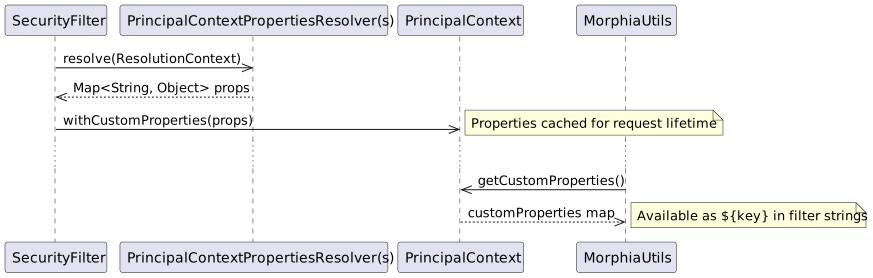
PrincipalContextPropertiesResolver allows applications to enrich PrincipalContext with custom, domain-specific properties during authentication. Unlike AccessListResolver (which is invoked per-query and scoped to specific resources), these properties are resolved once when the principal context is built and are available throughout the request lifecycle.
Use cases:
-
Associate/Sales Rep binding: Link a UserProfile to an Associate entity and expose
associateIdfor filtering -
Territory assignments: Expose
accessibleTerritoryIdsbased on the user’s role assignments -
Organizational hierarchies: Expose
accessibleLocationIdsvia ontology relationships -
Custom attributes: Any domain-specific property needed for security filtering
How it works:
-
SPI:
com.e2eq.framework.model.securityrules.PrincipalContextPropertiesResolver -
priority(): Execution order (lower = earlier). Default: 1000. -
resolve(ResolutionContext): Return a Map<String, Object> of properties to add to PrincipalContext. -
ResolutionContextprovides access to: -
isAnonymous(),getPrincipalName(),getIdentityRoles(): Security identity info -
getUserId(),getSubjectId(): User identifiers -
getRealm(),getDataDomain(),getDomainContext(): Realm and domain context -
getHeader(name): HTTP request headers -
getJwtClaim(name): JWT token claims -
hasCredentials(),getCredentialUserId(),getCredentialRoles(): Database credentials -
SecurityFilter discovers all resolvers via CDI, invokes them in priority order, and merges results into PrincipalContext.customProperties.
-
MorphiaUtils.createStandardVariableMapFrom includes custom properties, making them available as
${key}in filter strings.
Example implementation:
package com.myapp.security;

import com.e2eq.framework.model.securityrules.PrincipalContextPropertiesResolver;
import com.e2eq.framework.model.securityrules.ResolutionContext;
import com.e2eq.ontology.repo.OntologyEdgeRepo;
import jakarta.enterprise.context.ApplicationScoped;
import jakarta.inject.Inject;
import java.util.*;

@ApplicationScoped
public class AssociatePropertiesResolver implements PrincipalContextPropertiesResolver {

    @Inject
    OntologyEdgeRepo edgeRepo;

    @Override
    public int priority() {
        return 100; // Run early
    }

    @Override
    public Map<String, Object> resolve(ResolutionContext context) {
        Map<String, Object> properties = new HashMap<>();

        // Skip for anonymous users
        if (context.isAnonymous()) {
            return properties;
        }

        String userProfileId = context.getSubjectId().orElse(context.getUserId());

        // Find Associate linked to this UserProfile via hasUser relationship
        // Associate.hasUser -> UserProfile (functional/1:1)
        Optional<String> associateId = edgeRepo.singleSrcIdByDst(
            context.getDataDomain(), "hasUser", userProfileId);

        if (associateId.isPresent()) {
            properties.put("associateId", associateId.get());

            // Get territories this associate can access
            Set<String> territoryIds = edgeRepo.dstIdsBySrc(
                context.getDataDomain(), "assignedToTerritory", associateId.get());
            properties.put("accessibleTerritoryIds", territoryIds);

            // Get locations via inferred canSeeLocation edge
            Set<String> locationIds = edgeRepo.dstIdsBySrc(
                context.getDataDomain(), "canSeeLocation", associateId.get());
            properties.put("accessibleLocationIds", locationIds);
        }

        return properties;
    }
}
Using custom properties in rules:
# Filter locations to those the associate can see
- name: associate-location-access
  securityURI:
    header: { identity: sales-rep, area: sales, functionalDomain: location, action: view }
    body:   { realm: '*', orgRefName: '*', accountNumber: '*', tenantId: '*', ownerId: '*', dataSegment: '*', resourceId: '*' }
  andFilterString: "dataDomain.tenantId:${pTenantId}"
  orFilterString: "_id:^${accessibleLocationIds}"
  effect: ALLOW
  priority: 200
# Filter orders by territory
- name: territory-order-access
securityURI:
header: { identity: sales-rep, area: sales, functionalDomain: order, action: view }
body: { realm: '*', orgRefName: '*', accountNumber: '*', tenantId: '*', ownerId: '*', dataSegment: '*', resourceId: '*' }
andFilterString: "dataDomain.tenantId:${pTenantId} AND territoryId:^${accessibleTerritoryIds}"
effect: ALLOW
priority: 200Accessing properties programmatically:
// In application code or postconditionScript
PrincipalContext pctx = SecurityContext.getPrincipalContext().get();

// Get a single property
String associateId = (String) pctx.getCustomProperty("associateId");

// Get with type safety
Set<String> locationIds = pctx.getCustomProperty("accessibleLocationIds", Set.class);

// Get all custom properties
Map<String, Object> allProps = pctx.getCustomProperties();
Comparison: PrincipalContextPropertiesResolver vs AccessListResolver
| Aspect | PrincipalContextPropertiesResolver | AccessListResolver |
|---|---|---|
When invoked |
Once during authentication (eager) |
Per query during rule evaluation (lazy) |
Context available |
SecurityIdentity, JWT claims, HTTP headers, Credentials |
PrincipalContext, ResourceContext, ModelClass |
Caching |
Cached in PrincipalContext for request lifetime |
Per-request via RuleContext |
Use case |
User-level properties constant across all queries |
Resource-specific access lists that vary by model/action |
Performance |
Single invocation per request |
Invoked per repository call |
Guidance:
-
Use PrincipalContextPropertiesResolver for properties that apply to the user regardless of what resource they’re accessing (e.g., associate ID, territory assignments).
-
Use AccessListResolver when the access list depends on the specific resource type or action being performed.
-
Both mechanisms can coexist and complement each other.
-
Return empty maps (not null) from resolvers; resolver failures are logged and skipped, not propagated.
-
Properties should not override built-in PrincipalContext fields (userId, roles, etc.).
Where filters are applied (MorphiaRepo methods):
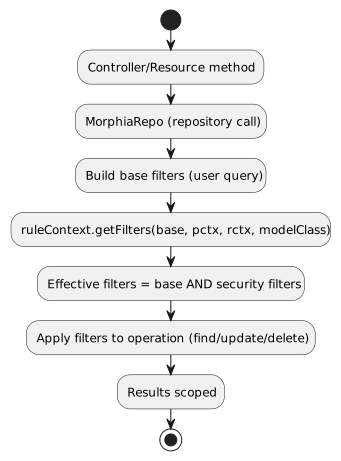
-
getList / getListByQuery / find: RuleContext.getFilters augments the base filters with the effective security filters before executing the query.
-
count: same as read paths, ensuring counts reflect scoped visibility.
-
save (create): rules typically do not inject filters for inserts; writes are validated by separate preconditions or postconditionScript. If your policy encodes write-scope, author UPDATE/DELETE rules to guard modifications rather than CREATE, unless your domain enforces ownership/tenant on insert.
-
update / merge / set / bulk set: the security filters are ANDed into the target selection so only documents visible under the policy are affected.
-
delete (by id or by query): security filters are applied to the selection to prevent deleting outside the allowed scope.
Implementation reference:
// Repositories call into RuleContext to augment filters
List<Filter> filters = ruleContext.getFilters(baseFilters,
    SecurityContext.getPrincipalContext().get(),
    SecurityContext.getResourceContext().get(),
    getPersistentClass());
Query<T> query = datastore.find(getPersistentClass()).filter(filters.toArray(new Filter[0]));
Notes:
-
Filters are applied regardless of whether the match decision was ALLOW or DENY; only ALLOW rules contribute filters. DENY rules decide the outcome but do not add filters.
-
finalRule: true stops evaluating later rules for both decision and filter contribution.
-
If no ALLOW rules match, repositories may still execute with caller-provided filters, but upstream permission checks should have DENIED the action; by convention, most endpoints call checkRules and short-circuit DENY before hitting the database.
Example impact per MorphiaRepo method:
-
save: no security filters are injected into the insert operation; enforce ownership/tenant fields via model validation and/or postconditionScript.
-
find/findById: adds security filters; if the requested id is outside scope, the result is empty.
-
getList/getListByQuery: adds security filters to user-supplied query; scope cannot be broadened by the client.
-
update/merge: AND the security filters into the update selector; records outside scope are unaffected.
-
delete: AND the security filters into the delete selector; out-of-scope records are not removed.
Example payload:
{
  "refName": "defaultUserPolicy",
  "displayName": "Default user policy",
  "principalId": "user",
  "description": "Users can act on their own data; deny dangerous ops in security area",
  "rules": [
    {
      "name": "view-own-resources",
      "description": "Limit reads to owner and default data segment",
      "securityURI": {
        "header": { "identity": "user", "area": "*", "functionalDomain": "*", "action": "*" },
        "body":   { "realm": "*", "orgRefName": "*", "accountNumber": "*", "tenantId": "*", "ownerId": "*", "dataSegment": "*", "resourceId": "*" }
      },
      "andFilterString": "dataDomain.ownerId:${principalId}&&dataDomain.dataSegment:#0",
      "effect": "ALLOW",
      "priority": 300,
      "finalRule": false
    },
    {
      "name": "deny-delete-in-security",
      "securityURI": {
        "header": { "identity": "user", "area": "security", "functionalDomain": "*", "action": "delete" },
        "body":   { "realm": "*", "orgRefName": "*", "accountNumber": "*", "tenantId": "*", "ownerId": "*", "dataSegment": "*", "resourceId": "*" }
      },
      "effect": "DENY",
      "priority": 100,
      "finalRule": true
    }
  ]
}
22.15.5. Endpoints
All endpoints are relative to /security/permission/policies. These are inherited from BaseResource and are consistent across entity resources.
-
GET /list
-
Query params: skip, limit, filter, sort, projection
-
Returns a Collection<Policy> with paging metadata; respects X-Realm.
-
-
GET /id/{id} and GET /id?id=…
-
Fetch a single Policy by id.
-
-
GET /refName/{refName} and GET /refName?refName=…
-
Fetch a single Policy by refName.
-
-
GET /count?filter=…
-
Returns a CounterResponse with total matching entities.
-
-
GET /schema
-
Returns JSON Schema for Policy.
-
-
POST /
-
Create or upsert a Policy (if id is present and matches an existing entity in the selected realm, it is updated).
-
-
PUT /set?id=…&pairs=field:value
-
Targeted field updates by id. pairs is a repeated query parameter specifying field/value pairs.
-
-
PUT /bulk/setByQuery?filter=…&pairs=…
-
Bulk updates by query. Note: ignoreRules=true is not supported on this endpoint.
-
-
PUT /bulk/setByIds
-
Bulk updates by list of ids posted in the request body.
-
-
PUT /bulk/setByRefAndDomain
-
Bulk updates by a list of (refName, dataDomain) pairs in the request body.
-
-
DELETE /id/{id} (or /id?id=…)
-
Delete by id.
-
-
DELETE /refName/{refName} (or /refName?refName=…)
-
Delete by refName.
-
-
CSV import/export endpoints for bulk operations:
-
GET /csv – export as CSV (field selection, encoding, etc.)
-
POST /csv – import CSV into Policies
-
POST /csv/session – analyze CSV and create an import session (preview)
-
POST /csv/session/{sessionId}/commit – commit a previously analyzed session
-
DELETE /csv/session/{sessionId} – cancel a session
-
GET /csv/session/{sessionId}/rows – page through analyzed rows
-
-
Index management (admin only):
-
POST /indexes/ensureIndexes/{realm}?collectionName=policy
-
Headers:
-
Authorization: Bearer <token>
-
X-Realm: realm identifier (optional but recommended in multi-tenant deployments)
Filtering and sorting:
-
filter uses the ANTLR-based DSL (see REST CRUD > Query Language)
-
sort uses comma-separated fields with optional +/- prefix; projection accepts a comma-separated field list
22.15.6. Examples
-
Create or update a Policy
curl -X POST \
  -H "Authorization: Bearer $JWT" \
  -H "Content-Type: application/json" \
  -H "X-Realm: system-com" \
  https://host/api/security/permission/policies \
-d @policy.json-
List policies for principalId=user
curl -H "Authorization: Bearer $JWT" \
     -H "X-Realm: system-com" \
"https://host/api/security/permission/policies/list?filter=principalId:'user'&sort=+refName&limit=50"-
Delete a policy by refName
curl -X DELETE \
  -H "Authorization: Bearer $JWT" \
  -H "X-Realm: system-com" \
  "https://host/api/security/permission/policies/refName/defaultUserPolicy"
22.15.7. How changes affect rule bases and enforcement
-
Persistence vs. in-memory rules:
-
PolicyResource updates the persistent store of policies (one policy per principalId or role with a list of rules).
-
RuleContext is the in-memory evaluator used by repositories and resources to enforce permissions. It matches SecurityURIHeader/Body, orders rules by priority, and applies effects and filters.
-
Making persisted policy changes effective:
-
On startup, migrations (see InitializeDatabase and AddAnonymousSecurityRules) typically seed default policies and/or programmatically add rules to RuleContext.
-
When you modify policies via REST, you have two options to apply them at runtime:
-
Implement a reload step that reads policies from PolicyRepo and rehydrates RuleContext (for example, RuleContext.clear(); then add rules built from current policies).
-
Restart the service or trigger whatever policy-loader your application uses at boot.
-
-
Tip: If you maintain a background watcher or admin endpoint to refresh policies, keep it tenant/realm-aware and idempotent.
-
Evaluation semantics (recap):
-
Rules are sorted by ascending priority; the first decisive rule sets the outcome. finalRule=true stops further processing.
-
andFilterString/orFilterString contribute repository filters through RuleContext.getFilters(), constraining result sets and write scopes.
-
principalId can be a concrete userId or a role; RuleContext considers both the principal and all associated roles.
-
Safe rollout:
-
Create new policies with a higher numeric priority (lower precedence) first, test with GET /schema and dry-run queries.
-
Use realm scoping via X-Realm to stage changes in a non-production realm.
-
Prefer DENY with low priority numbers for critical protections.
See also: - Permissions: Matching Algorithm, Priorities, and Multiple Matching RuleBases (sections above) - REST CRUD: Query Language and generic endpoint behaviors
22.16. Realm override (X-Realm) and Impersonation (X-Impersonate)
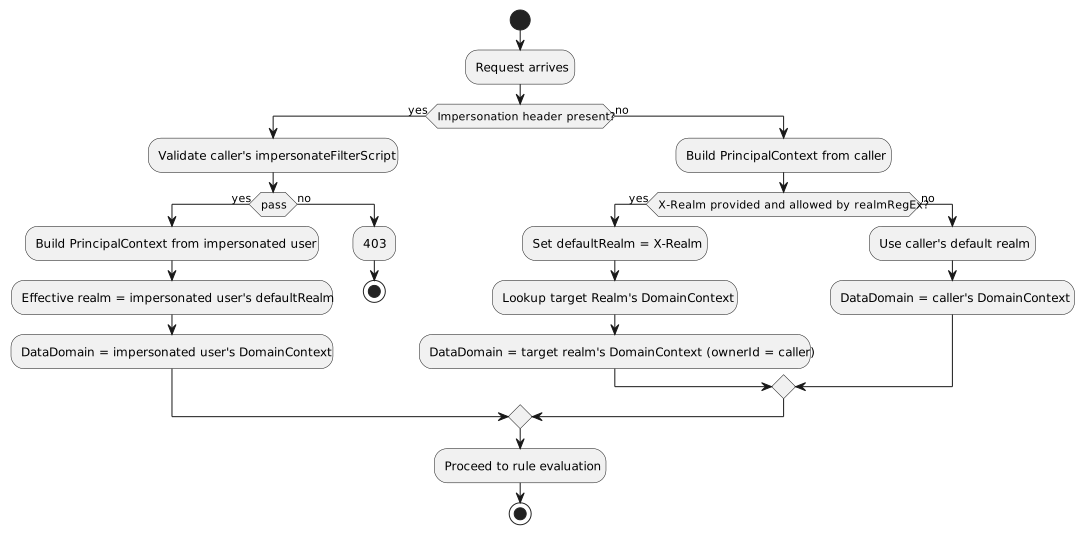
This section explains how to use the request headers X-Realm, X-Impersonate-, and X-Acting-On-Behalf-Of- alongside permission rule bases. These headers influence which realm (database) a request operates against and, in the case of impersonation, which identity’s roles are evaluated by the rule engine.
22.16.1. What they do (at a glance)
-
X-Realm: Overrides the target realm (MongoDB database) used by repositories for this request. Your own identity and roles remain the same. The DataDomain is updated to the target realm’s default DomainContext (while preserving your userId as the ownerId). This ensures that data created via X-Realm is properly scoped to the target realm’s tenant/org structure.
-
X-Impersonate-Subject or X-Impersonate-UserId: Causes the request to run as another identity. The effective permissions become those of the impersonated identity (potentially more or less than your own). This is analogous to sudo on Unix or to "simulate a user/role" for troubleshooting.
-
X-Acting-On-Behalf-Of-Subject or X-Acting-On-Behalf-Of-UserId: Records that the caller is acting on behalf of another party (for audit/tracking purposes). Unlike impersonation, this does NOT change permissions—the caller retains their own identity and roles.
Only one of X-Impersonate-Subject or X-Impersonate-UserId may be supplied per request. Supplying both results in a 400/IllegalArgumentException.
22.16.2. How the headers integrate with permission evaluation
-
Rule matching and effects (ALLOW/DENY) still follow the standard algorithm described earlier.
-
With X-Realm (no impersonation):
-
The PrincipalContext.defaultRealm is set to the header value (after validation), and repositories operate in that realm.
-
The DataDomain is updated from the target realm’s DomainContext (org, tenant, account, dataSegment), while preserving your userId as the ownerId.
-
Your own roles and identity remain intact; the rule base is evaluated for your identity and roles but with the target realm’s data context.
-
Permission filter strings can use
${defaultRealm}to dynamically scope queries based on the active realm. -
With impersonation:
-
The PrincipalContext is rebuilt from the impersonated user’s credential. The effective roles used by the rule engine include the impersonated user’s roles; the platform also merges in the caller’s security roles from Quarkus SecurityIdentity. This means permissions can be a superset; design policy rules accordingly.
-
The effective realm for the request is set to the impersonated user’s default realm (not the X-Realm header). If you passed X-Realm, it is still validated (see below) but not used to override the impersonated default realm in the current implementation.
-
The DataDomain is set from the impersonated user’s DomainContext.
-
With Acting-On-Behalf-Of:
-
The caller retains their own identity, roles, realm, and DataDomain.
-
The X-Acting-On-Behalf-Of-Subject or X-Acting-On-Behalf-Of-UserId is recorded in the PrincipalContext for audit purposes.
-
This is useful for service-to-service calls or when a support agent needs to perform actions that should be attributed to a customer.
22.16.3. Required credential configuration (CredentialUserIdPassword)
Two fields on CredentialUserIdPassword govern whether a user may use these headers:
-
realmRegEx (for X-Realm):
-
A wildcard pattern ("*" matches any sequence; case-insensitive) listing the realms a user is allowed to target with X-Realm.
-
If X-Realm is present but realmRegEx is null/blank or does not match the requested realm, the server returns 403 Forbidden.
-
Examples:
-
"*" → allow any realm
-
"acme-*" → allow realms that start with acme-
-
"dev|stage|prod" is not supported as-is; use wildcards like "dev*" and "stage*" or a combined pattern like "(dev|stage|prod)" only if you store a true regex. The current validator replaces '' with "." and matches case-insensitively.
-
impersonateFilterScript (for X-Impersonate-*):
-
A JavaScript snippet executed by the server (GraalVM) that must return a boolean. It receives three variables: username (the caller’s subject), userId (caller’s userId), and realm (the requested realm or current DB name).
-
If the script evaluates to false, the server returns 403 Forbidden for impersonation.
-
If the script is missing (null) and you attempt impersonation, the server rejects the request with 400/IllegalArgumentException.
Example impersonation script (allow only company admins to impersonate in dev realms):
// username = caller's subject, userId = caller's userId, realm = requested realm (or current)
(username.endsWith('@acme.com') && realm.startsWith('dev-'))
Tip: Manage these two fields via your auth provider’s admin APIs or directly through CredentialRepo in controlled environments.
22.16.4. End-to-end behavior from SecurityFilter (reference)
The SecurityFilter constructs the PrincipalContext/ResourceContext before rule evaluation: - X-Realm is read and, if present, validated against the caller’s credential.realmRegEx. - If impersonation headers are present: - The caller’s credential.impersonateFilterScript is executed. If it returns true, the impersonated user’s credential is loaded and used to build the PrincipalContext. - The final PrincipalContext carries the impersonated user’s defaultRealm and roles (merged with the caller’s SecurityIdentity roles), and may copy area2RealmOverrides from the impersonated credential. - Without impersonation, the PrincipalContext is built from the caller’s credential; X-Realm, when valid, sets the defaultRealm for this request.
22.16.5. Practical differences and use cases
-
Realm override (X-Realm):
-
Who you are does not change; only where you act changes. Your permissions (as determined by policies attached to your identity/roles) are applied against data in the specified realm.
-
DataDomain changes: The DataDomain is updated from the target realm’s DomainContext (tenant, org, account), ensuring new records are created with the correct scoping.
-
Use cases:
-
Multi-tenant admin tooling that needs to inspect or repair data in customer realms.
-
Reporting or backfills where the same service is pointed at different tenant databases per request.
-
Creating data in a target realm with proper DataDomain stamping.
-
Impersonation (X-Impersonate-*):
-
Who you are (for authorization purposes) changes. You act with the impersonated identity’s permissions; depending on your configuration, additional caller roles may be merged.
-
The DataDomain is set from the impersonated user’s credential.
-
Use cases:
-
Temporary elevation to an admin identity (sudo-like) for break-glass operations.
-
Simulate what a given role/identity can see/do for troubleshooting or customer support.
-
Testing user-specific permission rules without logging in as that user.
-
Acting-On-Behalf-Of (X-Acting-On-Behalf-Of-*):
-
Who you are does NOT change; you retain your own identity, roles, realm, and DataDomain.
-
The "acting on behalf of" information is recorded in the PrincipalContext for audit trails.
-
Use cases:
-
Service-to-service calls where the downstream service needs to know the original requestor.
-
Support agents performing actions that should be audited as being done "on behalf of" a customer.
-
Compliance and audit requirements where the chain of delegation must be recorded.
Caveats: - Never set a permissive impersonateFilterScript in production. Keep it restrictive and auditable. - When using both X-Realm and impersonation in one call, be aware that the effective realm will be the impersonated user’s default realm; X-Realm is not applied in the impersonation branch in the current implementation. - realmRegEx must be populated for any user who needs realm override; leaving it blank effectively disables X-Realm for that user. - Acting-On-Behalf-Of headers do NOT grant any additional permissions; they are purely for audit purposes.
22.16.6. Examples
-
List policies in a different realm using your own identity
curl -H "Authorization: Bearer $JWT" \
     -H "X-Realm: acme-prod" \
"https://host/api/security/permission/policies/list?limit=20&sort=+refName"-
Simulate another user by subject while staying in their default realm
curl -H "Authorization: Bearer $JWT" \
     -H "X-Impersonate-Subject: 3d8f4e7b-...-idp-subject" \
"https://host/api/security/permission/policies/list?limit=20"-
Attempt impersonation with a realm hint (validated by script; effective realm = impersonated default)
curl -H "Authorization: Bearer $JWT" \
     -H "X-Realm: dev-acme" \
     -H "X-Impersonate-UserId: tenant-admin" \
     "https://host/api/security/permission/policies/list?limit=20"
Security outcomes in all cases continue to be driven by your rule bases (Policy rules) matched against the effective PrincipalContext and ResourceContext.
22.17. Data domain assignment on create: DomainContext and DataDomainPolicy
This section explains how Quantum decides which dataDomain is stamped on newly created records, why this decision is necessary in a multi‑tenant system, what the default behavior is, and how you can override it globally or per Functional Area / Functional Domain. It also describes the DataDomainResolver interface and the default implementation provided by the framework.
22.17.1. The problem this solves (and why it matters)
In a multi‑tenant platform you must ensure each new record is written to the correct data partition so later reads/updates can be scoped safely. If the dataDomain is wrong or missing, you risk leaking data across tenants or making your own data inaccessible due to mis‑scoping.
Historically, Quantum set the dataDomain of new entities to match the creator’s credential (i.e., the principal’s DomainContext → DataDomain). That default is sensible in many cases, but real systems often need more specific behavior per business area or type. For example: - You may centralize HR records in a single org‑level domain regardless of who created them. - Sales invoices for EU customers must live under an EU data segment. - A specific product area might always write into a shared catalog domain separate from the author’s tenant.
These needs require a simple, deterministic way to override the default per Functional Area and/or Functional Domain.
22.17.2. Key concepts recap: DomainContext and DataDomain
- DomainContext (on credentials/realms)
-
captures the principal’s scoping defaults (realm, org/account/tenant identifiers, data segment). At request time this is materialized into a DataDomain.
- DataDomain
-
is what gets stamped onto persisted entities and later used by repositories to constrain queries and updates.
If you do nothing, new records inherit the principal’s DataDomain.
22.17.3. The default policy (do nothing and it works)
Out of the box, Quantum preserves the existing behavior: if no policy is configured, the resolver falls back to the authenticated principal’s DataDomain. This guarantees compatibility with existing applications.
Concretely: - ValidationInterceptor checks if an entity being persisted lacks a dataDomain. - If missing, it calls DataDomainResolver.resolveForCreate(area, domain). - The DefaultDataDomainResolver first looks for overrides (credential‑attached or global); if none match, it returns the principal’s DataDomain from the current SecurityContext.
22.17.4. Policy scopes: principal‑attached vs. global
You can define overrides at two levels: - Principal‑attached (per credential): attach a DataDomainPolicy to a CredentialUserIdPassword. The SecurityFilter places this policy into the PrincipalContext, so it applies only to records created by that principal. This is useful for VIP service accounts or specific partners. - Global policy: an application‑wide DataDomainPolicy provided by GlobalDataDomainPolicyProvider. If present, this applies when the principal has no specific override for the matching area/domain.
Precedence: principal‑attached policy wins over global policy; if neither applies, fall back to the principal’s credential domain.
22.17.5. The policy map and matching
A DataDomainPolicy is a small map of rules: Map<String, DataDomainPolicyEntry> policyEntries, keyed by "<FunctionalArea>:<FunctionalDomain>" with support for "*" wildcards. The resolver evaluates keys in this order:
-
area:domain (most specific)
-
area:*
-
*:domain
-
: (global catch‑all)
-
Fallback to principal’s domain if no entry yields a value
Each DataDomainPolicyEntry has a resolutionMode: - FROM_CREDENTIAL (default): use the principal’s credential domain (i.e., the historical behavior). - FIXED: use the first DataDomain listed in dataDomains on the entry.
Example policy definitions (illustrative JSON):
{
  "policyEntries": {
    "Sales:Invoice": { "resolutionMode": "FIXED", "dataDomains": [ {"orgRefName": "ACME", "tenantId": "eu-1", "dataSegment": "INVOICE"} ] },
    "Sales:*":      { "resolutionMode": "FROM_CREDENTIAL" },
    "*:HR":         { "resolutionMode": "FIXED", "dataDomains": [ {"orgRefName": "GLOBAL", "tenantId": "hr", "dataSegment": "HR"} ] },
    "*:*":          { "resolutionMode": "FROM_CREDENTIAL" }
  }
}
Behavior of the above: - Sales:Invoice records always go to the fixed EU invoices domain. - Any other Sales:* creation uses the creator’s credential domain. - All HR records go to a central HR domain. - Otherwise, default to the creator’s domain.
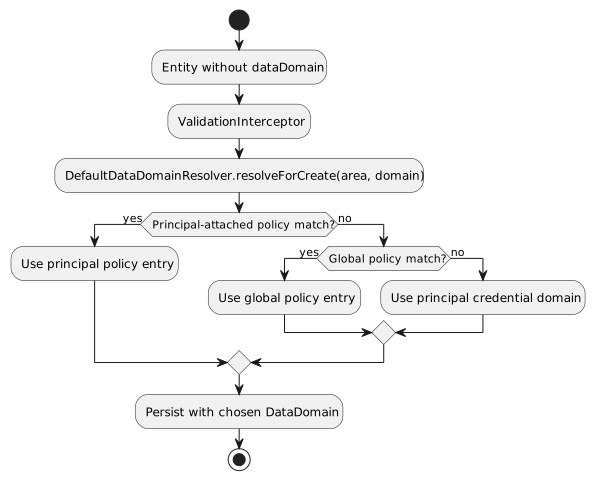
22.17.6. How the resolver works
Interfaces and default implementation:
public interface DataDomainResolver {
  DataDomain resolveForCreate(String functionalArea, String functionalDomain);
}

@ApplicationScoped
public class DefaultDataDomainResolver implements DataDomainResolver {
  @Inject GlobalDataDomainPolicyProvider globalPolicyProvider;
  public DataDomain resolveForCreate(String area, String domain) {
    DataDomain principalDD = SecurityContext.getPrincipalDataDomain()
      .orElseThrow(() -> new IllegalStateException("Principal context not providing a data domain"));
    List<String> keys = List.of(areaOrStar(area)+":"+areaOrStar(domain), areaOrStar(area)+":*", "*:"+areaOrStar(domain), "*:*");
    // 1) principal‑attached policy from PrincipalContext
    DataDomain fromPrincipal = resolveFrom(policyFromPrincipal(), keys, principalDD);
    if (fromPrincipal != null) return fromPrincipal;
    // 2) global policy
    DataDomain fromGlobal = resolveFrom(globalPolicyProvider.getPolicy().orElse(null), keys, principalDD);
    if (fromGlobal != null) return fromGlobal;
    // 3) default fallback
    return principalDD;
  }
}
Integration point: - ValidationInterceptor injects DataDomainResolver and calls it in prePersist when an entity’s dataDomain is null. - SecurityFilter propagates a principal’s attached DataDomainPolicy (if any) into the PrincipalContext so the resolver can see it.
22.17.7. When would you want a non‑global policy?
Here are a few concrete scenarios: - Centralized HR: All HR Employee records are written to a shared HR domain regardless of the team creating them. This supports a shared‑service HR model without duplicating HR data per tenant. - Regulated invoices: In the Sales:Invoice domain for EU, you must write under a specific EU tenantId/dataSegment to satisfy data residency. Other Sales domains can keep default behavior. - Shared catalog: The Catalog:Item domain is a cross‑tenant shared catalog maintained by a core team. Writes should go to a canonical catalog domain even when initiated by tenant‑specific users. - VIP account override: A particular integration user should always write to a staging domain for testing purposes, while all others use defaults. Attach a small policy to just that credential.
22.17.8. Relation to tenancy models
The policy mechanism supports both siloed and pooled tenancy: - Siloed tenancy: Most domains default to FROM_CREDENTIAL (each tenant writes to its own partition). Only a few shared services (e.g., HR, catalog) use FIXED to centralize data. - Pooled tenancy: You may lean on FIXED policies more often to route writes into pooled/segment‑specific domains (e.g., region, product line), while still enforcing read/write scoping via permissions.
Because the resolver always validates through the principal context and falls back safely, you can introduce overrides gradually without destabilizing existing flows.
22.17.9. Authoring tips
-
Start with no policy and verify your default flows. Add entries only where necessary.
-
Prefer specific keys (area:domain) for clarity; use wildcards sparingly.
-
Keep FIXED DataDomain objects minimal and valid for your deployment (orgRefName, tenantId, and dataSegment as needed).
-
Document any global policy so teams know which areas are centralized.
22.17.10. API pointers
-
CredentialUserIdPassword.dataDomainPolicy: optional per‑credential overrides (propagated to PrincipalContext).
-
GlobalDataDomainPolicyProvider: holds an optional in‑memory global policy (null by default).
-
DataDomainPolicyEntry.resolutionMode: FROM_CREDENTIAL (default) or FIXED.
-
DataDomainResolver / DefaultDataDomainResolver: the extension point and default behavior.
22.17.11. Ontology in Permission Rules (optional)
If you enable the ontology modules, you can author rules that constrain access by semantic relationships, not field paths. This keeps policies stable as your object model evolves.
Key idea
-
Materialize edges in Mongo using OntologyMaterializer (e.g., placedInOrg, orderShipsToRegion).
-
During rule evaluation, translate a semantic constraint like "has edge placedInOrg to OrgX" into a set of IDs, and combine that with your query.
How to use
-
Preferred: author a rule with a semantic hint and let the application translate it via ListQueryRewriter.
-
Minimal change path: publish a variable via an AccessListResolver and use an IN filter over _id.
Example (resolver + IN filter)
-
Add an AccessListResolver that returns order IDs for which (tenantId, p="placedInOrg", dst=orgRefName) exists.
-
In your rule’s AND filter string (query language), use: id:^${idsByPlacedInOrg}
See also
-
Ontology overview and examples: Ontologies in Quantum
-
Integration with Morphia and multi-tenancy: Integrating Ontology
Operational notes
-
Ontology is optional. Enable it per service when the config flag and dependencies are present.
-
Always scope edge queries by tenantId sourced from RuleContext.
-
Index edges on (tenantId, p, dst) and (tenantId, src, p) for performance.
Rule language: add hasEdge()
We introduce a policy function/operator to reference ontology edges directly from rules. This lets policies constrain access by semantic relationships instead of field paths.
Signature
-
hasEdge(predicate, dstIdOrVar)
-
hasIncomingEdge(predicate, srcIdOrVar)
Parameters
-
predicate: String name of the ontology predicate (e.g., "placedInOrg", "orderShipsToRegion").
-
dstIdOrVar / srcIdOrVar: Either a concrete id/refName or a variable resolved from RuleContext (e.g., principal.orgRefName, request.region, ${principalId}).
Semantics
-
hasEdge: The rule grants/filters entities (sources) for which an edge exists: (tenantId, src = entity._id, p = predicate, dst = resolvedDst).
-
hasIncomingEdge: The rule grants/filters entities (targets) for which an edge exists: (tenantId, src = resolvedSrc, p = predicate, dst = entity._id). Useful for finding entities that are destinations of a relationship (e.g., "find locations reachable FROM an associate").
-
Multi-tenant safety: tenantId is always taken from RuleContext/DomainContext.
Composition
-
hasEdge and hasIncomingEdge can be combined with existing rule clauses (and/or/not) and other filters (states, tags, ownerId, etc.).
Examples
-
Allow viewing Orders in the caller’s org (including ancestors via ontology closure):
-
allow VIEW Order when hasEdge("placedInOrg", principal.orgRefName)
-
Restrict list to Orders shipping to a region chosen in request:
-
allow LIST Order when hasEdge("orderShipsToRegion", request.region)
-
Allow viewing Locations reachable from the current user:
-
allow VIEW Location when hasIncomingEdge("canAccessLocation", ${principalId})
|
In |
Under the hood
-
Policy evaluation resolves dstIdOrVar / srcIdOrVar against RuleContext (for example, principal.orgRefName → "OrgP").
-
The list/filter query is rewritten using ListQueryRewriter.rewriteForHasEdge(…) or rewriteForHasIncomingEdge(…), which turns the predicate and resolved ID into a set of target/source IDs and merges it with the base query efficiently.
-
OntologyEdgeDao must be indexed on (tenantId, p, dst) and (tenantId, src, p) for performance.
Full end-to-end example (implementation pattern)
1) Author a rule (illustrative YAML/pseudocode)
- name: list-orders-by-org
  priority: 100
  securityURI:
    header:
      identity: USER
      area: sales
      functionalDomain: order
      action: list
    body:
      realm: '*'
      accountNumber: '*'
      tenantId: '*'
      dataSegment: '*'
      ownerId: '*'
      resourceId: '*'
  effect: ALLOW
  # Semantic constraint expressed via ontology helper in postconditionScript
  postconditionScript: hasEdge("placedInOrg", pcontext?.dataDomain?.orgRefName) === true
Another example using hasIncomingEdge:
- name: view-reachable-locations
  priority: 110
  securityURI:
    header:
      identity: USER
      area: core
      functionalDomain: location
      action: view
  effect: ALLOW
  # Find locations that the current user has a "canAccessLocation" edge to
  andFilterString: "hasIncomingEdge(canAccessLocation, ${principalId})"
2) Evaluate policy and apply constraint in the repository/list path
import com.e2eq.ontology.policy.ListQueryRewriter;
import com.e2eq.ontology.repo.OntologyEdgeRepo;
import com.mongodb.client.model.Filters;
import org.bson.conversions.Bson;

// Injected once per service when ontology is enabled (Quarkus CDI)
@jakarta.inject.Inject OntologyEdgeDao edgeDao;
ListQueryRewriter rewriter = new ListQueryRewriter(edgeDao);

// Inside your list method, after building the base filter
String tenantId = ruleContext.getRealmId(pctx, rctx); // or from DomainContext
String predicate = "placedInOrg";
String orgRefName = pctx.getDataDomain().getOrgRefName(); // resolves principal.orgRefName

Bson base = Filters.and(existingFilters...);
Bson rewritten = rewriter.rewriteForHasEdge(base, tenantId, predicate, orgRefName);
var results = datastore.getDatabase().getCollection("orders").find(rewritten).iterator();

// Example for hasIncomingEdge in code
Bson locationRewritten = rewriter.rewriteForHasIncomingEdge(locationBase, tenantId, "canAccessLocation", principalId);
3) Morphia-typed queries alternative
// If you’re using Morphia’s typed Query API
Set<String> ids = edgeDao.srcIdsByDst(tenantId, "placedInOrg", orgRefName);
if (ids.isEmpty()) {
  return java.util.List.of(); // short-circuit
}
query.filter(dev.morphia.query.filters.Filters.in("_id", ids));
Developer requirements and checklist
-
Enable ontology (optional feature): set e2eq.ontology.enabled=true in your app and add module dependencies.
-
Provide a TBox (OntologyRegistry) and run OntologyMaterializer on entity changes to keep edges up to date.
-
Inject EdgeDao as a CDI bean (@Inject); indexes are ensured automatically at startup.
-
Always pass tenantId from RuleContext/DomainContext; never cross tenants.
-
When using variables on the RHS (dstIdOrVar), ensure the RuleContext exposes them (for example, principal.orgRefName or request.region).
-
Monitor provenance (edge.prov) and re-materialize edges when intermediate nodes change.
Notes
-
hasEdge() is a policy function; it is evaluated before constructing database filters. It is not part of the core BIAPI query grammar.
-
If ontology is disabled, skip the rewrite (return base) or configure a no-op implementation so policies that include hasEdge are rejected early with a clear error message.
22.17.12. Label resolution SPI and hasLabel() in rules
Labels are a lightweight way to attach semantic markers to principals and resources, and then use them in rule scripts. Quantum provides a pluggable label resolution SPI and a script helper to check labels during policy evaluation.
Why labels? - Decouple policy from rigid fields (e.g., “VIP”, “HARD_DELETE_DISABLED”, “B2B”). - Compute labels from multiple sources (simple tags, advancedTags, dynamic attributes, or custom derivations).
Components
-
LabelResolver (SPI):
public interface LabelResolver { boolean supports(Class<?> type); java.util.Set<String> resolveLabels(Object entity); } -
DefaultLabelResolver (built-in): Applies to UnversionedBaseModel.
-
Collects tags (String[]), advancedTags.name, and optionally any dynamicAttributes whose isInheritable()==true, using best‑effort reflection.
-
LabelService: Aggregates all LabelResolver beans via CDI and delegates to the first that supports the entity type. Also supports annotation-based extraction (see below).
-
Annotations (optional, opt-in at your model):
@LabelSource(method = "computeLabels") // class-level method returning Collection<String>, String[], or String
public class MyEntity { ... }

public class MyEntity {
  @LabelField                // field can be Collection<String>, String[], or String
  private java.util.List<String> policyLabels;
}
Availability in rule scripts
During policy evaluation, RuleContext resolves labels for both principal and resource contexts and installs a script helper:
-
hasLabel(label: String) → Boolean
-
Returns true if the current resource context has the specified label.
-
Label resolution uses LabelService (including custom resolvers and annotations) at evaluation time.
Examples (postcondition script)
// Allow if the resource is labeled VIP
hasLabel("VIP")

// Combine with other helpers when ontology is enabled
hasLabel("RESTRICTED") && !hasEdge("placedInOrg", "OrgX")
Extending labels for your domain
-
Add a new resolver:
@jakarta.enterprise.context.ApplicationScoped public class InvoiceLabelResolver implements LabelResolver { public boolean supports(Class<?> type) { return type.getName().endsWith("Invoice"); } public java.util.Set<String> resolveLabels(Object entity) { var out = new java.util.LinkedHashSet<String>(); var inv = (com.example.Invoice) entity; if (inv.isHighValue()) out.add("HIGH_VALUE"); if (inv.isPastDue()) out.add("PAST_DUE"); return out; } } -
Or annotate your model with @LabelSource/@LabelField to contribute labels without writing a resolver.
Notes - Labels are resolved best‑effort; failures are swallowed to keep policy evaluation robust. - If multiple resolvers exist, the first that supports the type wins. Prefer narrow supports() checks. - Keep label names stable; treat them as part of your policy contract.
22.18. Script Helpers reference (when enabled)
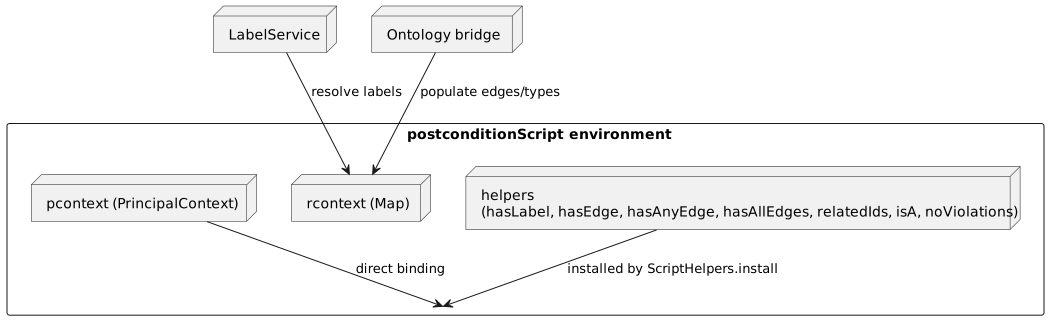
Script helpers are small functions injected into the postconditionScript environment to make common policy checks concise. They are provided by com.e2eq.ontology.policy.ScriptHelpers.install(…) when the optional ontology/label modules are present. In all cases, postconditionScript also has direct access to:
-
pcontext: the Java PrincipalContext for the caller
-
rcontext: a lightweight map for resource-related helper data (labels, types, edges, violations) when populated by your application
Availability notes: - Labels are made available by RuleContext via LabelService. hasLabel() checks the resource’s labels only. - Edges, types, and violations must be populated by your application into the rcontext map before calling RuleContext.runScript (typically via an ontology bridge). If absent, edge/type helpers return false/empty.
Helpers and examples:
-
isA(type: String) → Boolean
-
Purpose: Check whether the resource has a semantic type in rcontext.types.
-
Example:
// Allow when the resource is of type "Invoice" isA("Invoice") -
hasLabel(label: String) → Boolean
-
Purpose: Check whether the resource has a policy label (labels resolved via LabelService).
-
Example:
// Permit view if resource is labeled PUBLIC hasLabel("PUBLIC") -
hasEdge(predicate: String, dst: String|null) → Boolean
-
Purpose: True if an ontology edge with property p=predicate exists from the current resource to dst. If dst is null, true if any dst exists for the predicate.
-
Example:
// Require that this resource is placed in the caller's org hasEdge("placedInOrg", pcontext?.dataDomain?.orgRefName) -
hasIncomingEdge(predicate: String, src: String|null) → Boolean
-
Purpose: True if an ontology edge with property p=predicate exists from src to the current resource. If src is null, true if any src exists for the predicate.
-
Example:
// Permit view if the current resource is a location reachable from the caller hasIncomingEdge("canAccessLocation", principalId) -
hasAnyEdge(predicate: String, dsts: Collection<String>) → Boolean
-
Purpose: True if there is at least one edge to any of the destinations.
-
Example:
// Allow if the order ships to any of the selected regions hasAnyEdge("orderShipsToRegion", ["NA", "EU"]) === true -
hasAllEdges(predicate: String, dsts: Collection<String>) → Boolean
-
Purpose: True only if there is an edge for every destination in the list.
-
Example:
// Require all compliance flags to be present hasAllEdges("hasComplianceFlag", ["KYC", "AML"]) === true -
relatedIds(predicate: String) → List<String>
-
Purpose: Return the list of dst ids for edges with property p=predicate.
-
Example:
// Use in conjunction with a filter list variable (via AccessListResolver) var projectIds = relatedIds("belongsToProject"); projectIds && projectIds.length > 0 -
noViolations() → Boolean
-
Purpose: True if rcontext.violations is empty. Helpful when upstream validators populate violations.
-
Example:
// Deny action if any violations were detected earlier in the pipeline
noViolations() === true
Best practices: - Prefer simple boolean expressions; keep postconditionScript fast and side-effect free. - When using ontology helpers, always scope your edge materialization by tenantId to avoid cross-tenant leakage. - Combine helpers with SecurityURIBody scoping and repository filters for defense in depth.
Cross‑references: - Ontology usage and hasEdge: see Ontology in Permission Rules. - Label SPI and hasLabel: see Label resolution SPI. - AccessListResolver for list variables in filters: see "AccessListResolvers (SPI) for list-based access" above.
22.18.1. Security Annotations: FunctionalMapping and FunctionalAction
Quantum uses annotations to declare a model or resource’s functional area, domain, and actions for security evaluation. This replaces the legacy bmFunctionalArea() and bmFunctionalDomain() methods.
@FunctionalMapping
Use @FunctionalMapping on model classes or resource classes to declare their business placement:
import com.e2eq.framework.annotations.FunctionalMapping;

@Entity
@FunctionalMapping(area = "catalog", domain = "product")
public class Product extends BaseModel {
    // No need to override bmFunctionalArea/bmFunctionalDomain
}@Path("/products")
@FunctionalMapping(area = "catalog", domain = "product")
public class ProductResource extends BaseResource<Product, ProductRepo> {
// All methods inherit area/domain from class annotation
}@FunctionalAction
Use @FunctionalAction on JAX-RS resource methods when the action differs from the HTTP verb default:
@Path("/products")
public class ProductResource {

    @POST
    @FunctionalAction("CREATE")  // Explicit, though POST implies CREATE
    public Product create(Product payload) {
        return productRepo.save(payload);
    }

    @GET
    @Path("/{id}")
    // No annotation needed - GET implies VIEW
    public Product get(@PathParam("id") String id) {
        return productRepo.findById(id);
    }

    @PUT
    @Path("/{id}/approve")
    @FunctionalAction("APPROVE")  // Custom action beyond standard CRUD
    public Product approve(@PathParam("id") String id) {
        Product p = productRepo.findById(id);
        p.setStatus("APPROVED");
        return productRepo.save(p);
    }
}
Default Action Mapping
When @FunctionalAction is not present, actions are inferred from HTTP methods:
| HTTP Method | Default Action |
|---|---|
GET |
VIEW |
POST |
CREATE |
PUT |
UPDATE |
PATCH |
UPDATE |
DELETE |
DELETE |
How the Framework Uses These Annotations
SecurityFilter
-
Reads
@FunctionalMappingfrom the matched resource class for area/domain -
Reads
@FunctionalActionfrom the method, or infers from HTTP method -
Falls back to path-based parsing if annotations are missing
Scoped Action Enablement
-
Reuses the same
area / functionalDomain / actiontuple as the dependency-tracking key for runtime action enablement -
Lets the framework answer more than "is this policy allowed?" and also report whether the action is feature-enabled and operationally ready
-
Treats capabilities as an application-level composition concept built on top of one or more scoped actions, not as a new core security primitive
MorphiaRepo.fillUIActions
-
Uses
@FunctionalMappingon model classes to resolve allowed UI actions -
Falls back to legacy
bmFunctionalArea()/bmFunctionalDomain()methods
PermissionResource
-
Prefers
@FunctionalMappingwhen listing functional domains -
Falls back to legacy methods when annotation is missing
Migration from Legacy Methods
Current (Legacy) Approach
@Entity
public class Product extends BaseModel {
    @Override
    public String bmFunctionalArea() {
        return "Catalog";
    }

    @Override
    public String bmFunctionalDomain() {
        return "Product";
    }
}
New (Recommended) Approach
@Entity
@FunctionalMapping(area = "catalog", domain = "product")
public class Product extends BaseModel {
    // Clean - no method overrides needed
}
Transitional Support
You can use both during migration:
- If @FunctionalMapping is present, it takes precedence
- If missing, legacy methods are used as fallback
- Plan to remove legacy methods in future releases
Best Practices
Consistent Naming
Use lowercase, kebab-case for areas and domains:
@FunctionalMapping(area = "supply-chain", domain = "purchase-order")
@FunctionalMapping(area = "catalog", domain = "product")
@FunctionalMapping(area = "identity", domain = "user-profile")
Resource vs Model Annotations
-
Prefer model annotations for consistency across all usage
-
Use resource annotations only when the resource handles multiple model types
-
Avoid duplicating annotations on both model and resource for the same entity
-
Be consistent with naming because the same tuple may be used by policies, UI action derivation, and scoped action enablement manifests
Custom Actions
Define custom actions for business operations beyond CRUD:
@PUT
@Path("/{id}/publish")
@FunctionalAction("PUBLISH")
public Product publish(@PathParam("id") String id) { ... }

@POST
@Path("/{id}/duplicate")
@FunctionalAction("DUPLICATE")
public Product duplicate(@PathParam("id") String id) { ... }

@DELETE
@Path("/{id}/archive")
@FunctionalAction("ARCHIVE")  // Soft delete vs hard DELETE
public void archive(@PathParam("id") String id) { ... }
Bypassing Data Scoping for System Operations
Some endpoints perform system-level operations that don’t operate on tenant-scoped data entities. For example:
-
Database migration operations (index creation, schema changes)
-
System initialization and setup endpoints
-
Administrative operations that don’t query/modify tenant-scoped records
For these endpoints, permission rules may return a SCOPED decision with data-level constraints like dataDomain.tenantId:${pTenantId}. However, since there’s no data entity to scope on, these constraints can’t be meaningfully applied.
Use bypassDataScoping = true to mark such endpoints:
@POST
@Path("/indexes/applyAllIndexes/{realm}")
@RolesAllowed("admin")
@FunctionalMapping(area = "migration", domain = "indexes")
@FunctionalAction(value = "APPLY_ALL_INDEXES", bypassDataScoping = true)
public void applyAllIndexes(@PathParam("realm") String realm) {
    migrationService.applyAllIndexes(realm);
}
How It Works
When bypassDataScoping = true:
-
Permission checks still apply - The user must still be authorized (ALLOW decision) based on their roles and the permission rules
-
SCOPED constraints are ignored - Data-level filters (like
dataDomain.tenantId:${pTenantId}) are bypassed because they’re not applicable -
Audit logging - The framework logs when data scoping is bypassed for transparency
Security Considerations
Only use bypassDataScoping = true for endpoints that genuinely do not operate on tenant-scoped data. Misuse could expose cross-tenant data access vulnerabilities.
|
| Use Case | bypassDataScoping | Why |
|---|---|---|
Database migrations |
|
Index/schema operations don’t involve tenant data |
System initialization |
|
Setup operations are realm-wide, not tenant-scoped |
CRUD on tenant data |
|
Must respect tenant isolation |
Report generation |
|
Reports should only include user’s accessible data |
Example: MigrationResource
The MigrationResource class uses bypassDataScoping for all index management operations:
@Path("/system/migration")
@RolesAllowed({"admin"})
public class MigrationResource {

   @POST
   @Path("/indexes/applyIndexes/{realm}")
   @FunctionalMapping(area = "MIGRATION", domain = "INDEXES")
   @FunctionalAction(value = "APPLY_INDEXES", bypassDataScoping = true)
   public void applyIndexes(@PathParam("realm") String realm) {
      migrationService.applyIndexes(realm);
   }

   @POST
   @Path("/indexes/dropAllIndexes/{realm}")
   @FunctionalMapping(area = "MIGRATION", domain = "INDEXES")
   @FunctionalAction(value = "DROP_ALL_INDEXES", bypassDataScoping = true)
   public void dropIndexes(@PathParam("realm") String realm) {
      migrationService.dropAllIndexes(realm);
   }
}
Integration with Permission Rules
Annotations feed into permission rule matching:
- name: allow-catalog-reads
  priority: 300
  match:
    method: [GET]
    # Matches area/domain from @FunctionalMapping
    functionalArea: catalog
    functionalDomain: product
  rolesAny: [USER, ADMIN]
  effect: ALLOW
- name: admin-only-approval
priority: 100
match:
method: [PUT]
functionalArea: catalog
functionalDomain: product
# Matches @FunctionalAction("APPROVE")
action: APPROVE
rolesAll: [ADMIN]
effect: ALLOW23. 9. Seed packs: Declarative tenant seeding
Problem: Provisioning repeatable, versioned baseline data for tenants.
Why for SaaS: Every tenant must start with known-good defaults; upgrades must be idempotent and auditable.
How Quantum helps: Seed packs with manifests, datasets, transforms, includes, archetypes, and a registry.
Walkthrough: Create a seed pack, apply it programmatically, and verify idempotency.
24. Seed packs and declarative tenant seeding
Quantum 1.2 introduces a seed-pack subsystem that lets applications publish versioned baseline
content without hard-coding values in ChangeSet beans or maintaining a separate "seed" tenant.
24.1. Introduction
24.1.1. The problem
In multi-tenant SaaS platforms, every new tenant must start with a known-good baseline of data: code lists, roles, default settings, reference values, and sometimes product- or region-specific content. Traditionally this baseline is scattered across ad‑hoc SQL/Mongo scripts, hand-written bootstrap code, or a "template" tenant that is copied forward. These approaches are hard to version, review, test, and repeat reliably across environments.
Compounding the issue, tenants evolve over time. As modules are upgraded, their baseline content must be updated too. Without a disciplined mechanism, teams risk drift between environments and tenants, brittle migrations, and non-idempotent provisioning that causes duplicates or corruption.
24.1.2. Why this needs to be solved
-
Operational consistency: Provisioning should be predictable, repeatable, and safe to re-run.
-
Developer velocity: Changes to baseline data should be reviewed like code and travel with the module that owns them.
-
Compliance and audit: You need to know exactly which version of seed content was applied to which tenant and when.
-
Composability: Different product editions or SKUs need different combinations of baseline content without forked scripts.
24.1.3. How seed packs solve it
Seed packs provide a declarative, versioned, and composable way to describe tenant baseline data: - A manifest (manifest.yaml) declares datasets, natural keys, transforms, required indexes, and optional includes/archetypes. - Datasets point to JSON/NDJSON files that are upserted using natural-key filters, making runs idempotent. - Transforms inject tenant/realm identifiers and can rewrite references deterministically. - Includes compose other packs with exact versions or semantic version ranges, enabling dependency management. - Archetypes bundle a named set of packs to represent product tiers or verticals. - A registry records checksums per dataset so unchanged data is skipped on subsequent runs.
Together, these features make seeding safe, observable, and maintainable across development, test, and production.
The next section expands on why seed packs are beneficial and how to use them effectively.
24.2. Why seed packs?
-
Versioned + reviewable: seed packs are plain files (YAML + JSON/NDJSON) that live next to your module code. Pull requests show exactly which records changed.
-
Composable: packs can depend on other packs and expose named archetypes for different product editions or verticals.
-
Pluggable sources: load packs from the filesystem, object storage, or even a curated seed database by providing a custom
SeedSource. -
Tenant-aware: transforms inject tenant identifiers and remap references before persisting.
-
Idempotent: a
SeedRegistrytracks checksums per dataset so provisioning can be re-run safely.
24.3. High-level flow
-
SeedLoaderdiscovers manifests via the configuredSeedSourceimplementations (for example the providedFileSeedSource). -
A manifest (
manifest.yaml) declares datasets, required indexes, transforms, optional includes, and archetypes. -
During provisioning a migration invokes
SeedLoader.apply(…)with the packs (or archetype) that should be materialised for the tenant. -
Records are parsed, transformed, and upserted through a
SeedRepositoryimplementation. The defaultMongoSeedRepositorywrites to the tenant realm using natural-key filters. -
The
SeedRegistry(backed by_seed_registryviaMongoSeedRegistry) records the checksum so unchanged datasets are skipped on later runs.
24.4. Manifest quick reference
seedPack: logistics-core
version: 1.4.2
includes:
  - accounting-base@^1.1

datasets:
  - collection: codeLists
    file: datasets/codelists.ndjson
    naturalKey: [codeListName, code]
    upsert: true
    requiredIndexes:
      - name: uk_codeLists_name_code
        unique: true
        keys:
          codeListName: 1
          code: 1
    transforms:
      - type: tenantSubstitution
        config:
          tenantField: tenantId
          orgField: orgRefName
          ownerField: ownerId
          realmField: realmId

archetypes:
  - name: FulfillmentPlus
    includes:
      - logistics-core@^1.4
      - shipping-defaults@~2
24.5. Realm filtering
Seed packs can be restricted to specific realms using includeRealms or excludeRealms in the scope block of the manifest. This controls which realms a seed pack applies to during provisioning.
-
includeRealms— the seed pack applies ONLY to the listed realms -
excludeRealms— the seed pack applies to ALL realms EXCEPT those listed -
If neither is set, the seed pack applies to all realms (default behavior)
These two fields are mutually exclusive — setting both causes a validation error at manifest load time.
Realm filtering composes with the scope type. The type-based check (GLOBAL, PER_TENANT, TENANT_LIST, etc.) runs first; if it passes, the realm filter is applied as an additional constraint.
|
Realm filtering requires |
24.5.1. Include realms (explicit list)
Use includeRealms when a seed pack should only be applied to specific realms — for example, customer-specific configuration or region-specific reference data:
seedPack: acme-custom-config
version: 1.0.0
scope:
  type: GLOBAL
  includeRealms:
    - acme-com
    - acme-staging-com

datasets:
  - collection: codeLists
    file: datasets/acme-codes.ndjson
    naturalKey: [code]
This seed pack will only be applied when the target realm is acme-com or acme-staging-com. All other realms skip it.
24.5.2. Exclude realms
Use excludeRealms when a seed pack should apply everywhere except certain realms — for example, excluding test or system realms from production seed data:
seedPack: standard-permissions
version: 2.1.0
scope:
  type: GLOBAL
  excludeRealms:
    - test-system-com
    - dev-local-com

datasets:
  - collection: policy
    file: datasets/policies.ndjson
    naturalKey: [refName]
    upsert: true
This seed pack applies to every realm except test-system-com and dev-local-com.
24.5.3. Backward compatibility
The previously declared (but unused) realms field in the scope block is treated as an alias for includeRealms:
scope:
  type: GLOBAL
  realms: [acme-com]    # equivalent to includeRealms: [acme-com]
24.6. Programmatic usage
SeedLoader loader = SeedLoader.builder()
        .addSeedSource(new FileSeedSource("local", Paths.get("seed-packs")))
        .seedRepository(new MongoSeedRepository(mongoClient))
        .seedRegistry(new MongoSeedRegistry(mongoClient))
        .build();

SeedContext ctx = SeedContext.builder(realmId)
        .tenantId(tenantId)
        .orgRefName(orgRef)
        .accountId(accountId)
        .ownerId(ownerId)
        .build();

loader.apply(List.of(
        SeedPackRef.range("logistics-core", "^1.4"),
        SeedPackRef.of("oms-defaults")
), ctx);
Callers can also use loader.applyArchetype("FulfillmentPlus", ctx) to resolve an archetype defined
in any manifest.
24.7. Extensibility hooks
-
Implement
SeedSourceto load manifests from custom storage (S3, Git, curated seed DB…). -
Register additional
SeedTransformFactoryinstances with the builder to support bespoke transformations (for example JMESPath projections or deterministic ObjectId mapping). -
Swap in a different
SeedRepository/SeedRegistryto write to alternative datastores or change the idempotency policy.
24.8. Operational tips
-
Validate manifests in CI by running the loader against a disposable database.
-
Keep seed pack versions aligned with module versions so upgrade paths are clear.
-
Derive any ObjectIds deterministically from natural keys inside a transform so data can be re-applied without collisions.
-
Use archetypes to model product tiers and optional modules:
TenantProvisioningServicecan decide which archetype(s) to apply based on SKU.
24.9. Primary scenarios
-
Initial tenant provisioning
-
Apply one or more seed packs to bootstrap a brand-new tenant (realm) with baseline code lists, roles, and default settings.
-
Use SeedPackRef.of("pack-name") or SeedPackRef.range("pack-name", "^1.4") to control versions.
-
-
Updating a module to a new version
-
Publish a new seed pack version (e.g., logistics-core 1.5.0) with incremental dataset changes.
-
Re-run loader.apply(…) for the same tenant; unchanged datasets are skipped via _seed_registry, modified datasets are re-applied.
-
-
Idempotent re-apply during deployments
-
Safe to invoke on every startup/migration. Upserts are driven by naturalKey and upsert: true.
-
Keep natural keys stable; derive surrogate IDs deterministically in a transform if needed.
-
-
Selecting product tiers with archetypes
-
Define archetypes in a manifest to bundle multiple seed packs under a named edition.
-
Call loader.applyArchetype("FulfillmentPlus", ctx) to materialize the predefined stack for a tenant.
-
-
Composing packs with includes
-
Use includes to depend on base packs (e.g., accounting-base@^1.1) and extend with your own datasets.
-
Includes support exact (=1.2.3) and range (e.g., ^1.4, ~2) selectors via SeedPackRef.parse("name@spec").
-
-
Partial refresh of specific datasets
-
You can split large packs into multiple datasets and re-apply only the packs you want by passing a smaller list to loader.apply(…).
-
-
Testing seed packs
-
Add an integration test similar to SeedLoaderIntegrationTest that seeds into an ephemeral MongoDB and asserts collection state and _seed_registry entries.
-
24.10. Explicit examples
24.10.1. Example 1: Minimal manifest and NDJSON
seedPack: demo-seed
version: 1.0.0

datasets:
  - collection: codeLists
    file: datasets/codeLists.ndjson
    naturalKey: [ code ]
    upsert: true
    requiredIndexes:
      - name: uk_codeLists_code
        unique: true
        keys:
          code: 1
    transforms:
      - type: tenantSubstitution
        config:
          tenantField: tenantId
          orgField: orgRefName
          accountField: accountId
          ownerField: ownerId
          realmField: realmId
Example NDJSON (datasets/codeLists.ndjson):
{"code": "NEW", "label": "New"}
{"code": "CLOSED", "label": "Closed"}
24.10.2. Example 2: Applying packs in code
SeedLoader loader = SeedLoader.builder()
        .addSeedSource(new FileSeedSource("local", Paths.get("seed-packs")))
        .seedRepository(new MongoSeedRepository(mongoClient))
        .seedRegistry(new MongoSeedRegistry(mongoClient))
        .build();

SeedContext ctx = SeedContext.builder("my-realm")
        .tenantId("tenant-123")
        .orgRefName("tenant-123")
        .accountId("acct-123")
        .ownerId("owner-123")
        .build();

loader.apply(List.of(
        SeedPackRef.of("demo-seed"),
        SeedPackRef.range("logistics-core", "^1.4")
), ctx);
24.10.3. Example 3: Using an archetype
archetypes:
  - name: FulfillmentPlus
    includes:
      - logistics-core@^1.4
      - shipping-defaults@~2
Apply programmatically:
loader.applyArchetype("FulfillmentPlus", ctx);24.10.4. Example 4: Exact version and includes in a manifest
seedPack: shipping-defaults
version: 2.3.0
includes:
- accounting-base@=1.1.2
- logistics-core@^1.5
datasets:
- collection: shippingMethods
file: datasets/methods.json
naturalKey: [ code ]24.11. Troubleshooting
-
Manifest parsing errors: Confirm manifest.yaml keys match SeedPackManifest fields; boolean flags like upsert and unique must be proper booleans.
-
Duplicate key or unique index violations: Check naturalKey and requiredIndexes; ensure transforms don’t change key fields inconsistently.
-
Nothing changes on re-run: The _seed_registry may have recorded the same checksum; bump version or change dataset content.
-
File resolution issues: Ensure FileSeedSource base path points to the correct seed-packs directory and file names match.
24.12. How seeds are applied automatically at startup
The framework now applies seed packs via a dedicated SeedStartupRunner, independent of schema migrations. This runner discovers and applies the latest version of each seed pack for important realms (system/default/test) on application startup.
Key points:
- Discovery: SeedStartupRunner constructs a SeedLoader with a FileSeedSource pointing at the configured seed root. Set quantum.seed.root (for tests we default to src/main/resources/seed-packs). The source walks the directory tree and locates every manifest.yaml file.
- Selection: For each discovered seed pack name, the runner selects the latest semantic version and builds SeedPackRef.exact(name, version) for application.
- Execution: The runner builds a SeedContext for the target realm and calls loader.apply(refs, context). Indexes declared in the manifest are created before data is upserted.
- Idempotency + repeatable: The MongoSeedRegistry stores a checksum per dataset in the realm’s _seed_registry collection. If the checksum matches on a later run, the dataset is skipped; if it changes, the dataset is re-applied.
- Concurrency safety: The runner uses a Sherlock distributed lock per realm to prevent concurrent execution across nodes.
Configuration snippet:
# test profile uses a local seed root
quantum.seed.root=src/test/resources/seed-packs
# control seed runner behavior
quantum.seeds.enabled=true
quantum.seeds.apply.on-startup=true24.12.1. Configuring which realms receive seeds on startup
By default, SeedStartupRunner applies seeds to the system, default, and test realms. You can customize this behavior using a combination of:
-
Configuration property (
quantum.seed-pack.apply.realms): A comma-separated list of realm names to seed on startup. -
Realm flag (
applySeedsOnStartup): A boolean field on the Realm model/entity that, when set totrue, includes that realm for automatic seeding.
The startup runner unions both sources: realms from the config property plus realms with the applySeedsOnStartup flag enabled.
Configuration examples:
# Explicit list of realms to seed
quantum.seed-pack.apply.realms=system-com,production-com,staging-com
# Disable config-based realms (only flag-based realms will be seeded)
quantum.seed-pack.apply.realms=noneSetting the flag on a Realm entity:
Realm realm = Realm.builder()
.emailDomain("acme.com")
.databaseName("acme-com")
.domainContext(domainContext)
.applySeedsOnStartup(true) // This realm will receive seeds on startup
.build();
realmRepo.save(realm);Or update an existing realm:
Optional<Realm> realmOpt = realmRepo.findByDatabaseName("acme-com", true, systemRealm);
if (realmOpt.isPresent()) {
Realm realm = realmOpt.get();
realm.setApplySeedsOnStartup(true);
realmRepo.save(realm);
}Resolution logic:
-
If
quantum.seed-pack.apply.realmsis configured with realm names (not "none" or empty), those realms are added to the list. -
The runner then queries the Realm collection in the system realm for all realms with
applySeedsOnStartup=trueand adds those to the list. -
The union of both sources (deduped) determines which realms receive seeds.
-
If neither is configured, the default behavior applies: system, default, and test realms.
Notes:
-
The Realm collection is always stored in the system realm (e.g.,
system-com). -
The
applySeedsOnStartupflag defaults tofalsefor all realms. -
This allows dynamic realm configuration without redeploying the application—just update the Realm entity in the database.
24.13. Transforms in depth
Transforms are small, composable functions that shape each dataset record just before it is written to the database. They let you keep dataset files generic and inject environment/tenant specifics or perform repeatable rewrites at apply time.
What a transform gets and returns: - Input: the current record (a Map), the SeedContext, and the Dataset definition - Output: the next record (Map) to be passed to the rest of the pipeline; return null or an empty map to drop the record
Where transforms are declared (manifest):
datasets:
- collection: codeLists
file: datasets/codeLists.ndjson
naturalKey: [ codeListName, code ]
upsert: true
transforms:
- type: tenantSubstitution
config:
tenantField: tenantId
orgField: orgRefName
ownerField: ownerId
accountField: accountNum
realmField: realmId
# Additional transforms can be added here and will execute in orderExecution semantics: - Ordering: transforms are executed top-to-bottom for each record - Short-circuit: if any transform returns null or an empty map, the record is skipped and no write occurs - Overwrite rules: a transform can set or overwrite fields on the record; when upsert=true, the final transformed record replaces the existing one matched by naturalKey - Interaction with naturalKey and indexes: transforms run before naturalKey validation and index creation; do not remove fields listed in naturalKey, otherwise an error will be thrown during write
Built-in transform types:
-
tenantSubstitution: Injects identifiers from SeedContext into the record’s dataDomain.* fields (tenant/org/owner/account) and sets realmId at the record root. Config keys in the manifest (defaults target dataDomain.*):
-
tenantField: key inside dataDomain to receive tenantId (default: tenantId)
-
orgField: key inside dataDomain to receive orgRefName (default: orgRefName)
-
ownerField: key inside dataDomain to receive ownerId (default: ownerId)
-
accountField: key inside dataDomain to receive account number (default: accountNum)
-
realmField: root-level field to receive realmId (default: realmId)
-
stringInterpolation: Performs variable substitution on string fields using
{variableName}syntax. Walks through all string fields (including nested maps and lists) and replaces variable references with resolved values. Config keys: -
fields: optional list of field names to interpolate; if omitted, all string fields are processed
-
failOnMissing: if true, throws an exception when a variable cannot be resolved; if false (default), unresolved variables are left as-is
Built-in variables available from SeedContext:
- {realm} or {realmId}: the realm/database identifier
- {tenantId}: the tenant identifier
- {orgRefName}: the organization reference name
- {accountId}: the account identifier
- {ownerId}: the owner identifier
Example manifest usage:
transforms:
- type: stringInterpolation
config:
fields: ["runAsUserId", "description"]
failOnMissing: falseExample dataset with variables:
{"refName":"adminRule","runAsUserId":"admin@{tenantId}","realm":"{realm}"}
{"refName":"systemRule","config":{"owner":"{ownerId}","account":"{accountId}"}}After interpolation with tenantId="acme-corp" and realm="acme-realm":
{"refName":"adminRule","runAsUserId":"admin@acme-corp","realm":"acme-realm"}
{"refName":"systemRule","config":{"owner":"owner-123","account":"account-456"}}Notes and guarantees: - Optional values missing from SeedContext are simply omitted; existing record values are preserved unless you target the same field - Transforms operate on in-memory maps and cannot perform I/O by default; keep them deterministic so re-runs are idempotent - Compose multiple transforms when needed (for example: first tenantSubstitution, then a custom id computation) - To add new transform types, implement SeedTransformFactory and register it during SeedLoader.builder() with registerTransformFactory("myType", new MyFactory()); then declare - type: myType in the manifest - To add custom variables for stringInterpolation, implement SeedVariableResolver and register it with the builder using addVariableResolver(resolver) or make it a CDI bean for automatic discovery
When to use transforms (and why): - Injecting tenant/realm identity: keep datasets source-controlled and generic; inject tenant IDs at apply time (tenantSubstitution) - Deterministic IDs: derive _id or other surrogate keys from naturalKey so upserts remain stable across environments - Normalization and defaults: add missing fields, convert formats, enforce enums before write - Reference remapping: translate human-readable codes in the dataset into datastore-specific identifiers (ObjectIds, UUIDs) in a repeatable way
Practical examples
1) Tenant identity injection (built-in) Manifest snippet:
transforms:
- type: tenantSubstitution
config:
tenantField: tenantId
orgField: orgRefName
ownerField: ownerId
accountField: accountId
realmField: realmIdWhy: keep codeLists.ndjson portable across tenants; provisioning injects the right IDs based on SeedContext.
2) Deterministic _id from natural key (custom) - Goal: ensure stable MongoDB _id across re-applies and environments, derived from codeListName+code - Approach: implement a custom transform that computes a SHA-1/MD5 hash (or any deterministic function) and sets _id
Java registration:
SeedLoader loader = SeedLoader.builder()
.addSeedSource(new FileSeedSource("local", Paths.get("seed-packs")))
.seedRepository(new MongoSeedRepository(mongoClient))
.seedRegistry(new MongoSeedRegistry(mongoClient))
.registerTransformFactory("deterministicId", new DeterministicIdTransform.Factory())
.build();Manifest usage:
transforms:
- type: tenantSubstitution
- type: deterministicId
config:
sourceFields: [ codeListName, code ]
targetField: _id
algorithm: sha1Why: makes upserts resilient and allows cross-environment joins by a stable key.
3) Foreign key remapping by code (custom) - Goal: dataset uses human-readable statusCode; transform maps it to a canonical statusId - Approach: custom transform with an in-memory map or deterministic derivation
Manifest usage:
transforms:
- type: mapCode
config:
field: statusCode
target: statusId
mapping:
NEW: 100
CLOSED: 900Why: keeps datasets human-friendly while persisting efficient identifiers.
4) Defaulting and sanitization (custom) - Goal: ensure missing fields get defaults and strings are trimmed/lowercased - Approach: simple custom transform that fills defaults and cleans values
Manifest usage:
transforms:
- type: defaults
config:
defaults:
isActive: true
locale: en_US
- type: sanitize
config:
trim: [ label ]
lowercase: [ email ]Why: enforces consistency without editing large datasets.
Testing transforms: - Add integration tests that seed into an ephemeral DB and assert both record shape and _seed_registry entries - For custom transforms, add focused unit tests for edge cases (missing fields, nulls, unexpected types)
24.13.1. Creating your own transforms (example: DropIfTransform)
Custom transforms let you implement project-specific shaping logic. You implement two small interfaces and register the type on the SeedLoader builder. Below we walk through a simple "drop the record if a field equals a value" transform used in tests, called DropIfTransform.
Overview of the SPI: - SeedTransform: executes per-record and can return a new map (continue) or null/empty (drop this record). - SeedTransformFactory: builds a SeedTransform instance from the manifest’s Transform definition (provides access to type and config map).
Minimal interfaces (simplified for clarity):
public interface SeedTransform {
Map<String, Object> apply(Map<String, Object> record,
SeedContext context,
SeedPackManifest.Dataset dataset);
}
public interface SeedTransformFactory {
SeedTransform create(SeedPackManifest.Transform transformDefinition);
}Implementation: DropIfTransform - Behavior: if record[field] equals a configured value, return null to short-circuit the pipeline and skip writing the record; otherwise, pass the record through unchanged.
package com.example.seed.transforms;
import com.e2eq.framework.service.seed.*;
import java.util.Map;
import java.util.Objects;
public final class DropIfTransform implements SeedTransform {
private final String field;
private final String equalsValue;
public DropIfTransform(String field, String equalsValue) {
this.field = field;
this.equalsValue = equalsValue;
}
@Override
public Map<String, Object> apply(Map<String, Object> record, SeedContext context, SeedPackManifest.Dataset dataset) {
Object v = record.get(field);
if (Objects.equals(Objects.toString(v, null), equalsValue)) {
return null; // short-circuit: drop this record
}
return record;
}
public static final class Factory implements SeedTransformFactory {
@Override
public SeedTransform create(SeedPackManifest.Transform transformDefinition) {
Map<String, Object> cfg = transformDefinition.getConfig();
String field = Objects.toString(cfg.get("field"), null);
String eq = Objects.toString(cfg.get("equals"), null);
return new DropIfTransform(field, eq);
}
}
}Registration on the SeedLoader builder:
SeedLoader loader = SeedLoader.builder()
.addSeedSource(new FileSeedSource("local", Paths.get("seed-packs")))
.seedRepository(new MongoSeedRepository(mongoClient))
.seedRegistry(new MongoSeedRegistry(mongoClient))
.registerTransformFactory("dropIf", new DropIfTransform.Factory())
.build();Manifest usage:
datasets:
- collection: codeLists
file: datasets/codeLists.ndjson
naturalKey: [ code ]
upsert: true
transforms:
- type: dropIf
config:
field: status
equals: CLOSEDNotes and tips: - Validation: your factory should validate required config keys and fail fast with a clear error if missing/invalid. - Determinism: keep transforms pure and deterministic (no I/O) so seeding remains idempotent. - Short-circuit: returning null or an empty map drops the record; otherwise, the next transform in the list will receive the (possibly mutated) map. - Composition: you can chain several transforms; for example, first dropIf, then tenantSubstitution, then a custom deterministicId. - Packaging: test-only transforms can live under test sources; production transforms should be in main sources and registered where you construct the SeedLoader (for example, in a ChangeSet or a provisioning service).
24.13.2. Custom variable resolvers for stringInterpolation
The stringInterpolation transform supports custom variable resolution via the SeedVariableResolver SPI. This allows you to define application-specific variables that can be used in seed data alongside the built-in context variables.
SeedVariableResolver interface:
public interface SeedVariableResolver {
/**
* Attempts to resolve a variable by name.
* @param variableName the name of the variable (without braces)
* @param context the seed context
* @return Optional containing the resolved value, or empty if not handled
*/
Optional<String> resolve(String variableName, SeedContext context);
/**
* Returns the priority of this resolver. Higher priority = consulted first.
* Default is 0. Built-in context resolver has priority -100 (lowest).
*/
default int priority() {
return 0;
}
}Implementation example (environment-based resolver):
package com.example.seed;
import com.e2eq.framework.service.seed.*;
import jakarta.enterprise.context.ApplicationScoped;
import java.util.Optional;
@ApplicationScoped // CDI auto-discovery
public class EnvironmentVariableResolver implements SeedVariableResolver {
@Override
public Optional<String> resolve(String variableName, SeedContext context) {
// Resolve variables prefixed with "env."
if (variableName.startsWith("env.")) {
String envName = variableName.substring(4);
return Optional.ofNullable(System.getenv(envName));
}
return Optional.empty();
}
@Override
public int priority() {
return 10; // Higher than context resolver (-100)
}
}With the above resolver, you can use environment variables in seed data:
{"apiEndpoint": "{env.API_BASE_URL}", "adminEmail": "admin@{tenantId}"}Manual registration (alternative to CDI):
SeedLoader loader = SeedLoader.builder()
.addSeedSource(new FileSeedSource("local", Paths.get("seed-packs")))
.seedRepository(new MongoSeedRepository(mongoClient))
.seedRegistry(new MongoSeedRegistry(mongoClient))
.addVariableResolver(new EnvironmentVariableResolver())
.build();Priority and override behavior:
- Resolvers are consulted in priority order (highest first)
- The first resolver that returns a non-empty Optional wins
- Custom resolvers can override built-in context values by using a higher priority
- The built-in SeedContextVariableResolver has priority -100, so any resolver with priority >= 0 will be consulted first
Example: overriding a context variable:
@ApplicationScoped
public class TenantOverrideResolver implements SeedVariableResolver {
@Override
public Optional<String> resolve(String variableName, SeedContext context) {
if ("tenantId".equals(variableName)) {
// Override tenantId with a computed value
return Optional.of("custom-" + context.getTenantId().orElse("unknown"));
}
return Optional.empty();
}
@Override
public int priority() {
return 100; // Higher than context resolver
}
}24.13.3. Seed record listeners (reacting to seed data)
The SeedRecordListener SPI allows application components to react when seed records are applied to the database. This is useful for synchronizing application state with seeded data, such as registering scheduled jobs, updating caches, or triggering other side effects.
| The framework provides only the SPI interface. Applications must implement their own listeners for collections they care about. Listeners run within the security context established by the seed operation, so they have access to the tenant/realm context. |
SeedRecordListener interface:
public interface SeedRecordListener {
/**
* Determines whether this listener should receive callbacks for the given collection.
*/
boolean appliesTo(String collection, SeedContext context);
/**
* Called after seed records have been successfully applied to the database.
*/
void onRecordsApplied(SeedRecordEvent event);
/**
* Returns the priority of this listener. Higher priority = invoked first.
*/
default int priority() { return 0; }
/**
* If true, listener runs asynchronously in a separate thread.
*/
default boolean async() { return false; }
}Application-level implementation example
The following example shows how an application can implement a listener to synchronize job configurations when seeds are applied. This code would live in the application, not the framework:
@ApplicationScoped
public class JobRunnerSeedListener implements SeedRecordListener {
@Inject
JobScheduler jobScheduler;
@Override
public boolean appliesTo(String collection, SeedContext context) {
return "autoPublishConfig".equals(collection) ||
"scheduledJobs".equals(collection);
}
@Override
public void onRecordsApplied(SeedRecordEvent event) {
Log.infof("Syncing %d job config records from seed to JobRunner",
event.getRecordCount());
for (Map<String, Object> record : event.getRecords()) {
jobScheduler.registerOrUpdate(record);
}
}
@Override
public int priority() {
return 100; // High priority to run early
}
}With the above listener (implemented in your application), whenever the autoPublishConfig collection receives seed data, the JobRunner will automatically sync its internal state with the database.
Security context
Listeners run within the security context established by the seed operation (SeedStartupRunner or SeedLoaderService). This means:
-
The
SecurityContext.getPrincipalContext()is available with tenant/realm information -
Any repository operations or service calls will execute with appropriate permissions
-
Listeners can access tenant-specific data and perform tenant-aware operations
Example accessing security context in a listener:
@Override
public void onRecordsApplied(SeedRecordEvent event) {
Optional<PrincipalContext> principal = SecurityContext.getPrincipalContext();
if (principal.isPresent()) {
String tenantId = principal.get().getDataDomain().getTenantId();
String userId = principal.get().getUserId();
Log.infof("Processing seeds for tenant %s as user %s", tenantId, userId);
}
// Process records with proper tenant context...
}SeedRecordEvent properties
-
getCollection(): The collection/entity name -
getSeedPack(): The seed pack that provided the data -
getVersion(): The seed pack version -
getContext(): The SeedContext with realm/tenant info -
getRealm(): Shortcut forgetContext().getRealm() -
getRecords(): List of applied records (transformed, final form) -
isUpsert(): Whether upsert (true) or insert-only (false) -
getRecordCount(): Number of records applied
Registration
CDI auto-discovery (recommended):
// Just annotate your listener with @ApplicationScoped
// It will be automatically discovered and registered
@ApplicationScoped
public class MyAppSeedListener implements SeedRecordListener { ... }Manual registration (alternative):
SeedLoader loader = SeedLoader.builder()
.addSeedSource(new FileSeedSource("local", Paths.get("seed-packs")))
.seedRepository(new MongoSeedRepository(mongoClient))
.seedRegistry(new MongoSeedRegistry(mongoClient))
.addRecordListener(new MyAppSeedListener())
.build();Best practices
-
Listeners are invoked after records have been persisted to the database
-
Listener exceptions are caught and logged; they don’t interrupt the seeding process
-
Async listeners (
async() = true) run in separate threads and don’t block seeding -
CDI-discovered listeners are automatically registered when using
SeedLoaderService -
Keep listener logic fast and idempotent since seeds may be re-applied
-
Use the security context to ensure tenant-aware operations
24.14. Test walkthrough: SeedLoaderIntegrationTest
The SeedLoaderIntegrationTest demonstrates end-to-end seeding using the demo seed pack at src/main/resources/seed-packs/demo-seed.
What the test does:
- Creates a SeedLoader backed by FileSeedSource, MongoSeedRepository, and MongoSeedRegistry.
- Builds a SeedContext populated with tenant/realm details to exercise the tenantSubstitution transform.
- Applies the pack reference SeedPackRef.of("demo-seed"), which resolves the latest version of that pack (1.0.0 in tests).
- Asserts that 2 records were inserted into the codeLists collection and that the tenantSubstitution fields were populated from the context.
- Verifies an entry was written to _seed_registry with the dataset checksum and records: 2.
- Re-applies the same pack and asserts the record count remains 2, demonstrating idempotency (thanks to upsert + registry checksum).
Why these design choices:
- NDJSON for datasets: allows streaming large datasets and simple line-by-line diffs in code review; arrays are also supported for smaller payloads.
- Natural-key upsert: manifests declare naturalKey to form the filter for replaceOne(…, upsert=true) ensuring idempotent writes and predictable overwrites.
- Transform pipeline: keeps dataset files free of environment-specific values; all tenant/realm specifics are injected consistently at apply time.
- Registry-based skip: checksums per dataset avoid unnecessary writes when content hasn’t changed—fast, safe re-runs during deployments.
- Semantic-version selection: when multiple versions of a pack are available, the latest semver is used unless an exact version is requested.
Alternatives considered: - Store seed state in an external table keyed only by version. Rejected in favor of per-dataset checksums to detect content drift without bumping versions. - Hardcode seeding logic inside ad-hoc migrations. Rejected for lack of composability and poor reviewability. - Use inserts only (no upsert). Rejected due to lack of idempotence and difficulty correcting baseline data.
24.15. Archetypes explained
Archetypes are named compositions of seed packs that model a product edition, SKU, or vertical stack. Instead of listing several packs every time you provision a tenant, you define an archetype once in a manifest and then apply it by name.
What an archetype is in this context: - It lives inside a seed pack manifest under archetypes:. - It contains a list of includes (same syntax as top-level includes) referring to packs and version ranges. - When applied, the loader resolves those pack refs plus the hosting pack itself (the manifest that defines the archetype) so that local datasets are included as part of the archetype. - Resolution uses semantic version rules and deduplicates by pack name, respecting dependency order and preventing cycles.
When to use archetypes: - To represent product tiers (e.g., Community, Pro, Enterprise) that bundle different combinations of base packs and optional modules. - To group verticalized defaults (e.g., Logistics-Fulfillment, Healthcare-Core) without forcing consumers to know every underlying pack.
24.15.1. Example A: Define and apply an archetype in the same pack
Manifest (logistics-core/manifest.yaml):
seedPack: logistics-core
version: 1.4.2
includes:
- accounting-base@^1.1
datasets:
- collection: codeLists
file: datasets/codelists.ndjson
naturalKey: [ codeListName, code ]
upsert: true
archetypes:
- name: FulfillmentPlus
includes:
- logistics-core@^1.4 # self + constraints
- shipping-defaults@~2Applying it in code:
SeedLoader loader = SeedLoader.builder()
.addSeedSource(new FileSeedSource("local", Paths.get("seed-packs")))
.seedRepository(new MongoSeedRepository(mongoClient))
.seedRegistry(new MongoSeedRegistry(mongoClient))
.build();
SeedContext ctx = SeedContext.builder("my-realm").build();
loader.applyArchetype("FulfillmentPlus", ctx);Notes: - applyArchetype looks up the latest manifest that defines an archetype named "FulfillmentPlus" across all discovered packs, resolves the include refs, and then applies the union. - If multiple manifests define the same archetype name, the latest semver manifest wins.
24.15.2. Example B: Cross-pack archetype in a dedicated "editions" pack
You can centralize product definitions into a thin pack that only defines archetypes and forward-references other packs:
Manifest (product-editions/manifest.yaml):
seedPack: product-editions
version: 1.0.0
archetypes:
- name: Enterprise
includes:
- logistics-core@^1.5
- shipping-defaults@~2
- analytics-starter@^0.9Apply in code:
loader.applyArchetype("Enterprise", ctx);This keeps edition composition decoupled from individual module packs.
24.15.3. Resolution and ordering details
-
Version matching: Each include can be exact (=1.2.3), a semver range (e.g., ^1.5, ~2), or omitted (latest). See SeedPackRef.parse("name@spec").
-
Deduplication: If multiple includes select the same pack name (possibly different versions), the highest version that satisfies all constraints is chosen; duplicates are applied only once.
-
Dependency order: Includes are recursively resolved depth-first, while the loader guards against cycles and applies datasets in a stable order per resolved pack.
24.15.4. Interaction with ApplySeedPacksChangeSet
-
The Apply Seed Packs change set scans the seed root and applies the latest version of every discovered pack to the realm. It does not automatically choose an archetype.
-
Use applyArchetype programmatically (e.g., from a TenantProvisioningService) when you want to provision only the packs that belong to a specific edition.
-
You can combine approaches: let migrations ensure baseline packs are present for all tenants; then, on tenant onboarding, call applyArchetype(…) to add edition-specific content.
24.15.5. Tenant provisioning with archetypes
The tenant provisioning API accepts an optional list of archetype names and will apply the corresponding seed packs during onboarding.
-
Endpoint: POST /admin/tenants
-
Request body fields (subset):
-
tenantEmailDomain, orgRefName, accountId, adminUserId, adminUsername, adminPassword
-
archetypes: optional array of strings (archetype names)
-
Behavior:
-
After running migrations and creating the admin user, each archetype is resolved across all manifests and applied using the same SeedLoader used elsewhere.
-
If an archetype name is unknown, the request fails with 409/500 depending on context.
Example request:
{
"tenantEmailDomain": "demo-archetype.example",
"orgRefName": "demo-archetype.example",
"accountId": "9999999999",
"adminUserId": "admin@demo-archetype.example",
"adminUsername": "admin@demo-archetype.example",
"adminPassword": "secret",
"archetypes": ["DemoArchetype"]
}On success, the new realm (demo-archetype-example) will have the datasets from the selected archetypes applied and recorded in the _seed_registry.
24.16. REST API for seed packs
The framework exposes admin-only endpoints to inspect and apply seed packs per realm (tenant DB). These are disabled to non-admin users via role checks.
Base path: /admin/seeds
Endpoints: - GET /admin/seeds/pending/{realm} - Lists pending seed packs for the realm. A pack is pending if any dataset checksum differs from the last applied or was never applied. - Optional query parameter: filter=pack1,pack2 to restrict by pack name. - Response example:
+
[
{
"seedId": "demo-seed@1.0.0",
"seedPack": "demo-seed",
"version": "1.0.0",
"datasets": [
{"collection": "codeLists", "file": "datasets/codelists.ndjson", "checksum": "..."}
]
}
]-
POST /admin/seeds/apply/{realm}
-
Applies the latest version of all discovered packs (or only those matching filter).
-
Query parameter: filter=pack1,pack2
-
Response example:
{"applied":["demo-seed"]} -
POST /admin/seeds/{realm}/{seedPack}/apply
-
Applies the latest version of a single pack by name. Idempotent: unchanged datasets are skipped.
-
Response example:
{"applied":["demo-seed"]} -
GET /admin/seeds/history/{realm}
-
Returns the per-dataset seeding history as recorded in the
_seed_registrycollection.
Authentication and roles: - All endpoints require role admin. In integration tests you can use @TestSecurity(user="admin", roles={"admin").
Configuration: - quantum.seed.root: filesystem path to the root folder where seed packs are discovered. In tests this defaults to src/test/resources/seed-packs. - quantum.seed.apply.filter: optional comma-separated list of pack names to limit automatic application by changeset.
24.17. Using MorphiaSeedRepository (Morphia-backed seeding)
Note about collection vs modelClass: - You can now omit collection in a dataset when you specify modelClass. The framework will derive the collection name from the Morphia mapping of the model class. - Derivation rules: if the model class has @Entity with a non-empty value, that value is used as the collection name; otherwise the simple Java class name is used. - This derived name is used consistently for logging, in the _seed_registry entries, and for the Mongo fallback path. - Backwards compatibility: specifying collection is still supported, and will override the derived name.
In addition to the default Mongo-based persistence, you can instruct the seeding pipeline to persist a dataset via a Morphia repository mapped to a concrete UnversionedBaseModel. This enables: - Automatic class discriminator fields (for example, Morphia’s _t) and proper collection mapping. - Population of framework-managed fields (dataDomain, audit info, etc.) by the repository layer. - Consistent security filtering and validations applied by Morphia repos in normal runtime.
How to enable Morphia for a dataset: - Add modelClass to the dataset in manifest.yaml with the fully-qualified class name that extends UnversionedBaseModel. - Keep naturalKey and transforms as usual. The loader will still compute checksums and idempotently upsert.
Example manifest snippet:
seedPack: morphia-demo
version: 1.0.0
datasets:
- collection: CodeList
file: datasets/codeList.ndjson
naturalKey: [category, key]
upsert: true
modelClass: com.e2eq.framework.model.persistent.base.CodeList
transforms:
- type: tenantSubstitution
config:
tenantField: tenantId
orgField: orgRefName
ownerField: ownerId
accountField: accountNum
realmField: realmIdWalkthrough (based on the integration test MorphiaSeedRepositoryIntegrationTest): - The test builds a SeedLoader with MorphiaSeedRepository and MongoSeedRegistry pointing at src/test/resources/seed-packs. - A SeedContext is created for a test realm. For repository-layer behavior (dataDomain, permissions), a minimal SecurityContext is also established in the test. - The loader applies SeedPackRef.of("morphia-demo"), which reads datasets/codeList.ndjson with two CodeList records. - The dataset declares modelClass, so MorphiaSeedRepository resolves the CodeList MorphiaRepo and attempts to save via Morphia. - If Morphia permission rules are not yet configured for the realm, MorphiaSeedRepository automatically falls back to a direct Mongo write, ensuring seeds still apply predictably but without Morphia-only fields. - The test then asserts that two documents exist in the CodeList collection and that _seed_registry has a matching history entry for the dataset checksum with records: 2.
Key behaviors and edge cases: - Indexes: When modelClass is present, ensureIndexes relies on Morphia mapping to enforce annotated indexes for the model. Any requiredIndexes declared in the manifest are still respected by the Mongo fallback. - Transforms: tenantSubstitution adds tenant context fields. When saving via Morphia, the repository adapts top-level tenant fields into dataDomain.* automatically for common models, and removes transient fields like realmId before mapping. - Permissions: If repository permissions prevent writes (for example, missing policies in a brand-new realm), MorphiaSeedRepository will log a warning and fall back to Mongo so seeding is not blocked. As you evolve policies, the Morphia path will be taken automatically on future runs. - Idempotency: Upsert semantics still honor naturalKey for both Morphia and Mongo paths, and _seed_registry records checksums so unchanged datasets are skipped.
See also: - Test source: quantum-framework/src/test/java/com/e2eq/framework/service/seed/MorphiaSeedRepositoryIntegrationTest.java - Manifest and dataset: quantum-framework/src/test/resources/seed-packs/morphia-demo - Admin APIs: /admin/seeds to list pending, apply packs, and inspect history per realm.
24.18. Dataset URLs and routing (file:// and s3://)
Starting with Quantum 1.2.2, dataset files in a manifest can be specified either as:
-
Relative paths (backward compatible): resolved relative to the manifest’s own location as provided by its SeedSource (filesystem or S3).
-
Absolute URLs with a scheme that identifies the source: currently supported schemes are file:// and s3://. The loader automatically routes these URLs to the appropriate SeedSource at runtime.
Notes: - If the dataset value contains "://", it is treated as a URL and routed by scheme. Otherwise it is treated as a relative path. - Using URLs allows you to mix sources inside a single manifest (e.g., some datasets from the local filesystem and others from S3). - This is extensible; additional schemes can be supported by adding optional modules in the future.
Examples:
seedPack: mixed-demo
version: 0.1.0
datasets:
# Relative path (resolved relative to the manifest location)
- collection: localDefaults
file: datasets/defaults.ndjson
naturalKey: [ key ]
upsert: true
# Absolute filesystem URL
- collection: roles
file: file:///opt/app/seed-packs/roles.ndjson
naturalKey: [ code ]
upsert: true
# Absolute S3 URL
- collection: carriers
file: s3://my-seeds/mixed-demo/0.1.0/carriers.ndjson
naturalKey: [ code ]
upsert: trueRouting behavior: - Relative path: delegated to the SeedSource that loaded the manifest (unchanged behavior). - file:// URL: handled by FileSeedSource. - s3:// URL: handled by S3SeedSource (requires the optional quantum-seed-s3 module on the classpath).
24.19. S3 Seed Source (optional module)
The framework provides an optional SeedSource backed by Amazon S3, packaged in a separate module so you can include it only when needed:
-
Module:
quantum-seed-s3 -
Class:
com.end2endlogic.quantum.seed.s3.S3SeedSource -
Purpose: Discover seed pack manifests and datasets stored in S3; optionally assume an IAM role via STS if cross‑account access is required.
24.19.1. When to use S3 vs. filesystem
Use S3 when any of the following apply: - You want a single canonical location for seed content shared across services and environments. - You need to distribute seed packs across many runtimes (containers, serverless) without baking files into images. - You want to leverage S3 features: versioning, object immutability, access logging, and cross‑account sharing. - CI/CD pipelines or content teams publish seed packs independently from application deployments.
Filesystem may be simpler when: - Developing locally with small packs that live inside your project. - You prefer packs bundled within the application JAR/image and don’t need central distribution.
Advantages of S3 over filesystem: - Centralized distribution and caching via S3/CloudFront. - Cross‑account access with STS AssumeRole. - Object versioning and retention policies for auditability. - Decouples seed content delivery from app build artifacts.
24.19.2. S3 layout conventions
S3SeedSource expects the same on-disk structure as FileSeedSource, just hosted under a bucket + optional prefix. Each seed pack version is a folder containing a manifest file and any referenced datasets. For example:
-
s3://my-seeds/seed-packs/customer/1.0.0/manifest.yaml
-
s3://my-seeds/seed-packs/customer/1.0.0/customers.ndjson
-
s3://my-seeds/seed-packs/logistics-core/1.4.2/manifest.yaml
Notes:
- The manifest file name defaults to manifest.yaml but can be overridden.
- Dataset file paths in the manifest are resolved relative to the manifest’s key (folder).
24.19.3. Configuration and credentials
Constructor parameters for S3SeedSource: - id: Human-friendly source id (e.g., "s3-main"). - bucket: S3 bucket name. - prefix: Optional prefix under which seed packs live (e.g., "seed-packs/"). May be empty. - manifestFileName: Optional. Defaults to "manifest.yaml". - region: Optional AWS region. If omitted, AWS SDK v2 region resolution applies. - roleArn: Optional ARN of a role to assume via STS. If omitted/blank, the default credentials chain is used. - roleSessionName: Optional session name when assuming a role. Defaults to "quantum-seed". - externalId: Optional ExternalId for AssumeRole if the target role trust policy requires it. - roleDuration: Optional session duration for AssumeRole; defaults to 30 minutes.
Credential modes: - Default credentials chain (no roleArn): The AWS SDK v2 uses environment variables, profile, ECS/EC2/Lambda task role, etc. - AssumeRole (roleArn provided): The source uses STS to assume the specified role before calling S3.
IAM considerations:
- The credentials (base or assumed) must allow s3:ListBucket on the bucket (scoped to the prefix) and s3:GetObject for objects under the prefix.
- For cross‑account usage, grant the calling account sts:AssumeRole on the target role, and in the role’s policy grant the S3 permissions above.
Minimal target role policy example:
{
"Version": "2012-10-17",
"Statement": [
{
"Effect": "Allow",
"Action": ["s3:ListBucket"],
"Resource": "arn:aws:s3:::my-seeds",
"Condition": {"StringLike": {"s3:prefix": ["seed-packs/*"]}}
},
{
"Effect": "Allow",
"Action": ["s3:GetObject"],
"Resource": "arn:aws:s3:::my-seeds/seed-packs/*"
}
]
}24.19.4. Usage examples
Create a loader that discovers packs from S3 with the runtime IAM role or local credentials:
import com.e2eq.framework.service.seed.*;
import com.end2endlogic.quantum.seed.s3.S3SeedSource;
import software.amazon.awssdk.regions.Region;
SeedLoader loader = SeedLoader.builder()
.addSeedSource(new S3SeedSource(
"s3-main",
"my-seeds",
"seed-packs/",
"manifest.yaml",
Region.US_EAST_1,
null, // roleArn null => use default creds / runtime role
null,
null,
null))
.seedRepository(new MongoSeedRepository(mongoClient))
.seedRegistry(new MongoSeedRegistry(mongoClient))
.build();Assuming a cross‑account role:
SeedLoader loader = SeedLoader.builder()
.addSeedSource(new S3SeedSource(
"s3-cross-account",
"partner-seeds",
"prod/",
"manifest.yaml",
Region.US_WEST_2,
"arn:aws:iam::123456789012:role/SeedReadOnly",
"quantum-seed-session",
"external-id-abc123",
java.time.Duration.ofMinutes(45)))
.seedRepository(new MongoSeedRepository(mongoClient))
.seedRegistry(new MongoSeedRegistry(mongoClient))
.build();Using the builder helper:
import com.end2endlogic.quantum.seed.s3.S3SeedSourceBuilder;
S3SeedSource s3 = new S3SeedSourceBuilder()
.id("s3-main")
.bucket("my-seeds")
.prefix("seed-packs/")
.region(Region.US_EAST_1)
.build();24.19.5. Defining datasets in the manifest (S3)
Manifests can reference S3 in two ways:
-
Relative paths (backward compatible): when a manifest itself is loaded from S3, dataset files are resolved relative to the manifest’s S3 key (folder), just like the filesystem source.
-
Absolute URLs: you can specify s3://bucket/key URLs directly in any manifest. These are routed to S3 regardless of where the manifest was discovered from.
Example S3 manifest and dataset layout:
s3://my-seeds/seed-packs/customer/1.0.0/manifest.yaml
s3://my-seeds/seed-packs/customer/1.0.0/customers.ndjson
s3://my-seeds/seed-packs/customer/1.0.0/roles.jsonManifest file (manifest.yaml):
seedPack: customer
version: 1.0.0
datasets:
- collection: customers
file: customers.ndjson # resolved relative to the manifest’s folder in S3
naturalKey: [ accountNumber ]
upsert: true
- collection: roles
file: roles.json # also relative to the manifest’s folder
naturalKey: [ code ]
upsert: true
archetypes:
- name: CustomerBase
includes:
- customer@=1.0.0No additional configuration is required in the manifest to indicate S3; the SeedSource you configure at runtime determines where manifests are discovered and how dataset paths are resolved.
24.19.6. Troubleshooting
-
Access denied: Verify credentials or the assumed role’s permissions for ListBucket/GetObject on the bucket/prefix.
-
Region mismatch: Provide an explicit region if your runtime’s default region doesn’t match the bucket’s region.
-
Object not found: Confirm the prefix and that the manifest file name matches (default is manifest.yaml).
-
Slow discovery: Use a tighter prefix to avoid scanning a large bucket namespace; consider S3 inventory or object tagging strategies if your repository grows significantly.
25. 10. Migrations
Problem: Evolving schemas and data safely across environments.
Why for SaaS: Continuous delivery means frequent, incremental change with strict uptime and audit needs.
How Quantum helps: Opinionated patterns and hooks for applying safe migrations.
Walkthrough: Add and run a simple migration.
26. Database Migrations and Index Management
This guide explains Quantum’s MongoDB migration subsystem (quantum-morphia-repos), how migrations are authored and executed, and how to manage indexes. It also documents the REST APIs that trigger migrations and index operations.
26.1. Overview
Quantum uses a simple, versioned change‑set mechanism to evolve MongoDB schemas and seed data safely across realms (databases). Key building blocks:
-
ChangeSetBean: a CDI bean describing one migration step with metadata (from/to version, priority, etc.) and an execute method.
-
ChangeSetBase: convenience base class you can extend; provides logging helpers and optional targeting controls.
-
MigrationService: discovers pending change sets, applies them in order within a transaction, records execution, and bumps the DatabaseVersion.
-
DatabaseVersion and ChangeSetRecord: stored in Mongo to track current schema version and previously executed change sets.
26.2. Semantic Versioning
Semantic Versioning (SemVer) expresses versions in the form MAJOR.MINOR.PATCH (for example, 1.4.2):
-
MAJOR: increment for incompatible/breaking schema changes.
-
MINOR: increment for backward‑compatible additions (new collections/fields that don’t break existing code).
-
PATCH: increment for backward‑compatible fixes or small adjustments.
Why this matters for migrations: - Ordering: migrations must apply in a deterministic order that reflects real compatibility. SemVer provides a natural ordering and clear intent for authors and reviewers. - Compatibility checks: the application can assert that the current database is “new enough” to run the code safely.
How semver4j is used: - Parsing and validation: version strings are parsed into a SemVer object. Invalid strings fail fast during parsing, ensuring only compliant versions are stored and compared. - Introspection and comparison: the parsed object exposes major/minor/patch components and supports comparisons, enabling safe ordering and “greater than / less than” checks. - Consistent string form: the canonical string is retained for display, logs, and API responses.
How DatabaseVersion leverages SemVer: - Single source of truth: DatabaseVersion stores the canonical SemVer string alongside a parsed SemVer object for logic and comparisons. - Efficient ordering: for fast sorting and tie‑breaking, DatabaseVersion also keeps a compact integer encoding of MAJOR.MINOR.PATCH as (major*100) + (minor*10) + patch (e.g., 1.0.3 → 103). This makes numeric comparisons straightforward while still recording the exact SemVer string. - Migration flow: when migrations run, successful execution records the new database version in DatabaseVersion. Startup checks compare the stored version to the required quantum.database.version to prevent the app from running against an older, incompatible schema.
Recommendations: - Always bump MAJOR for breaking data changes, MINOR for additive changes, and PATCH for backward‑compatible fixes. - Keep change sets small and target a single to‑version per change set to make intent clear. - Use SemVer consistently in getDbFromVersion/getDbToVersion across all change sets so ordering and compatibility checks remain reliable.
26.3. Configuration
The following MicroProfile config properties influence migrations:
-
quantum.database.version: target version the application requires (SemVer, e.g., 1.0.3). MigrationService.checkDataBaseVersion compares this to the stored version.
-
quantum.database.migration.enabled: feature flag checked by resources/services when running migrations. Default: true.
-
quantum.database.migration.changeset.package: package containing change sets (CDI still discovers beans via type, but this property documents the intended package).
-
quantum.migration.apply.realms: optional comma-separated list of additional realms to initialize during application startup. These startup migrations are evaluated before
SeedStartupRunnerruns, so realms listed here can be safely included inquantum.seed-pack.apply.realms. -
quantum.realmConfig.systemRealm, quantum.realmConfig.defaultRealm, quantum.realmConfig.testRealm: well‑known realms used by MigrationResource when running migrations across environments. On startup, MigrationService checks whether the system realm database exists and is initialized; if missing or uninitialized, it runs all pending change sets and applies indexes (creating all entity collections, including credentials). Set
quantum.realmConfig.systemRealmto your application’s system database name (e.g.system-com) inapplication.propertiesso the correct database is created and initialized when dropped or empty. -
quantum.defaultSystemPassword: initial password for the system user credential when created by the AddSystemUserCredential change set (default:
test123456). Set inapplication.properties; the system user (quantum.realmConfig.systemUserId) is created in the credentials collection so login with that user works. -
quantum.database.version: target schema version (e.g. 1.0.4). Must be at least 1.0.4 for the system user credential to be created during migration.
26.4. How change sets are discovered and executed
-
Discovery: MigrationService#getAllChangeSetBeans locates all CDI beans implementing ChangeSetBean.
-
Ordering: change sets are sorted by dbToVersionInt, then by priority (ascending). That ensures lower target versions apply before higher ones; priority resolves ties.
-
Pending selection: For the target realm, MigrationService#getAllPendingChangeSetBeans considers a change set pending if either (a) it has never run, (b) the bean’s changeSetVersion is greater than the last recorded one, or (c) the bean’s checksum is non-null and differs from the last recorded checksum in ChangeSetRecord. It also compares each change set’s dbToVersion against the stored DatabaseVersion.
-
Locking: A distributed lock (Mongo‑backed Sherlock) is acquired per realm before applying change sets to prevent concurrent execution.
-
Transactions: Each change set runs within a MorphiaSession transaction; on success the change is recorded in ChangeSetRecord and DatabaseVersion is advanced (if higher). On failure the transaction is aborted and the error returned.
-
Realms: Migrations run per realm (Mongo database). A change set can optionally be restricted to certain database names or even override the realm it executes against (see below).
26.5. Authoring a change set
Implement ChangeSetBean; most change sets extend ChangeSetBase.
Required metadata methods:
-
getId(): a string id for human tracking (e.g., 00003)
-
getDbFromVersion() / getDbFromVersionInt(): previous version you are migrating from (SemVer and an int like 102 for 1.0.2)
-
getDbToVersion() / getDbToVersionInt(): target version after running this change (SemVer and int)
-
getPriority(): integer priority when multiple change sets have same toVersion
-
getAuthor(), getName(), getDescription(), getScope(): informational fields recorded in ChangeSetRecord
-
getChangeSetVersion() [optional]: an integer you bump when the definition/logic of this change set evolves but its target database version does not. Defaults to 1.
-
getChecksum() [optional]: a stable checksum string representing the content/logic of the change set. If provided and it changes, the change set will re-run even if versions did not change.
Execution method:
-
void execute(MorphiaSession session, MongoClient mongoClient, MultiEmitter<? super String> emitter)
-
Perform your data/index changes using the provided session (transaction).
-
Use emitter.emit("message") to stream log lines back to SSE clients.
Optional targeting controls (provided by ChangeSetBase):
-
boolean isOverrideDatabase(): return true to execute against a specific database instead of the requested realm.
-
String getOverrideDatabaseName(): the concrete database name to use when overriding.
-
Set<String> getApplicableDatabases(): return a set of database names to which this change set should apply. Return null or an empty set to allow all.
Logging helper:
-
ChangeSetBase.log(String, MultiEmitter) emits to both Quarkus log and the SSE stream.
26.6. Example change sets in the framework
Package: com.e2eq.framework.model.persistent.morphia.changesets
-
InitializeDatabase
-
Seeds foundational data in a new realm: counters (e.g., accountNumber), system Organization and Account, initial Rule and Policy scaffolding, default user profiles and security model. Uses EnvConfigUtils and SecurityUtils to derive system DataDomain and defaults.
-
AddAnonymousSecurityRules
-
Adds a defaultAnonymousPolicy with an allow rule for unauthenticated actions such as registration and contact‑us in the website area.
-
AddRealms
-
Creates the system and default Realm records based on configuration, if missing.
These are typical examples of idempotent change sets that can be safely re‑evaluated.
26.7. REST APIs to trigger migrations (MigrationResource)
Base path: /system/migration
Security: Most endpoints require admin role; dbversion is PermitAll for introspection.
-
GET /system/migration/dbversion/{realm}
-
Returns the current DatabaseVersion document for the given realm, or 404 if not found.
-
Example: curl -s http://localhost:8080/system/migration/dbversion/system-com
-
POST /system/migration/indexes/applyIndexes/{realm}
-
Admin only. Calls MigrationService.applyIndexes(realm) which invokes Morphia Datastore.applyIndexes() for all mapped entities. Use this after adding @Indexed annotations.
-
Example: curl -X POST -H "Authorization: Bearer $TOKEN" http://localhost:8080/system/migration/indexes/applyIndexes/system-com
-
POST /system/migration/indexes/dropAllIndexes/{realm}
-
Admin only. Drops all indexes on all mapped collections in the realm. Useful before re‑creation or when changing index definitions.
-
Example: curl -X POST -H "Authorization: Bearer $TOKEN" http://localhost:8080/system/migration/indexes/dropAllIndexes/system-com
-
POST /system/migration/initialize/{realm}
-
Admin only. Server‑Sent Events (SSE) stream that executes all pending change sets for the specific realm.
-
Example (note -N to keep connection open): curl -N -X POST -H "Authorization: Bearer $TOKEN" http://localhost:8080/system/migration/initialize/system-com
-
GET /system/migration/start
-
Admin only. SSE stream that runs pending change sets across test, system, and default realms from configuration.
-
Example: curl -N -H "Authorization: Bearer $TOKEN" http://localhost:8080/system/migration/start
-
GET /system/migration/start/{realm}
-
Admin only. SSE for a specific realm.
-
Example: curl -N -H "Authorization: Bearer $TOKEN" http://localhost:8080/system/migration/start/my-realm
SSE responses stream human‑readable messages produced by MigrationService and your change sets. The connection ends with "Task completed" or an error message.
26.8. Per‑entity index management (BaseResource)
Every entity resource that extends BaseResource<T, R extends BaseMorphiaRepo<T>> exposes a convenience endpoint to (re)create indexes for a single collection in a realm.
-
POST <entity‑resource‑base‑path>/indexes/ensureIndexes/{realm}?collectionName=<collection>
-
Admin only. Invokes R.ensureIndexes(realm, collectionName).
-
Use this when you want to reapply indexes for one collection without touching others.
-
Example (assuming a ProductResource at /products): curl -X POST -H "Authorization: Bearer $TOKEN" \ "http://localhost:8080/products/indexes/ensureIndexes/system-com?collectionName=product"
26.9. Global index management (MigrationService)
MigrationService also exposes programmatic index utilities used by the MigrationResource endpoints:
-
applyIndexes(realm): calls Morphia Datastore.applyIndexes() for the realm.
-
dropAllIndexes(realm): iterates mapped entities and drops indexes on each underlying collection.
26.10. Validating versions at startup
-
MigrationService.checkDataBaseVersion() compares the stored DatabaseVersion in each well‑known realm to quantum.database.version and throws a DatabaseMigrationException when lower than required. This prevents the app from running against an incompatible schema.
-
MigrationService.checkInitialized(realm) is a convenience that asserts DatabaseVersion exists and is >= required version; helpful for preflight checks.
26.11. Notes and best practices
-
Make change sets idempotent: Always check for existing records before creating/updating indexes or documents.
-
Use SemVer consistently for from/to versions. The framework computes an integer form (e.g., 1.0.3 → 103) for ordering.
-
Prefer small, focused change sets with clear descriptions and authorship.
-
Use the MultiEmitter in execute(…) to provide progress to operators consuming the SSE endpoint.
-
Apply new indexes with applyIndexes after deploying models with new @Indexed annotations; optionally dropAllIndexes then applyIndexes when changing index definitions across the board.
-
Limit scope: use getApplicableDatabases() to constrain execution to specific databases, or isOverrideDatabase/getOverrideDatabaseName to target a different database when appropriate.
26.11.1. Checksum vs. from/to versions
ChangeSetBean introduces two optional mechanisms that influence whether a change set runs again after it has already executed:
-
changeSetVersion (int): A manual counter you increment when you intentionally want the same change set (same to-version) to run again because its logic changed or needs to reapply. Defaults to 1.
-
checksum (String): A content-derived fingerprint of the change set’s implementation. If provided, the framework will re-run the change set whenever the checksum differs from the last recorded value, even if versions and changeSetVersion are unchanged.
How they complement getDbFromVersion/getDbToVersion:
-
getDbFromVersion/getDbToVersion define the database version boundary the change set moves the realm across. They control ordering and whether the database version should advance on success.
-
changeSetVersion/checksum control repeatability of a change set at a fixed to-version. They do not change ordering; they only indicate that the change set should be applied again.
Typical usage patterns:
-
Minor logic refactor that should re-apply: bump changeSetVersion, or update checksum if you compute it from code/resources.
-
Data or index definition tweaked without a version bump: provide getChecksum() that reflects the relevant definitions (e.g., hash of DDL/index specs or embedded dataset), so the system auto-detects changes and re-runs.
-
Actual schema version change: bump getDbToVersion (and possibly from) as usual; you may leave changeSetVersion and checksum alone.
Recording and behavior in ChangeSetRecord:
-
On each execution, MigrationService stores changeSetVersion and checksum alongside from/to versions.
-
A change set is considered pending if no record exists, or the bean’s changeSetVersion is greater than the recorded one, or the bean’s checksum is non-null and differs from the recorded checksum.
-
After a successful run, DatabaseVersion is updated to dbToVersion if it is higher than current.
Caveats:
-
If you return null from getChecksum(), only first-run and changeSetVersion increases can trigger re-execution.
-
Ensure your checksum is stable across processes and deterministic for the same logic; do not include timestamps or environment-specific data.
-
When migrating large datasets, prefer idempotent logic so repeated runs are safe even if checksum forces a re-run.
27. 11. Testing
Problem: Validating behavior quickly and reliably, including tenant-specific behavior.
Why for SaaS: Isolation, entitlements, and data variance require strong test coverage.
How Quantum helps: Test utilities, runtime hooks, and integration testing guidance.
Walkthrough: Write integration tests for APIs and seed packs.
27.1. Testing in Quantum: Security Contexts, Repos, and REST APIs
27.1.1. Testing Framework
This guide explains how to write effective tests in the Quantum framework, with a focus on setting the security context and choosing the right Quarkus testing patterns for repository logic vs. REST APIs.
It covers four practical patterns you can use to establish the security context in tests: - Extending BaseRepoTest - Using a try-with-resources SecuritySession - Using a scoped-call pattern to wrap work under a SecuritySession - Using the @TestSecurity annotation
In addition, it outlines how to test REST endpoints vs. repository logic and highlights useful features of the Quarkus Test Framework.
27.1.2. Prerequisites and glossary
-
RuleContext: the in-memory rule engine configuration used by authorization checks.
-
PrincipalContext (pContext): who is performing the action (userId, roles, realms, data domain).
-
ResourceContext (rContext): what is being acted upon (area/domain, resource, action).
-
SecuritySession: a small utility that binds PrincipalContext and ResourceContext to SecurityContext for the current thread, and clears them on close.
-
SecurityIdentity: Quarkus’ current identity (used by @TestSecurity and HTTP request security).
27.1.3. Pattern 1 — Extend BaseRepoTest
For repository tests (no HTTP), the simplest approach is to extend BaseRepoTest.
What BaseRepoTest does for you: - Initializes RuleContext with default rules. - Builds default pContext and rContext for a system/test user. - Ensures test database migrations are applied. - Gives you protected fields pContext and rContext you can use in your test.
Example:
@QuarkusTest
class MyRepoTest extends com.e2eq.framework.persistent.BaseRepoTest {
@Inject
com.e2eq.framework.model.persistent.morphia.UserProfileRepo userProfileRepo;
@Test
void canReadUnderTestUser() {
// Activate the security context for this block
try (final com.e2eq.framework.securityrules.SecuritySession ignored =
new com.e2eq.framework.securityrules.SecuritySession(pContext, rContext)) {
var list = userProfileRepo.list(testUtils.getTestRealm());
org.junit.jupiter.api.Assertions.assertNotNull(list);
}
}
}Notes: - BaseRepoTest prepares contexts but does not keep them permanently active. Wrap repo calls that require authorization in a SecuritySession (see Pattern 2), or activate it in @BeforeEach if many test methods use it. - BaseRepoTest also runs migrations once using your test principal, which avoids authorization failures during initialization.
27.1.4. Pattern 2 — Try-with-resources SecuritySession
Use SecuritySession explicitly to scope work that should run under a specific PrincipalContext and ResourceContext. This is the most explicit pattern and works in both repository and service-level tests.
Example:
@QuarkusTest
class CredentialRepoTest extends com.e2eq.framework.persistent.BaseRepoTest {
@Inject
com.e2eq.framework.model.persistent.morphia.CredentialRepo credRepo;
@Test
void findByUserId_asTestUser() {
try (final com.e2eq.framework.securityrules.SecuritySession s =
new com.e2eq.framework.securityrules.SecuritySession(pContext, rContext)) {
var op = credRepo.findByUserId(testUtils.getTestUserId(), testUtils.getSystemRealm());
org.junit.jupiter.api.Assertions.assertTrue(op.isPresent());
}
}
}Tips: - Prefer try-with-resources so contexts are always cleared, even when assertions fail. - You can construct custom PrincipalContext/ResourceContext for specific scenarios (e.g., different roles or realms) and pass them to SecuritySession.
27.1.5. Pattern 3 — Scoped-call wrapper (ScopedCallScope)
If you prefer not to repeat try-with-resources blocks, wrap your work in a helper that creates a SecuritySession, runs your logic, and ensures cleanup. This is sometimes called a “scoped call” pattern, often referred to as a ScopedCallScope.
Example helper (placed in test sources):
public final class SecurityScopes {
private SecurityScopes() {}
public static <T> T call(
com.e2eq.framework.model.securityrules.PrincipalContext p,
com.e2eq.framework.model.securityrules.ResourceContext r,
java.util.concurrent.Callable<T> work) {
try (final com.e2eq.framework.securityrules.SecuritySession s =
new com.e2eq.framework.securityrules.SecuritySession(p, r)) {
try { return work.call(); }
catch (Exception e) { throw new RuntimeException(e); }
}
}
public static void run(
com.e2eq.framework.model.securityrules.PrincipalContext p,
com.e2eq.framework.model.securityrules.ResourceContext r,
Runnable work) {
try (final com.e2eq.framework.securityrules.SecuritySession s =
new com.e2eq.framework.securityrules.SecuritySession(p, r)) {
work.run();
}
}
}Usage:
var result = SecurityScopes.call(pContext, rContext, () -> repo.getByUserId(realm, userId));
SecurityScopes.run(pContext, rContext, () -> repo.save(realm, entity));This achieves the same effect as try-with-resources but centralizes the pattern.
27.1.6. Pattern 4 — @TestSecurity annotation (Quarkus)
For tests that run through HTTP (and in some repo tests), you can use Quarkus’ @io.quarkus.test.security.TestSecurity to set the SecurityIdentity without creating a SecuritySession.
Quantum integrates with this in two places: - SecurityFilter: when a request has a SecurityIdentity but no JWT, it builds a PrincipalContext from the identity (user and roles). You can also pass X-Realm to control the realm. - MorphiaRepo: when repo methods are invoked under @TestSecurity with no active SecuritySession, MorphiaRepo lazily builds PrincipalContext from SecurityIdentity and sets a safe default ResourceContext to enable rule evaluation.
Example (HTTP):
@QuarkusTest
class SecureResourceTest {
@Inject com.e2eq.framework.util.TestUtils testUtils;
@Test
@io.quarkus.test.security.TestSecurity(user = "test@system.com", roles = {"user"})
void listProfiles_asUser() {
io.restassured.RestAssured.given()
.header("X-Realm", testUtils.getTestRealm())
.when().get("/user/userProfile/list")
.then().statusCode(200);
}
}Example (repo call under @TestSecurity fallback, no SecuritySession):
@QuarkusTest
class RepoFallbackTest {
@Inject com.e2eq.framework.util.TestUtils testUtils;
@Inject com.e2eq.framework.model.persistent.morphia.CredentialRepo credentialRepo;
@Test
@io.quarkus.test.security.TestSecurity(user = "test@system.com", roles = {"user"})
void repoUsesIdentityWhenNoSecuritySession() {
// Internally, MorphiaRepo will ensure PrincipalContext exists using SecurityIdentity
credentialRepo.findByUserId("nonexistent@end2endlogic.com", testUtils.getTestRealm(), false);
// Optionally assert that SecurityContext has been initialized
org.junit.jupiter.api.Assertions.assertTrue(
com.e2eq.framework.model.securityrules.SecurityContext.getPrincipalContext().isPresent());
}
}Notes: - @TestSecurity is perfect for authorizing requests in HTTP tests without generating JWTs. - For repo tests that require precise ResourceContext (area/domain/action), prefer SecuritySession; MorphiaRepo sets a generic default ResourceContext when needed.
27.1.7. Testing REST APIs vs. Repository Logic
When to prefer REST (HTTP) tests: - End-to-end authorization: validate request filters, identity mapping, realm headers, and JWT handling. - Request/response shape and status codes. - Role-based access checks via @TestSecurity.
How to test REST APIs: - Use @QuarkusTest and RestAssured: [source,java] ---- var resp = io.restassured.RestAssured.given() .header("Content-Type", "application/json") .header("X-Realm", testUtils.getTestRealm()) .when().get("/user/userProfile/list") .then().statusCode(200).extract().response(); ---- - To test JWT-protected endpoints end-to-end, first call the login API to obtain a token, then pass Authorization: Bearer <token>. See SecurityTest.testGetUserProfileRESTAPI for a complete example.
When to prefer repository/service tests: - You want precise control over PrincipalContext/ResourceContext and rule evaluation without HTTP overhead. - You are asserting persistence logic, query filters, or domain rules.
How to test repository logic: - Extend BaseRepoTest (Pattern 1) for ready-to-use pContext/rContext and migrations. - Wrap calls with SecuritySession (Pattern 2) or use a scoped-call helper (Pattern 3).
27.1.8. Useful Quarkus Test features
-
@QuarkusTest: boots the app for integration tests with CDI, config, and persistence.
-
RestAssured: fluent HTTP client baked into Quarkus tests; supports JSON assertions and extraction.
-
@TestSecurity: set SecurityIdentity (user, roles) for tests.
-
@InjectMock/@InjectSpy (quarkus-junit5-mockito): replace beans with mocks/spies for isolation.
-
@QuarkusTestResource: manage external resources (e.g., starting/stopping containers) for a test class or suite.
-
@TestHTTPEndpoint and @TestHTTPResource: convenient endpoint URI injection.
27.1.9. Real-world tips
-
Clearing thread locals: If you manipulate SecurityContext directly in advanced tests, clear it in @AfterEach to avoid cross-test leakage: [source,java] ---- @AfterEach void cleanup() { com.e2eq.framework.model.securityrules.SecurityContext.clear(); } ----
-
Realm routing: pass X-Realm in REST tests to select the target realm. SecurityFilter also validates realm access against user credentials when present.
-
Data prep: If your test needs specific users/roles, create them under a SecuritySession beforehand (see SecurityTest.ensureTestUserExists()).
-
Logging: enable DEBUG for com.e2eq to inspect rule evaluation and identity resolution during tests.
27.1.10. Summary
-
Use BaseRepoTest for repository tests and migrations, and wrap work in SecuritySession.
-
For less ceremony, create a simple scoped-call helper to run code under a SecuritySession.
-
For REST/API tests and quick identity setup, use @TestSecurity, realm headers, and RestAssured.
-
For full e2e security, obtain a JWT via the login API and include it in requests.
28. 12. Next steps
-
Explore the Supply Chain sample tutorial for an end-to-end scenario.
-
Use the Reference Guide to quickly jump to deeper explanations of any topic above.
29. Reference Guide
Quantum Reference Guide
This reference is a topic-based index that links to the in-depth tutorial sections. Use it to jump directly to a subject and then explore details in context.
30. Platform
-
Overview: Platform overview
-
Project setup: Project setup
31. Modeling and Tenancy
-
Ontologies in Quantum (deep dive): Modeling relationships with ontologies
-
Concrete e-commerce example: Orders, Shipments, Fulfillment, Returns
-
Integration with Morphia/permissions: Integrating ontology with rules and repos
-
Domain modeling: Domain modeling fundamentals
-
Completion tasks and groups: CompletionTasks, CompletionTaskGroups, payloads, and event stream
-
Tenant models and realms: Multi-tenant model and realm separation
-
Tenant onboarding and access invites: Provision tenants, configure onboarding workflow, and invite users into a tenant
-
Domain rule context: Domain rule context
32. APIs and Queries
-
REST CRUD: Building RESTful CRUD APIs
-
Query language: Query language and filtering
-
Scoped action enablement: Why an action is unavailable: policy, feature flags, settings, and readiness blockers
-
AI Agent integration: AI Agent Integration (tools discovery, schema, execute, session/trace)
-
MCP Server and Client: MCP Server and Client (Claude/Cursor integration, ontology tools, end-to-end example)
33. Security
-
Authentication: Authentication, permissions, and annotations
-
JWT tokens for API access: Generating JWT Tokens (login, service tokens, key pair generation)
-
Service tokens for integrations: Service Tokens (MCP servers, cron jobs, CI/CD, partner APIs)
-
Multiple auth providers: Multiple Authentication Providers (issuer resolution, per-tenant key pairs, external identity providers)
-
Key pair management: Key Pair Management (default keys module, configurable paths, production setup)
-
Shared links: Shared Links (time-bound link sharing, HMAC signing, access logging, revocation)
-
OAuth server: OAuth Server Module (built-in OAuth 2.0/OIDC authorization server, ChatGPT/Gemini/Grok integration, no external IdP needed)
-
Permissions: Permissions
-
Security annotations: Security annotations
-
Permission Resource Check APIs: Permission Resource: Check APIs and Client Usage
-
Label resolution and script helpers: Labels (SPI) and hasLabel()
-
Secrets and vault (global vs tenant-level): Secrets and Vault Configuration
34. Data Seeding
-
Seed packs (tutorial): Seed packs: Declarative tenant seeding
-
Seed packs (deep dive document): Seed packs and declarative tenant seeding
35. Email and Notifications
-
Email templates: Email Templates (Qute rendering, classpath defaults, realm overrides, Postmark delivery)
36. Operations
-
Migrations: Migrations
-
Testing: Testing
-
Usage metering and token allocation: Usage Metering and Token Allocation (API/LLM usage, token pools per tenant, scoped to APIs and Tools/LLM configs)
37. Samples
-
Supply Chain tutorial: Supply Chain
38. Appendix
For configuration, Quarkus integration details, and glossary, see the Appendix in the main index.
39. Ontology Modeling
Ontology Modeling
40. Ontologies in Quantum: Modeling Relationships That Are Resilient and Fast
| Looking for the short implementation plan? See PROPOSAL.md at the repository root for a concise module-by-module checklist. |
This section explains what an ontology is, how it differs from a traditional object model, and how the Quantum Ontology modules make it practical to apply ontology ideas to your domain models and queries. It also contrasts ontology-driven relationships with direct object references (for example, using @Reference or EntityReference).
40.1. What is an Ontology?
In software terms, an ontology is a formal, explicit specification of concepts and their relationships.
-
Concepts (Classes): Named categories/types in your domain. Concepts can form taxonomies (is-a hierarchies), be declared disjoint, or be equivalent.
-
Relationships (Properties): Named relationships between entities. Properties can have a domain (applies to X) and a range (points to Y). They may be inverse or transitive.
-
Axioms (Rules): Constraints and entailment rules, including property chains such as: if (A --p-→ B) and (B --q-→ C) then we infer (A --r-→ C).
-
Inference: The process of deriving new facts (types, labels, edges) that were not explicitly stored but follow from axioms and known facts.
An ontology is not the data; it is the schema plus logic that gives your data additional meaning and enables consistent, automated inferences.
40.2. Ontology vs. Object Model
A conventional object model focuses on concrete classes, fields, and direct references between objects at implementation time. An ontology focuses on semantic types and relationships, with explicit rules that can derive new knowledge independent of how objects are instantiated.
Key differences:
Purpose
-
Object model: Encapsulate data and behavior for application code generation and persistence.
-
Ontology: Encode shared meaning, constraints, and inference rules that remain stable as implementation details change.
Relationship handling
-
Object model: Typically uses direct references or foreign keys; traversals are hard-coded and fragile to change.
-
Ontology: Uses named predicates (properties) and can infer additional relationships by rules (property chains, inverses, transitivity).
Polymorphism and evolution
-
Object model: Polymorphism requires class inheritance in code; cross-cutting categories are awkward to add later.
-
Ontology: Entities can have multiple types/labels at once. New concepts and properties can be introduced without breaking existing data.
Querying
-
Object model: Queries couple to concrete classes and field paths; changes force query rewrites.
-
Ontology: Queries target semantic relationships; reasoners can materialize edges that queries reuse, decoupling queries from implementation details.
40.3. Why prefer Ontology-driven relationships over @Reference/EntityReference
Direct references (@Reference or custom EntityReference) are simple to start but become restrictive as domains grow:
-
Tight coupling: Code and queries couple to concrete field paths (customer.primaryAddress.id), making refactors risky.
-
Limited expressivity: Hard to encode and reuse higher-order relationships (e.g., "partners of my supplier’s parent org").
-
Poor polymorphism: References point to one collection/type; accommodating multiple target types requires extra code.
-
Performance pitfalls: Deep traversals cause extra queries, N+1 selects, or complex $lookup joins.
Ontology-driven edges address these issues:
-
Decoupling via predicates: Use named predicates (e.g., hasAddress, memberOf, supplies) that remain stable while internal object fields change.
-
Inference for reachability: Property chains can materialize implied links (A --p-→ B & B --q-→ C ⇒ A --r-→ C), avoiding runtime multi-hop traversals.
-
Polymorphism-first: A predicate can connect heterogeneous types; type inferences (domain/range) remain consistent.
-
Query performance: Pre-materialized edges allow single-hop, index-friendly queries (in or eq filters) instead of ad-hoc multi-collection traversals.
-
Resilience to change: You can add or modify rules without rewriting data structures or touching referencing fields across models.
40.4. How Quantum supports Ontologies
Quantum provides three cooperating modules that make ontology modeling practical and fast:
-
quantum-ontology-core (package com.e2eq.ontology.core)
-
OntologyRegistry: Holds the TBox (terminology) of your ontology.
-
ClassDef: Concept names and relationships (parents, disjointWith, sameAs).
-
PropertyDef: Property names with optional domain, range, inverse flags, and transitivity.
-
PropertyChainDef: Rules that define multi-hop implications (chains → implied property).
-
TBox: Container for classes, properties, and property chains.
-
Reasoner interface and ForwardChainingReasoner: Given an entity snapshot and the registry, computes inferences:
-
New types/labels to assert on entities.
-
New edges to add (implied by property chains, inverses, or other rules).
-
quantum-ontology-mongo (package com.e2eq.ontology.mongo)
-
EdgeDao: A thin DAO around an edges collection in Mongo. Each edge contains tenantId, src, predicate p, dst, inferred flag, provenance, and timestamp.
-
OntologyMaterializer: Runs the Reasoner for an entity snapshot and upserts the inferred edges, so queries can be rewritten to simple in/in eq filters.
-
quantum-ontology-policy-bridge (package com.e2eq.ontology.policy)
-
ListQueryRewriter: Takes a base query and rewrites it using the EdgeDao to filter by the set of source entity ids that have a specific predicate to a given destination.
-
This integrates ontology edges with RuleContext or policy decisions: policy asks for entities related by a predicate; the rewriter converts that into an efficient Mongo query.
-
quantum-ontology-policy-bridge (package com.e2eq.ontology.policy.rest)
-
OntologyAwareResource: Abstract REST base class that extends BaseResource to add ontology list (
GET /{path}/ontology) and detail context (GET /{path}/id/{id}/ontology) endpoints. Supports ontology constraints and optional aggregation/expand for combined attributes spanning collections. See OntologyAwareResource in REST CRUD for usage.
These modules let you define your ontology (core), materialize derived relations (mongo), and leverage them in access and list queries (policy bridge).
| In Quarkus, all ontology components are CDI-managed. Inject EdgeDao and services via @Inject; indexes are ensured automatically at startup by OntologyMongoProducers. Configure collection/database with properties ontology.mongo.database and ontology.mongo.collection.edges. |
40.5. Modeling guidance: from object fields to predicates
-
Name relationships explicitly
-
Define clear predicate names (hasAddress, memberOf, supplies, owns, assignedTo). Avoid encoding relationship semantics in field names only.
-
Keep object model minimal and flexible
-
Store lightweight identifiers (ids) as needed, but avoid deeply nested reference graphs that encode traversals in code.
-
Model polymorphic relationships
-
Prefer predicates that naturally connect multiple possible types (e.g., assignedTo can target User, Team, Bot) and rely on ontology type assertions to constrain where needed.
-
Use property chains for common paths
-
If business logic often traverses A → B → C, define a chain p∘q ⇒ r and materialize r for faster queries and simpler policies.
-
Capture inverses and transitivity
-
For natural inverses (parentOf ⇄ childOf) or transitive relations (partOf, locatedIn), define them in the ontology so edges and queries stay consistent.
-
Keep provenance
-
Record why an edge exists (prov.rule, prov.inputs) so you can recompute, audit, or retract when inputs change.
40.6. Querying with ontology edges vs direct references
-
Direct reference example (fragile/slow)
-
Query: "Find Orders whose buyer belongs to Org X or its parents."
-
With @Reference: requires joining Order → User → Org and recursing org.parent; costly and tightly coupled to fields.
-
Ontology edge example (resilient/fast)
-
Define predicates: placedBy(order, user), memberOf(user, org), ancestorOf(org, org). Define chain placedBy ∘ memberOf ⇒ placedInOrg.
-
Materialize edges: (order --placedInOrg-→ org). Also make ancestorOf transitive.
-
Query becomes: where order._id in EdgeDao.srcIdsByDst(tenantId, "placedInOrg", orgX).
-
With transitivity, you can precompute ancestor closure or add a chain placedInOrg ∘ ancestorOf ⇒ placedInOrg to include parents automatically.
40.7. Migration: from @Reference to ontology edges
-
Start by introducing predicates alongside existing references; do not remove references immediately.
-
Materialize edges for hot read paths; keep provenance so you can reconstruct.
-
Gradually update queries (list screens, policy filters) to use ListQueryRewriter with EdgeDao instead of deep traversals or $lookup.
-
Once stable, you can simplify models by removing rigid reference fields where unnecessary and rely on edges for read-side composition.
40.8. Performance and operational notes
-
Indexing: Create compound indexes on edges: (tenantId, p, dst) and (tenantId, src, p) to support both reverse and forward lookups.
-
Write amplification vs read wins: Materialization adds write work, but dramatically improves read latency and simplifies queries.
-
Consistency: Re-materialize edges on relevant entity changes (source, destination, or intermediate) using OntologyMaterializer.
-
Multi-tenancy: Keep tenantId in the edge key and filters; the provided EdgeDao methods include tenant scoping.
40.9. How this integrates with Functional Areas/Domains
-
Functional domains often map to concept clusters in the ontology. Use @FunctionalMapping to aid discovery and apply policies per area/domain.
-
Policies can refer to relationships semantically ("hasEdge placedInOrg OrgX") and rely on the policy bridge to turn this into efficient data filters.
40.10. Summary
-
Ontology-powered relationships provide a stable, semantic layer over your object model.
-
The Quantum Ontology modules let you define, infer, and query these relationships efficiently on MongoDB.
-
Compared with direct @Reference/EntityReference, ontology edges are more expressive, resilient to change, and typically faster for complex list/policy queries once materialized.
41. Concrete example: Sales Orders, Shipments, and evolving to Fulfillment/Returns
This example shows how to use an ontology to model relationships around Orders, Customers, and Shipments, and how the model can evolve to include Fulfillment and Returns without breaking existing queries. We will:
-
Define core concepts and predicates.
-
Add property chains that materialize implied relationships for fast queries.
-
Show how queries are rewritten using edges instead of deep object traversals.
-
Evolve the model to support Fulfillment and Returns with minimal changes.
Core concepts (classes)
-
Order, Customer, Organization, Shipment, Address, Region
-
Later evolution: FulfillmentTask, FulfillmentUnit, ReturnRequest, ReturnItem, RMA
Key predicates (relationships)
-
placedBy(order, customer): who placed the order
-
memberOf(customer, org): a customer belongs to an organization (or account)
-
orderHasShipment(order, shipment): outbound shipment for the order
-
shipsTo(shipment, address): shipment destination
-
locatedIn(address, region): address is located in a Region
-
ancestorOf(org, org): organizational ancestry (transitive)
Property chains (implied relationships)
-
placedBy ∘ memberOf ⇒ placedInOrg
-
If (order --placedBy-→ customer) and (customer --memberOf-→ org), then infer (order --placedInOrg-→ org)
-
orderHasShipment ∘ shipsTo ⇒ orderShipsTo
-
If (order --orderHasShipment-→ shipment) and (shipment --shipsTo-→ address), infer (order --orderShipsTo-→ address)
-
orderShipsTo ∘ locatedIn ⇒ orderShipsToRegion
-
If (order --orderShipsTo-→ address) and (address --locatedIn-→ region), infer (order --orderShipsToRegion-→ region)
-
placedInOrg ∘ ancestorOf ⇒ placedInOrg
-
Makes placedInOrg resilient to org hierarchy changes (ancestorOf is transitive). This is a common “closure” trick: re-assert the same predicate via chain to absorb hierarchy.
Diagram of the core classes and predicates for this example:
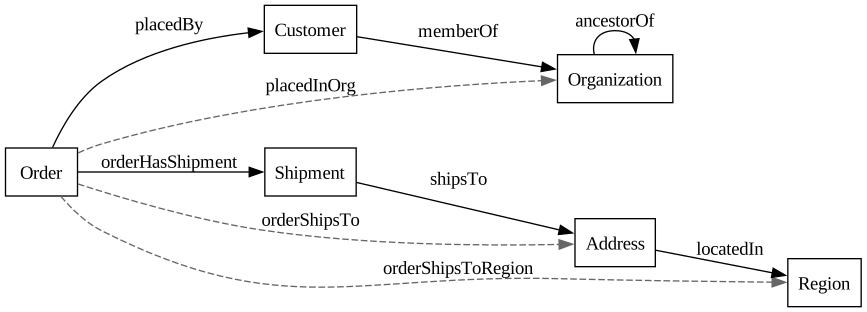
A minimal Java-style snippet to define this TBox
import java.util.*;
import com.e2eq.ontology.core.OntologyRegistry;
import com.e2eq.ontology.core.OntologyRegistry.*;
Map<String, ClassDef> classes = Map.of(
"Order", new ClassDef("Order", Set.of(), Set.of(), Set.of()),
"Customer", new ClassDef("Customer", Set.of(), Set.of(), Set.of()),
"Organization", new ClassDef("Organization", Set.of(), Set.of(), Set.of()),
"Shipment", new ClassDef("Shipment", Set.of(), Set.of(), Set.of()),
"Address", new ClassDef("Address", Set.of(), Set.of(), Set.of()),
"Region", new ClassDef("Region", Set.of(), Set.of(), Set.of())
);
Map<String, PropertyDef> props = Map.of(
"placedBy", new PropertyDef("placedBy", Optional.of("Order"), Optional.of("Customer"), false, Optional.empty(), false),
"memberOf", new PropertyDef("memberOf", Optional.of("Customer"), Optional.of("Organization"), false, Optional.empty(), false),
"orderHasShipment", new PropertyDef("orderHasShipment", Optional.of("Order"), Optional.of("Shipment"), false, Optional.empty(), false),
"shipsTo", new PropertyDef("shipsTo", Optional.of("Shipment"), Optional.of("Address"), false, Optional.empty(), false),
"locatedIn", new PropertyDef("locatedIn", Optional.of("Address"), Optional.of("Region"), false, Optional.empty(), false),
"ancestorOf", new PropertyDef("ancestorOf", Optional.of("Organization"), Optional.of("Organization"), false, Optional.empty(), true), // transitive
// implied predicates (no domain/range required, but you may add them for validation)
"placedInOrg", new PropertyDef("placedInOrg", Optional.of("Order"), Optional.of("Organization"), false, Optional.empty(), false),
"orderShipsTo", new PropertyDef("orderShipsTo", Optional.of("Order"), Optional.of("Address"), false, Optional.empty(), false),
"orderShipsToRegion", new PropertyDef("orderShipsToRegion", Optional.of("Order"), Optional.of("Region"), false, Optional.empty(), false)
);
List<PropertyChainDef> chains = List.of(
new PropertyChainDef(List.of("placedBy", "memberOf"), "placedInOrg"),
new PropertyChainDef(List.of("orderHasShipment", "shipsTo"), "orderShipsTo"),
new PropertyChainDef(List.of("orderShipsTo", "locatedIn"), "orderShipsToRegion"),
new PropertyChainDef(List.of("placedInOrg", "ancestorOf"), "placedInOrg")
);
OntologyRegistry.TBox tbox = new OntologyRegistry.TBox(classes, props, chains);
OntologyRegistry registry = OntologyRegistry.inMemory(tbox);Materializing edges for an Order
-
Explicit facts for order O1:
-
O1 placedBy C9
-
C9 memberOf OrgA
-
O1 orderHasShipment S17
-
S17 shipsTo Addr42
-
Addr42 locatedIn RegionWest
-
OrgA ancestorOf OrgParent
-
Inferred edges after running the reasoner for O1’s snapshot:
-
O1 placedInOrg OrgA
-
O1 placedInOrg OrgParent (via closure with ancestorOf)
-
O1 orderShipsTo Addr42
-
O1 orderShipsToRegion RegionWest
How queries become simple and fast
-
List Orders for Organization OrgParent (including children):
-
Instead of joining Order → Customer → Org and recursing org.parent, run a single filter using materialized edges.
import com.mongodb.client.model.Filters;
import org.bson.conversions.Bson;
import com.e2eq.ontology.policy.ListQueryRewriter;
Bson base = Filters.eq("status", "OPEN");
Bson rewritten = rewriter.rewriteForHasEdge(base, tenantId, "placedInOrg", "OrgParent");
// Use rewritten in your Mongo find-
List Orders shipping to RegionWest:
Bson rewritten2 = rewriter.rewriteForHasEdge(Filters.empty(), tenantId, "orderShipsToRegion", "RegionWest");Why this is resilient
-
If tomorrow Customer becomes AccountContact and the organization model gains Divisions and multi-parent org graphs, you only adjust predicates and chains.
-
Queries that rely on placedInOrg or orderShipsToRegion remain unchanged and fast, because edges are re-materialized by OntologyMaterializer.
Evolving the model: add Fulfillment
New concepts
-
FulfillmentTask: a unit of work to pick/pack/ship order lines
-
FulfillmentUnit: a logical grouping (e.g., wave, tote, parcel)
New predicates
-
fulfills(task, order)
-
realizedBy(order, fulfillmentUnit)
-
taskProduces(task, shipment)
New chains (implied)
-
fulfills ⇒ derived edge from task to order; combine with taskProduces to connect order to shipment without touching Order fields:
-
fulfills ∘ taskProduces ⇒ orderHasShipment
-
realizedBy ∘ orderHasShipment ⇒ fulfilledByUnit
-
If (order --realizedBy-→ fu) and (order --orderHasShipment-→ s) ⇒ (fu --fulfillsShipment-→ s) or simply (order --fulfilledByUnit-→ fu)
These chains let you introduce warehouse concepts without changing how UI filters orders by organization or ship-to region. Existing queries still operate via placedInOrg and orderShipsToRegion.
Evolving further: add Returns
New concepts
-
ReturnRequest, ReturnItem, RMA
New predicates
-
hasReturn(order, returnRequest)
-
returnFor(returnItem, order)
-
returnRma(returnRequest, rma)
New chains (implied)
-
hasReturn ⇒ openReturnOnOrg via placedInOrg:
-
hasReturn ∘ placedInOrg ⇒ returnPlacedInOrg
-
returnFor ∘ orderShipsToRegion ⇒ returnShipsToRegion
Example queries with new capabilities
-
List Orders with open returns in OrgParent:
Bson r = rewriter.rewriteForHasEdge(Filters.empty(), tenantId, "returnPlacedInOrg", "OrgParent");-
List Returns associated to Orders shipping to RegionWest:
Bson r2 = rewriter.rewriteForHasEdge(Filters.empty(), tenantId, "returnShipsToRegion", "RegionWest");Comparison with direct references (@Reference/EntityReference)
-
With direct references you would encode fields like Order.customer, Order.shipments, Shipment.address, Address.region and then implement multi-hop traversals in code or $lookup pipelines, rewriting them whenever you add Fulfillment or Returns.
-
With ontology edges, you keep predicates stable and add property chains. Existing list and policy queries keep working and typically become faster due to single-hop filters on an indexed edges collection.
Operational tips for this scenario
-
Ensure EdgeDao has indexes on (tenantId, p, dst) and (tenantId, src, p).
-
Use OntologyMaterializer when Order, Shipment, Customer, Address, or org hierarchy changes to keep edges fresh.
-
Keep provenance in edge.prov (rule, inputs) so you can recompute or retract edges when source data changes.
42. Visualizing ontology edges and provenance
This section uses simple diagrams to illustrate how explicit facts (edges) combine with ontology rules (property chains, inverses, transitivity) to produce inferred edges, and how provenance explains each inference.
42.1. Example graph: Orders, Customers, Organizations
We start from the running example introduced above. The following diagram shows explicit edges in solid lines and inferred edges as dotted lines.

You can add more nodes and predicates (shipments, addresses, regions) and draw similar diagrams. The important idea is that you query for semantics (placedInOrg), while the reasoner ensures the materialized edges exist according to the rules.
42.2. Example graph: Shipments and Regions

42.3. What is provenance and how to read it
Every inferred edge includes a provenance payload prov that answers “why does this edge exist?”. It captures the rule used and the contributing input edges. With recent enrichments, inputs also include type information when available.
Here is an example edge document (simplified JSON for clarity) for the inference O1 --placedInOrg-→ OrgA via the chain placedBy ∘ memberOf ⇒ placedInOrg:
{
"tenantId": "t1",
"src": "O1",
"srcType": "Order",
"p": "placedInOrg",
"dst": "OrgA",
"dstType": "Organization",
"inferred": true,
"prov": {
"rule": "chain",
"inputs": {
"chain": ["placedBy", "memberOf"],
"inputs": [
{ "src": "O1", "srcType": "Order", "p": "placedBy", "dst": "C9", "dstType": "Customer" },
{ "src": "C9", "srcType": "Customer", "p": "memberOf", "dst": "OrgA", "dstType": "Organization" }
]
}
},
"ts": "2025-10-20T10:01:02Z"
}Notes: - rule indicates which inference rule created the edge (chain, inverse, symmetric, transitive, subPropertyOf). - inputs lists the contributing explicit edges (or minimal hops) that justified the inference. When types are known from domain/range or snapshots, srcType and dstType are included. - This provenance enables audit, troubleshooting, and selective recomputation when inputs change.
For a transitive example, an O1 --placedInOrg-→ OrgParent edge could have:
{
"prov": {
"rule": "transitive",
"inputs": {
"prop": "placedInOrg",
"inputs": [ { "src": "O1", "p": "placedInOrg", "dst": "OrgA", "srcType": "Order", "dstType": "Organization" } ]
}
}
}| Provenance is for explanation and maintenance. The runtime edges you query on remain simple (src, p, dst) with optional type fields for validation and indexing. |
42.4. Querying Ontologies
Quantum provides several ways to leverage ontology relationships in your queries and business logic.
42.4.1. BIAPI Query Language Functions: hasEdge and hasIncomingEdge
The query language (BIAPIQuery) includes built-in functions to filter entities based on their ontology edges. These are the preferred way to perform ontology-aware queries from REST APIs or permission rules.
-
hasEdge(predicate, dst): Filters for entities (sources) that have an edge pointing TO a specific destination. -
hasIncomingEdge(predicate, src): Filters for entities (targets) that have an edge coming FROM a specific source.
Example BIAPI queries:
# Find orders placed in OrgA
hasEdge(placedInOrg, "OrgA")
# Find locations accessible by a specific associate
hasIncomingEdge(canAccessLocation, "associate-123")
# Combine with other filters
hasEdge(placedInOrg, "OrgA") && status:PENDING42.4.2. Programmatic Querying with EdgeDao
For more complex scenarios in Java code, you can use the EdgeDao directly:
@Inject
EdgeDao edgeDao;
// Find all destination IDs for a given source and predicate
Set<String> targetIds = edgeDao.dstIdsBySrc(tenantId, "Associate", associateId, "canAccessLocation");
// Find all source IDs for a given destination and predicate
Set<String> sourceIds = edgeDao.srcIdsByDst(tenantId, "canAccessLocation", locationId);43. Integrating Ontology with Morphia, Permissions, and Multi-tenancy
This section focuses on integration and developer experience: how ontology edges flow into Morphia-based repositories and the permission rule language, while remaining fully multi-tenant and secure.
43.1. Big picture: where ontology fits
-
Write path (materialization):
-
Your domain code persists entities with minimal direct references.
-
An OntologyMaterializer runs when entities change to derive and upsert edges into the edges collection (per tenant).
-
Policy path (authorization and list filters):
-
The permission rule language evaluates the caller’s SecurityContext/RuleContext and produces logical filters.
-
When a rule asks for a semantic relationship (hasEdge), we use ListQueryRewriter + EdgeDao to translate that into efficient Mongo filters over ids.
-
Read path (queries):
-
Morphia repos apply the base data-domain filters and the rewritten ontology constraint to queries, producing fast lists without deep joins.
43.2. Rule language: add hasEdge()
We introduce a policy function/operator to reference ontology edges directly from rules:
-
Signature: hasEdge(predicate, dstIdOrVar)
-
predicate: String name of the ontology predicate (e.g., "placedInOrg", "orderShipsToRegion").
-
dstIdOrVar: Either a concrete id/refName or a variable resolved from RuleContext (e.g., principal.orgRefName, request.region).
-
Semantics: The rule grants/filters entities for which an edge (tenantId, src = entity._id, p = predicate, dst = resolvedDst) exists.
-
Composition: hasEdge can be combined with existing rule clauses (and/or/not) and other filters (states, tags, ownerId, etc.).
Example rule snippets (illustrative):
-
Allow viewing Orders in the caller’s org (including ancestors via ontology closure):
-
allow VIEW Order when hasEdge("placedInOrg", principal.orgRefName)
-
Restrict list to Orders shipping to a region chosen in request:
-
allow LIST Order when hasEdge("orderShipsToRegion", request.region)
Under the hood, policy evaluation uses ListQueryRewriter.hasEdge(…), which converts hasEdge into a Morphia Filter limiting _id to the allowed source ids; compose it with your base filter via Filters.and(…).
43.3. Passing tenantId correctly
-
Always resolve tenantId from RuleContext/SecurityContext (the same source your repos use for realm/database selection).
-
EdgeDao and ListQueryRewriter already accept tenantId; never cross tenant boundaries when reading edges.
-
Index recommendation (per tenant):
-
(tenantId, p, dst)
-
(tenantId, src, p)
43.4. Morphia repository integration patterns
The goal is zero-friction usage in existing repos without invasive changes.
Option A: Apply ontology constraints in code paths that already construct BSON filters.
-
If your repo method builds a Bson filter before calling find(), wrap it through rewriter:
Bson base = Filters.and(existingFilter1, existingFilter2);
Bson rewritten = hasEdgeRequested
? rewriter.rewriteForHasEdge(base, tenantId, predicate, dst)
: base;
var cursor = datastore.getDatabase().getCollection(coll).find(rewritten);Option B: Apply ontology constraints to Morphia Filter/Query via ids.
-
When the repo uses Morphia’s typed query API instead of BSON, pre-compute the id set and constrain by _id:
Set<String> ids = edgeDao.srcIdsByDst(tenantId, predicate, dst);
if (ids.isEmpty()) {
return List.of(); // short-circuit
}
query.filter(Filters.in("_id", ids));Option C: Centralize in a tiny helper for developer ergonomics.
-
Provide one helper in your application layer, invoked wherever policies inject additional constraints:
public final class OntologyFilterHelper {
private final ListQueryRewriter rewriter;
public OntologyFilterHelper(ListQueryRewriter r) { this.rewriter = r; }
public Bson ensureHasEdge(Bson base, String tenantId, String predicate, String dst) {
return rewriter.rewriteForHasEdge(base, tenantId, predicate, dst);
}
}43.5. Where ontology materialization happens
-
Automatic on write via repository hook:
-
When you save or update an entity, the framework runs an internal PostPersistHook (OntologyWriteHook) that:
-
extracts explicit edges from fields/getters annotated with @OntologyProperty using a startup-built metadata cache (no per-call reflection), and
-
calls OntologyMaterializer to infer inverse, transitive, symmetric, and super-property edges and upsert them to the edges collection.
-
This is enabled by default. To disable temporarily (e.g., for bulk loads), set: ontology.auto-materialize=false
43.6. Custom Edge Providers: OntologyEdgeProvider and HierarchyListEdgeProvider
While annotations (@OntologyProperty) and property chains cover many use cases, some relationships require custom logic to determine edges. Quantum provides an SPI for implementing custom edge providers that are automatically discovered and integrated into the materialization process.
43.6.1. OntologyEdgeProvider: The Core SPI
The OntologyEdgeProvider interface allows you to contribute explicit edges for any entity instance. These edges are merged with annotation-derived edges before being passed to the reasoner.
public interface OntologyEdgeProvider {
/** @return true if this provider supports the given entity type */
boolean supports(Class<?> entityType);
/** Produce explicit edges for the given entity instance */
List<Reasoner.Edge> edges(String realmId, DataDomainInfo dataDomainInfo, Object entity);
}Implementations should be annotated with @ApplicationScoped for CDI discovery.
43.6.2. HierarchyListEdgeProvider: Handling Complex Hierarchies
A common pattern in SaaS applications is assigning users/entities to nodes in a hierarchy (e.g., Territories, Organizations) where they should also "inherit" relationships from descendant nodes. HierarchyListEdgeProvider is a specialized base class designed for this purpose.
Key features:
- Hierarchy Traversal: Automatically expands relationships through parent-child links.
- List Resolution: Resolves StaticDynamicList fields to concrete entity IDs.
- Change Tracking: Informs the framework which entities need re-materialization when a hierarchy node or list changes.
Example: Territory → Location Materialization
Consider a scenario where:
1. Associates are assigned to Territories.
2. Territories form a hierarchy.
3. Each Territory has a list of Locations.
4. We want to materialize Associate --canAccessLocation-→ Location edges.
@ApplicationScoped
public class TerritoryLocationEdgeProvider
extends HierarchyListEdgeProvider<Territory, Territory, Location> {
@Inject TerritoryRepo territoryRepo;
@Inject LocationListResolver listResolver;
@Override public Class<Territory> getSourceType() { return Territory.class; }
@Override public String getPredicate() { return "hasLocation"; }
@Override public String getTargetTypeName() { return "Location"; }
@Override
protected List<String> getAssignedNodeIds(Territory source) {
return List.of(source.getId().toString());
}
@Override
protected List<Territory> getChildNodes(ComputationContext context, String nodeId) {
return territoryRepo.getAllChildren(context.dataDomainInfo(), nodeId);
}
@Override
protected List<Location> resolveListItems(ComputationContext context, Territory node) {
return listResolver.resolve(context.dataDomainInfo(), node.getStaticDynamicList());
}
@Override
protected String extractTargetId(Location target) {
return target.getRefName();
}
}Combined with a Property Chain:
chains:
- chain: [hasTerritory, hasLocation]
implies: canAccessLocationThis setup ensures that when an Associate is linked to a Territory, they automatically get canAccessLocation edges to all locations in that territory and its descendants.
43.6.3. When to use Property Chains vs ComputedEdgeProvider
Understanding when to use property chains versus ComputedEdgeProvider is critical for modeling your ontology effectively. This section provides clear guidance on which approach to use.
Property Chains: Use for Sequential Multi-Hop Traversals
Property chains are ideal when your derived relationship follows a fixed sequence of predicates where each step is a simple, direct relationship.
Property chains handle:
-
Multi-hop paths through direct predicates: Deriving relationships through intermediate entities
-
Example:
Order --placedBy→ Customer --memberOf→ Organization ⇒ Order --placedInOrg→ Organization -
Example:
Order --orderHasShipment→ Shipment --shipsTo→ Address ⇒ Order --orderShipsTo→ Address
-
-
Transitive closure within chains: When one step is a transitive property
-
Example:
Order --placedInOrg→ Org1 --ancestorOf→ Org2 ⇒ Order --placedInOrg→ Org2 -
Propagates derived relationships up hierarchies automatically
-
-
Chain composition: Output of one chain feeds another
-
Chain 1:
[orderHasShipment, shipsTo]⇒orderShipsTo -
Chain 2:
[orderShipsTo, locatedIn]⇒orderShipsToRegion
-
Property chain example (YAML):
chains:
- chain: [placedBy, memberOf]
implies: placedInOrg
- chain: [orderHasShipment, shipsTo]
implies: orderShipsTo
- chain: [orderShipsTo, locatedIn]
implies: orderShipsToRegionProperty chain limitations:
-
Chains must be regular (non-transitive predicates in the chain itself)
-
Chains are strict sequential paths - no branching, alternation (
OR), or conditional logic -
No backtracking or negation
-
Cannot involve external data lookups or dynamic queries during computation
-
Cannot handle collection expansion where one entity has a list that must be resolved
ComputedEdgeProvider: Use for Complex Logic Beyond Sequential Paths
Use ComputedEdgeProvider when your derived edges require:
-
Database queries during computation: Loading related entities to determine targets
-
Collection/list resolution: The target set comes from resolving a list (static or dynamic)
-
Conditional logic: Different targets based on entity state or business rules
-
Non-sequential traversals: Logic that doesn’t follow a simple A→B→C pattern
When to use ComputedEdgeProvider:
| Scenario | Why Property Chains Won’t Work |
|---|---|
Associate → canSeeLocation → Location (via Territory hierarchy + LocationList) |
Requires loading the Territory, expanding to children, then resolving each Territory’s LocationList - involves list resolution |
User → canAccessCustomer → Customer (via assigned Regions and dynamic filters) |
Requires executing dynamic queries based on filter strings stored in Region entities |
Manager → canViewReport → Report (where Reports are determined by Department + Role combinations) |
Requires conditional logic based on both hierarchy position AND role assignments |
Entity → derivedTarget → Target (where targets depend on runtime configuration) |
Requires external lookups that chains cannot perform |
HierarchyListEdgeProvider: Specialized for Hierarchy + List Pattern
HierarchyListEdgeProvider<S, H, T> is a specialized base class for the common pattern:
-
Get assigned hierarchy nodes from source entity (e.g., Associate’s Territories)
-
Expand to include all child nodes (hierarchy traversal)
-
Resolve each node’s list (static or dynamic)
-
Create edges to the resolved items
Use HierarchyListEdgeProvider when:
-
Your source entity is assigned to hierarchy nodes (Territories, Departments, Regions)
-
Each hierarchy node has an associated list of target entities
-
The relationship should include targets from the assigned node AND all descendants
-
You need provenance tracking of which nodes and lists contributed to each edge
Example use cases:
-
Associate → canSeeLocation → Locationvia Territory hierarchy -
SalesRep → canAccessAccount → Accountvia Region hierarchy -
Employee → canViewDocument → Documentvia Department hierarchy
Example implementation:
@ApplicationScoped
public class AssociateCanSeeLocationProvider
extends HierarchyListEdgeProvider<Associate, Territory, Location> {
@Inject TerritoryRepo territoryRepo;
@Inject LocationListResolver listResolver;
@Override protected Class<Associate> getSourceType() { return Associate.class; }
@Override protected String getPredicate() { return "canSeeLocation"; }
@Override protected String getTargetTypeName() { return "Location"; }
@Override protected String getHierarchyTypeName() { return "Territory"; }
@Override
protected List<String> getAssignedNodeIds(Associate source) {
return source.getAssignedTerritories().stream()
.map(ref -> ref.getId().toString())
.toList();
}
@Override
protected Optional<Territory> loadHierarchyNode(ComputationContext ctx, String nodeId) {
return territoryRepo.findById(new ObjectId(nodeId));
}
@Override
protected List<Territory> getChildNodes(ComputationContext ctx, String nodeId) {
return territoryRepo.getAllChildren(new ObjectId(nodeId));
}
@Override
protected List<Location> resolveListItems(ComputationContext ctx, Territory node) {
return listResolver.resolve(ctx.getDataDomainInfo(), node.getStaticDynamicList());
}
@Override
protected String extractTargetId(Location target) {
return target.getId().toString();
}
}Decision Guide
| Approach | When to Use | Example |
|---|---|---|
Property Chain (YAML) |
Sequential multi-hop through direct predicates; no external data lookups needed |
|
Property Chain with Transitive |
Hierarchy rollup where relationships are direct predicates |
|
ComputedEdgeProvider |
Complex logic, conditional branching, or external data lookups |
Permission edges based on roles + entity state |
HierarchyListEdgeProvider |
Source assigned to hierarchy nodes, each with associated target lists |
|
Important Notes
-
Source types must be @OntologyClass annotated: ComputedEdgeProvider implementations will show a warning at startup if their source type lacks
@OntologyClass. The edges will not be processed during entity persistence. -
Providers are automatically discovered: Any
@ApplicationScopedclass extendingComputedEdgeProvideris automatically discovered and registered at startup. -
Provenance is tracked:
ComputedEdgeProviderandHierarchyListEdgeProviderautomatically track which inputs contributed to each computed edge, enabling smart incremental updates. -
Combine approaches when needed: You can use property chains for some relationships and computed providers for others in the same application.
43.6.4. Extending materialization with ComputedEdgeProvider (Advanced)
While OntologyEdgeProvider is sufficient for simple, direct edges, many real-world use cases require edges computed from complex logic, such as hierarchy traversal or dynamic list resolution. ComputedEdgeProvider is a more robust base class that provides:
-
Provenance tracking: Records why an edge exists (which hierarchy nodes and lists were involved).
-
Incremental updates: Tracks dependencies to know exactly which edges to recompute when a source changes.
-
Specialized hierarchy support:
HierarchyListEdgeProvidersimplifies implementing common patterns like "User can see Locations in their assigned Territories (and descendants)".
Example: Hierarchy-based Edge Provider
@ApplicationScoped
public class AssociateCanSeeLocationProvider
extends HierarchyListEdgeProvider<Associate, Territory, Location> {
@Inject TerritoryRepo territoryRepo;
@Inject LocationListResolver listResolver;
@Override protected Class<Associate> getSourceType() { return Associate.class; }
@Override protected String getPredicate() { return "canSeeLocation"; }
@Override protected String getTargetTypeName() { return "Location"; }
@Override protected String getHierarchyTypeName() { return "Territory"; }
@Override
protected List<String> getAssignedNodeIds(Associate source) {
return source.getAssignedTerritories().stream()
.map(ref -> ref.getId().toString())
.toList();
}
@Override
protected Optional<Territory> loadHierarchyNode(ComputationContext ctx, String nodeId) {
return territoryRepo.findById(new ObjectId(nodeId));
}
@Override
protected List<Territory> getChildNodes(ComputationContext ctx, String nodeId) {
return territoryRepo.getAllChildren(new ObjectId(nodeId));
}
@Override
protected List<Location> resolveListItems(ComputationContext ctx, Territory node) {
return listResolver.resolve(ctx.getDataDomainInfo(), node.getStaticDynamicList());
}
@Override
protected String extractTargetId(Location target) {
return target.getId().toString();
}
}Multi-hop and Provenance
ComputedEdgeProvider supports multi-hop capabilities by allowing providers to contribute to the overall ontology graph that is materialized. The provenance information captured by these providers includes:
-
Hierarchy Contributions: Every node traversed in a hierarchy path.
-
List Contributions: Every list (static or dynamic) resolved to find target entities.
This provenance is stored with the edge and allows the framework to perform smart, incremental recomputations when underlying data (like a Territory’s child nodes or a LocationList’s filter) changes.
43.6.5. Extending materialization with OntologyEdgeProvider (SPI)
The write hook is annotation-first and SPI-second:
-
First, it extracts explicit edges from @OntologyProperty fields/getters on the entity being saved.
-
Then, it discovers any CDI beans implementing com.e2eq.ontology.spi.OntologyEdgeProvider that support the entity type and merges their edges.
-
Finally, it persists explicit edges, prunes stale ones, and rematerializes inferred edges (inverse, subPropertyOf, transitive, symmetric).
This keeps OntologyWriteHook thin and generic while allowing domain modules to contribute additional explicit edges without changing the core.
Basic contract
-
Implementations must declare:
-
boolean supports(Class<?> entityType) — return true for the entity types you handle.
-
List<Reasoner.Edge> edges(String realmId, Object entity) — return explicit edges to add for that instance.
-
Register the implementation as a CDI bean (e.g., @ApplicationScoped) in your module; Quarkus will discover it.
-
Edges you return should use your domain refName (or id) for src/dst ids and the ontology type ids for srcType/dstType.
Example provider
@jakarta.enterprise.context.ApplicationScoped
public class UserCredentialEdgeProvider implements com.e2eq.ontology.spi.OntologyEdgeProvider {
@Override
public boolean supports(Class<?> entityType) {
return com.e2eq.framework.model.security.User.class.isAssignableFrom(entityType);
}
@Override
public java.util.List<com.e2eq.ontology.core.Reasoner.Edge> edges(String realmId, Object entity) {
var user = (com.e2eq.framework.model.security.User) entity;
String srcId = user.getRefName();
if (srcId == null || srcId.isBlank()) return java.util.List.of();
String credRef = user.getCredentialRefName();
if (credRef == null || credRef.isBlank()) return java.util.List.of();
return java.util.List.of(
new com.e2eq.ontology.core.Reasoner.Edge(
srcId, "User", "userHasCredential", credRef, "CredentialUserIdPassword", false, java.util.Optional.empty()
)
);
}
}Merging behavior and lifecycle
-
The hook calls all matching providers and concatenates their edges with the annotation-derived ones.
-
It computes the diff against prior explicit edges for the same source and prunes any stale explicit edges per predicate.
-
Then it invokes the reasoner/materializer to compute and upsert inferred edges.
-
Finally, it executes cascade policies (e.g., ORPHAN_REMOVE/DELETE) declared on @OntologyProperty, using the prior vs. new explicit state.
ID and type resolution tips
-
srcId: By default, the hook resolves an entity id using getRefName(), getId(), or toString() fallback. Prefer setting refName on your entities.
-
dstId: You may point to another entity by refName string (no fetch required) if your domain guarantees uniqueness per type and tenant.
-
srcType/dstType: Use the @OntologyClass(id=…) values for the types (e.g., "User", "CredentialUserIdPassword").
-
realmId: The framework passes the current tenant/realm id; include it when persisting or resolving external references if needed.
Testing your provider
-
You can write a Quarkus test that persists a source and any targets, calls OntologyWriteHook.afterPersist(tenant, entity), and asserts that:
-
the annotation-derived edges exist, and
-
your provider-derived edges are also present and marked as explicit (inferred=false).
Migration guidance
-
Start annotation-first. Only add a provider when edges depend on computed fields, cross-aggregate ids, or non-entity sources.
-
Keep providers small and focused per entity type. Avoid duplicating edges that annotations already cover.
-
If multiple providers contribute the same edge, the repo upsert is idempotent.
-
Intermediates and re-materialization:
-
If you change entities that are not the source but affect chains (e.g., Address.region, Customer.memberOf), those sources will get updated the next time they are saved. For immediate consistency across a tenant, run the re-materialization job (see below).
-
Provide nightly/backfill jobs for recomputing edges across a tenant when ontology rules evolve.
43.6.6. Configuration
# default is true
ontology.auto-materialize=true43.6.7. Example: annotate and save — edges are materialized automatically
@OntologyClass(id = "Order")
public class Order {
private String refName;
@OntologyProperty(id = "placedBy", functional = true)
public Customer getCustomer() { return customer; }
}
@OntologyClass(id = "Customer")
public class Customer {
private String refName;
@OntologyProperty(id = "memberOf")
public Organization getOrg() { return org; }
}-
Saving an Order will automatically create explicit placedBy and, via chains/inference, placedInOrg and inverse edges as defined in your ontology registry. No manual calls to OntologyMaterializer.apply(…) are required.
43.7. Security and multi-tenant considerations
-
Edge rows include tenantId and should be validated/filtered by tenant on every operation.
-
Never trust a client-supplied predicate or destination id blindly; combine with rule evaluation and whitelist allowed predicates per domain if needed.
-
For shared resources across tenants (rare), model cross-tenant permissions at the policy layer; don’t reuse edges across tenants unless explicitly designed.
43.8. Developer workflow and DX checklist
-
When writing a rule: use hasEdge("<predicate>", <rhs>) and rely on RuleContext variables for the destination when possible.
-
When writing a list endpoint: read optional ontology filter hints from the policy layer; if present, apply ensureHasEdge(…) before find().
-
When changing domain relationships: update predicates/chains and re-materialize; list/policy code stays unchanged.
-
When indexing a new tenant: include the edges indexes early and validate via a smoke test query using ListQueryRewriter.
43.9. Cookbook: end-to-end example with Orders + Org
-
Policy: allow LIST Order when hasEdge("placedInOrg", principal.orgRefName)
-
Request lifecycle: 1) Security filter builds SecurityContext and RuleContext with tenantId and principal. 2) Policy evaluation returns a directive to constrain by hasEdge("placedInOrg", orgRefName). 3) Repo builds base filter (state != ARCHIVED, etc.). 4) Repo calls OntologyFilterHelper.ensureHasEdge(base, tenantId, "placedInOrg", orgRefName). 5) Mongo executes a single-hop query using materialized edges; results respect both policy and multi-tenancy.
43.10. Migration notes for teams using @Reference
-
Keep existing references for write-side integrity and local joins where simple.
-
Introduce ontology edges on hot read paths first; update policy rules to hasEdge and verify results.
-
Gradually replace deep $lookup traversals with hasEdge-based rewrites.
-
Ensure materialization hooks are deployed before removing data fields used as inputs to the ontology.
44. Primer: First-time guide to core relationship semantics
If you are new to ontology terms, the following quick explanations will help you build intuition. Each concept explains what it means, a tiny example, and how it affects queries using hasEdge.
-
Functional property
-
What it means: For a given source entity, there is at most one target for this property. Think “single-valued.”
-
Example: placedBy(Order, Customer) is functional because an Order is placed by exactly one Customer.
-
Why it matters: On writes, the latest value replaces any previous one. In storage, you can enforce uniqueness for (tenantId, src, p). Queries are simpler because there’s at most one matching edge per source.
-
In practice: When you save an Order with a different placedBy, the old edge is replaced so hasEdge("placedBy", customerX) reflects the latest truth.
-
Transitive property
-
What it means: The relationship “chains through” intermediates. If A relates-to B and B relates-to C with the same property p, then A relates-to C by p as well.
-
Example: ancestorOf(Org, Org) is transitive: OrgA ancestorOf OrgB and OrgB ancestorOf OrgC implies OrgA ancestorOf OrgC.
-
Why it matters: You can answer reachability questions without specifying every hop. The system can materialize or compute the closure so queries like hasEdge("ancestorOf", OrgC) return OrgA even if the path is multiple hops.
-
In practice: Use transitive for hierarchies like parent/ancestor, partOf, locatedIn, reportsTo.
-
subPropertyOf (property hierarchy)
-
What it means: One property is a more specific form of another. If p ⊑ q (“p is a sub-property of q”), then every (s, p, o) also counts as (s, q, o).
-
Example: placedInOrg ⊑ inOrg. If an Order is placedInOrg ACME, then it is also inOrg ACME.
-
Why it matters: Queries written against the broader property (q) automatically include results from all its specializations (p). The system may materialize the super-property edges for performance.
-
In practice: You can write policies/queries once for inOrg and still match edges stored as placedInOrg.
-
inverseOf (inverse properties)
-
What it means: Two properties point in opposite directions. If p is the inverse of q, then (s, p, o) implies (o, q, s).
-
Example: parentOf ⇄ childOf. If OrgA parentOf OrgB, then OrgB childOf OrgA.
-
Why it matters: You only need to assert one direction; the system can infer the other. Queries can use whichever direction is natural.
-
In practice: If you stored parentOf, you can still query with hasEdge("childOf", OrgA) and find OrgB once inverses are materialized.
Putting it together - These traits combine. For example, placedInOrg can be declared a subPropertyOf inOrg; ancestorOf can be transitive; parentOf and childOf can be inverses. The reasoner uses these facts to materialize convenient edges so your queries remain simple and fast. - Your application code typically continues to use the same three query helpers: hasEdge, hasEdgeAny, notHasEdge. The richer semantics affect which edges exist, not how you call them.
45. New ontology features in this release
This release expands the ontology engine and query integration to support a richer, OWL‑RL–inspired subset while keeping the developer experience simple and backward compatible. The following capabilities are now available and used transparently by the materializer and query rewriter:
45.1. Feature overview
-
subClassOf (class hierarchy)
-
Model taxonomies (e.g., Order ⊑ Entity, Employee ⊑ Person). Used for validation and optional type filters.
-
subPropertyOf (property hierarchy)
-
If p ⊑ q and you assert (s, p, o), the system materializes (s, q, o). Queries on q will match p’s edges as well.
-
inverse properties
-
If p is the inverse of q, asserting (s, p, o) will materialize (o, q, s). Example: parentOf ⇄ childOf.
-
symmetric properties
-
For symmetric p, asserting (s, p, o) materializes (o, p, s). Example: peerOf between organizations.
-
transitive properties
-
For transitive p, if (s, p, m) and (m, p, o) then (s, p, o) is inferred. Typical for ancestorOf, partOf, locatedIn, memberOf within hierarchical contexts.
-
functional properties
-
For functional p, each source s has at most one destination o. Upserts replace the prior value. Useful for single-valued relations like placedBy on Order.
All inferred edges carry inferred=true and provenance containing the rule used (e.g., transitive, inverse, subPropertyOf). These edges live in the same collection and are fully queryable.
45.2. Business problems solved
-
E‑commerce organizational access
-
Problem: “Show me all orders placed in ACME (including subsidiaries).”
-
Solution: Define placedBy, memberOf, placedInOrg with chain placedBy ∘ memberOf ⇒ placedInOrg, and make ancestorOf transitive. Either materialize closure with a chain placedInOrg ∘ ancestorOf ⇒ placedInOrg or use p being transitive. Queries use hasEdge("placedInOrg", orgId).
-
HR management
-
Problem: “List employees who report to VP_X directly or indirectly.”
-
Solution: Define reportsTo as transitive. Query hasEdge("reportsTo", "VP_X").
-
Third‑party and data lineage
-
Problem: “Which datasets are derived from Source S?”
-
Solution: Define derivedFrom as transitive and inverse derivedInto. Record symmetric peerOf for bidirectional partnerships where relevant.
-
Supplier networks (supply chain)
-
Problem: “Find parts supplied by a vendor’s parent company’s peers.”
-
Solution: Use subPropertyOf to roll up specialized edges into a common supplies predicate, define parentOf/childOf inverses, and peerOf symmetric at the org level.
45.3. How to code it with current APIs
Below are concise examples showing how to define the ontology, materialize inferences, and query with existing components. These mirror the types already present in this repository and require no grammar changes.
45.3.1. 1) Define ontology (programmatic TBox)
A small TBox-level view of the classes and predicates we define:
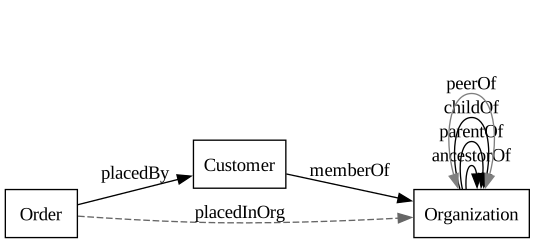
Java (at startup, e.g., in a CDI producer):
@Produces @Singleton
public OntologyRegistry ontologyRegistry() {
Map<String, OntologyRegistry.ClassDef> classes = Map.of(
"Order", new OntologyRegistry.ClassDef("Order", Set.of(), Set.of(), Set.of()),
"Customer", new OntologyRegistry.ClassDef("Customer", Set.of(), Set.of(), Set.of()),
"Organization",new OntologyRegistry.ClassDef("Organization", Set.of(), Set.of(), Set.of())
);
Map<String, OntologyRegistry.PropertyDef> props = new HashMap<>();
// Single-valued ⇒ functional
props.put("placedBy", new OntologyRegistry.PropertyDef(
"placedBy", Optional.of("Order"), Optional.of("Customer"), false, Optional.empty(),
false, /*transitive*/ false, /*symmetric*/ true /*functional*/, Set.of()
));
props.put("memberOf", new OntologyRegistry.PropertyDef(
"memberOf", Optional.of("Customer"), Optional.of("Organization"), false, Optional.empty(),
false, false, false, Set.of()
));
props.put("placedInOrg",new OntologyRegistry.PropertyDef(
"placedInOrg", Optional.of("Order"), Optional.of("Organization"), false, Optional.empty(),
false, false, false, Set.of("inOrg") // subPropertyOf example
));
props.put("inOrg", new OntologyRegistry.PropertyDef(
"inOrg", Optional.of("Order"), Optional.of("Organization"), false, Optional.empty(),
false, false, false, Set.of()
));
// Transitive ancestor relation
props.put("ancestorOf", new OntologyRegistry.PropertyDef(
"ancestorOf", Optional.of("Organization"), Optional.of("Organization"), false, Optional.empty(),
true, /*transitive*/ false, false, Set.of()
));
// Inverses and symmetric
props.put("parentOf", new OntologyRegistry.PropertyDef(
"parentOf", Optional.of("Organization"), Optional.of("Organization"), false, Optional.of("childOf"),
false, false, false, Set.of()
));
props.put("childOf", new OntologyRegistry.PropertyDef(
"childOf", Optional.of("Organization"), Optional.of("Organization"), true, Optional.empty(),
false, false, false, Set.of()
));
props.put("peerOf", new OntologyRegistry.PropertyDef(
"peerOf", Optional.of("Organization"), Optional.of("Organization"), false, Optional.empty(),
false, /*transitive*/ true, /*symmetric*/ false, /*functional*/ Set.of()
));
List<OntologyRegistry.PropertyChainDef> chains = List.of(
// Order --placedBy--> Customer --memberOf--> Org ⇒ Order --placedInOrg--> Org
new OntologyRegistry.PropertyChainDef(List.of("placedBy", "memberOf"), "placedInOrg"),
// Include ancestor closure for placedInOrg results
new OntologyRegistry.PropertyChainDef(List.of("placedInOrg", "ancestorOf"), "placedInOrg")
);
return OntologyRegistry.inMemory(new OntologyRegistry.TBox(classes, props, chains));
}Notes: - subPropertyOf is modeled via the PropertyDef.subPropertyOf set. - Inverse and symmetric are encoded in PropertyDef.inverseOf and PropertyDef.symmetric. - Transitivity is toggled via PropertyDef.transitive.
45.3.2. 2) Materialize inferences when data changes
Use OntologyMaterializer or call the Reasoner directly and upsert edges via OntologyEdgeRepo.
@Inject ForwardChainingReasoner reasoner;
@Inject OntologyRegistry ontologyRegistry;
@Inject OntologyEdgeRepo edgeRepo;
public void onOrderSaved(String tenant, String orderId, String customerId, String orgId) {
List<Reasoner.Edge> explicit = List.of(
new Reasoner.Edge(orderId, "Order", "placedBy", customerId, "Customer", false, Optional.empty()),
new Reasoner.Edge(customerId, "Customer", "memberOf", orgId, "Organization", false, Optional.empty())
);
Reasoner.EntitySnapshot snap = new Reasoner.EntitySnapshot(tenant, orderId, "Order", explicit);
Reasoner.InferenceResult out = reasoner.infer(snap, ontologyRegistry);
for (Reasoner.Edge e : out.addEdges()) {
Map<String,Object> prov = e.prov().map(p -> Map.<String,Object>of("rule", p.rule(), "inputs", p.inputs())).orElse(Map.of());
edgeRepo.upsert(tenant, e.srcType(), e.srcId(), e.p(), e.dstType(), e.dstId(), true, prov);
}
}The materializer computes and persists: - subPropertyOf roll‑ups (e.g., placedInOrg ⊑ inOrg ⇒ write inOrg) - inverse/symmetric counterparts - transitive closures (bounded to the snapshot inputs; you can also chain for closures)
45.3.3. 3) Query with ListQueryRewriter (Quarkus/Morphia)
Use hasEdge/hasEdgeAny/notHasEdge to turn ontology constraints into Morphia filters over your entity collection. The rewriter internally fetches the set of source ids from the edge store and builds an in("refName", …) filter that composes with your attribute predicates.
@Inject ListQueryRewriter queryRewriter;
@Inject MorphiaDatastore datastore;
public List<TestOrder> openOrdersIn(String tenant, String orgId) {
var status = dev.morphia.query.filters.Filters.eq("status", "OPEN");
var inOrg = queryRewriter.hasEdge(tenant, "placedInOrg", orgId);
var combined = dev.morphia.query.filters.Filters.and(status, inOrg);
return datastore.find(TestOrder.class).filter(combined).iterator().toList();
}To include multiple orgs:
var f = queryRewriter.hasEdgeAny(tenant, "placedInOrg", List.of("ORG-ACME", "ORG-GLOBEX"));To exclude restricted orgs:
var f = queryRewriter.notHasEdge(tenant, "placedInOrg", "ORG-RESTRICTED");45.3.4. Functional properties at write time
For single‑valued relationships declared functional, configure a unique index over (tenantId, src, p) in your edge store (or rely on repo semantics) and treat upserts as replacements.
Practical guidance: - Mark naturally single‑valued links functional (placedBy, primaryOwner). - On write, remove or overwrite any prior dst for the same (tenant, src, p).
45.4. Backward compatibility and migration
-
Grammar/API: No changes needed. The same hasEdge/hasEdgeAny/notHasEdge functions work; results simply become more expressive as ontology features are enabled.
-
Feature flags: You may enable features per property (e.g., transitive) gradually. Queries remain stable.
-
Provenance: Keep prov so you can re‑compute or retract inferred edges when inputs or rules change.
45.5. Troubleshooting and tips
-
Empty result from hasEdge: Means no matching edges exist; check whether inferences are being materialized for the predicate you expect.
-
Tenant scoping: All repo calls include tenantId; ensure you pass the correct tenant in both write and read paths.
-
Indexes: For heavy reads, ensure compound indexes on (tenantId, p, dst) and (tenantId, src, p). For functional, consider a unique (tenantId, src, p).
-
Testing: Use Quarkus @QuarkusTest to wire CDI and a test OntologyRegistry producer. Populate explicit edges, run the reasoner, then assert with the repo and query rewriter as shown in the integration tests included with the repository.
46. Model-first ontology with annotations and MorphiaOntologyLoader
This section shows how to use your Morphia model classes as the source of truth for the ontology. You annotate model classes/fields to declare ontology concepts and property traits; at startup, MorphiaOntologyLoader scans MorphiaDatastore.getMapper() to build the OntologyRegistry automatically.
46.1. Why model-first?
-
Single source of truth: semantics live next to the data model; less drift between code and config.
-
Safer refactors: renames/types evolve in code and the ontology follows.
-
No separate YAML/JSON needed for most use cases; optional overrides remain possible later if needed.
46.2. Annotations overview
Two lightweight annotations are used on model classes and fields. They are provided by quantum-ontology-core and can be added to any Morphia-mapped entity (deriving from UnversionedBaseModel).
-
@OntologyClass
-
id: optional explicit class id (defaults to the simple class name)
-
subClassOf: optional extra parents (in addition to Java inheritance)
-
@OntologyProperty
-
id: optional explicit property id (defaults to the field name)
-
subPropertyOf: property hierarchy roll-up targets
-
inverseOf: name of the inverse property (declare on one side)
-
transitive: whether the property is transitive
-
symmetric: whether the property is symmetric
-
functional: at most one target per source (defaults to true for single-valued fields)
-
domain: override inferred domain (defaults to declaring @OntologyClass)
-
range: override inferred range (defaults to the field/element type)
-
ref: target ontology class id when this field represents a relationship to another ontology type
-
relation: the multiplicity/cardinality for the relationship (NONE, ONE_TO_ONE, ONE_TO_MANY, MANY_TO_ONE, MANY_TO_MANY)
-
edgeType: the edge label used in the ontology graph; if omitted, falls back to id or field name
-
inverseOfEdge: optional inverse edge label if you prefer naming inverses at the edge level
-
materializeEdge: when false, keeps the reference value but skips edge creation (defaults to true)
-
cascade: optional cascade policies (NONE by default). Supports ORPHAN_REMOVE, DELETE, and BLOCK_IF_REFERENCED; see below.
-
cascadeDepth: limit for recursive cascades (default 1); used by DELETE cascades to bound depth and prevent long chains
| functional is inferred true for single-valued fields and false for collections/maps unless you override it. |
46.2.1. Relationship semantics on @OntologyProperty
When a field is annotated with @OntologyProperty and declares any of ref, relation, or edgeType, the framework treats it as a relationship and will materialize an ontology edge for it on persist/update.
Key attributes: - ref: Names the target ontology class id. If omitted, the loader attempts to infer it from the Java type of the field or its generic element type. - relation: Declares multiplicity. If not set, it is inferred from the field type: collections imply plural (ONE_TO_MANY), scalars imply singular (MANY_TO_ONE) by convention. - edgeType: Controls the predicate id used to write/read edges. If absent, the property id (or field name) is used. - materializeEdge: Set to false to store the reference value without creating graph edges; traversal and inferences will ignore this property.
Examples:
@OntologyClass(id = "Order")
@Entity("orders")
public class Order extends UnversionedBaseModel {
// Many orders reference one Customer (MANY_TO_ONE); name the edge explicitly
@OntologyProperty(
id = "customer",
ref = "Customer",
relation = RelationType.MANY_TO_ONE,
edgeType = "CUSTOMER_OF"
)
private String customerId; // or Customer if you store the object
}
@OntologyClass(id = "SCorp")
@Entity("scorps")
public class SCorp extends UnversionedBaseModel {
// One SCorp authorizes many Resolutions
@OntologyProperty(
id = "resolutionIds",
ref = "Resolution",
relation = RelationType.ONE_TO_MANY,
edgeType = "AUTHORIZES_RESOLUTION"
)
private List<String> resolutionIds;
}Runtime materialization (conceptual): - (Order) -[CUSTOMER_OF]→ (Customer) - (SCorp) -[AUTHORIZES_RESOLUTION]→ (Resolution)
| If ref is provided but edgeType is omitted, the system uses the property id (or field name). Consider using descriptive edge names for durability of queries. |
46.2.2. Cascading policies for relationships
Cascading is opt-in and conservative. It controls what happens to related targets and edges when a relationship is modified or a source is deleted.
Supported policies today: - ORPHAN_REMOVE: On update, when an element is removed from a collection (or a singular reference is replaced), the framework deletes the removed target if and only if no other sources still reference it via the same predicate. This is useful for owned child aggregates. - UNLINK: Edges are always pruned to reflect the current snapshot; you can think of this as implicit and always-on for edge hygiene.
Delete-time cascades (also supported): - DELETE: When deleting the source, also delete targets up to cascadeDepth with cycle guards. Targets are deleted only for predicates that declare DELETE on the source side. - BLOCK_IF_REFERENCED: Before deleting a target (either directly or via DELETE cascade), if the target is still referenced by another source via the same predicate, the deletion is skipped (or blocked) to preserve referential integrity.
Example (delete children when parent is deleted, with safety guards):
@OntologyClass(id = "Parent")
@Entity("parents")
public class Parent extends UnversionedBaseModel {
@OntologyProperty(
id = "children",
edgeType = "HAS_CHILD",
ref = "Child",
relation = RelationType.ONE_TO_MANY,
cascade = { CascadeType.DELETE, CascadeType.BLOCK_IF_REFERENCED },
cascadeDepth = 1 // delete only direct children
)
private List<Child> children = new ArrayList<>();
}Behavior: - Deleting a Parent removes explicit edges and, with DELETE, deletes its Child documents up to the specified depth. - With BLOCK_IF_REFERENCED, a Child that is still referenced by another Parent is not deleted; only the edge from the deleted Parent is removed. - Cycles are guarded by a visited set; depth prevents long delete chains.
See integration tests in the ontology-mongo module (CascadeDeleteIT) for expected behavior.
Example (owned children with orphan removal):
@OntologyClass(id = "Parent")
@Entity("parents")
public class Parent extends UnversionedBaseModel {
@OntologyProperty(
id = "children",
edgeType = "HAS_CHILD",
ref = "Child",
relation = RelationType.ONE_TO_MANY,
cascade = { CascadeType.ORPHAN_REMOVE }
)
private List<Child> children = new ArrayList<>();
}Behavior: - Persisting a Parent materializes edges (P --HAS_CHILD-→ C) for current children. - Removing a Child from the collection prunes the edge. If no other Parent points to that Child via HAS_CHILD, the Child entity is deleted. - If the Child is still referenced by another Parent, it is retained.
Verification: See integration tests under quantum-ontology-mongo it module (CascadeOrphanRemoveIT) covering both deletion and shared reference cases.
46.2.3. Business benefits of ontology relationships and cascade
-
Faster queries and policies: Pre-materialized edges make filtering by relationships a single indexed lookup instead of deep joins or application-side traversals.
-
Safer evolution: Edge names and ontology traits remain stable as you refactor field names/types; queries continue to work.
-
Cleaner models: Relationship intent lives in one place (@OntologyProperty) rather than being scattered across repos and services.
-
Reduced data drift: Automated edge pruning and orphan removal keep the graph consistent with your source-of-truth objects.
-
Auditability: Provenance on inferred edges documents why links exist, aiding debugging and compliance.
46.3. Example: Orders placed in an Organization (e-commerce)
Below we implement the same business example covered earlier using model annotations.
@OntologyClass(id = "Order")
@Entity(value = "orders")
public class Order extends UnversionedBaseModel {
private String status;
// Order --placedBy--> Customer (single-valued ⇒ functional)
@OntologyProperty(id = "placedBy", inverseOf = "placed", functional = true)
private Customer placedBy;
}
@OntologyClass(id = "Customer")
@Entity(value = "customers")
public class Customer extends UnversionedBaseModel {
// Customer --memberOf--> Org (transitive across org tree)
@OntologyProperty(id = "memberOf", transitive = true)
private Org memberOf;
}
@OntologyClass(id = "Organization")
@Entity(value = "orgs")
public class Org extends UnversionedBaseModel {
// Org --parentOf--> Org, with inverse childOf
@OntologyProperty(id = "parentOf", inverseOf = "childOf")
private Org parent;
// Optional symmetric relationship between peers
@OntologyProperty(id = "peerOf", symmetric = true)
private Set<Org> peers;
}Optionally, model a super-property to roll up specialized edges:
@OntologyClass(id = "Order")
public class Order extends UnversionedBaseModel {
@OntologyProperty(id = "placedBy", inverseOf = "placed", functional = true)
private Customer placedBy;
// Roll-up predicate for org membership of orders; placedInOrg ⊑ inOrg
@OntologyProperty(id = "placedInOrg", subPropertyOf = {"inOrg"})
private Org inOrgDirect;
}With these annotations in place, the loader will infer: - Classes: Order, Customer, Organization (+ hierarchy from Java inheritance) - Properties: placedBy (functional), memberOf (transitive), parentOf ⇄ childOf (inverse), peerOf (symmetric) - subPropertyOf: placedInOrg ⊑ inOrg (if declared)
46.4. How the registry is produced (Quarkus CDI)
OntologyCoreProducers wires MorphiaOntologyLoader by default. On startup it scans your models and produces a singleton OntologyRegistry.
@ApplicationScoped
public class OntologyCoreProducers {
@Inject MorphiaDatastore morphiaDatastore;
@Produces @Singleton
public OntologyRegistry ontologyRegistry() {
try {
MorphiaOntologyLoader loader = new MorphiaOntologyLoader(morphiaDatastore);
OntologyRegistry reg = loader.load();
return isEmpty(reg) ? emptyRegistry() : reg;
} catch (Throwable t) {
return emptyRegistry();
}
}
}If you need manual control (tests, migrations), you can call the loader directly:
MorphiaOntologyLoader loader = new MorphiaOntologyLoader(datastore);
OntologyRegistry registry = loader.load();| Keep annotations minimal. Only add traits that aren’t obvious from the Java type system (e.g., transitive, symmetric, inverse, subPropertyOf). |
46.5. Defining an ontology with YAML (YamlOntologyLoader)
You can also author your ontology in a simple YAML file and load it at runtime using YamlOntologyLoader. This is useful when: - You want product or ops teams to evolve predicates and chains without changing Java models. - You need to add an overlay (additional properties or chains) on top of what is discovered from annotations.
YAML structure supported by YamlOntologyLoader: - classes: list of concept ids - properties: list of predicate definitions with optional fields - id: predicate name - domain: optional class id for the source - range: optional class id for the target - inverseOf: optional inverse predicate id (declare on either side; loader wires both) - transitive: boolean - symmetric: boolean - relation: NONE | ONE_TO_ONE | ONE_TO_MANY | MANY_TO_ONE | MANY_TO_MANY (if provided, overrides functional) - functional: boolean (deprecated in favor of relation; still supported for backward compatibility) - subPropertyOf: list of super-predicate ids - chains: list of property chains - chain: [p1, p2, …] - implies: r
Example YAML (full file available in docs at user-guide/examples/ontology.yaml):
# Example ontology.yaml used by YamlOntologyLoader
version: 1
classes:
- id: Order
- id: Customer
- id: Organization
properties:
- id: placedBy
domain: Order
range: Customer
inverseOf: placed
functional: true
- id: placed
domain: Customer
range: Order
inverseOf: placedBy
- id: memberOf
domain: Customer
range: Organization
- id: placedInOrg
domain: Order
range: Organization
subPropertyOf: [ "inOrg" ]
- id: inOrg
domain: Order
range: Organization
- id: parentOf
domain: Organization
range: Organization
inverseOf: childOf
- id: childOf
domain: Organization
range: Organization
inverseOf: parentOf
- id: ancestorOf
domain: Organization
range: Organization
transitive: true
- id: peerOf
domain: Organization
range: Organization
symmetric: true
chains:
- chain: [ "placedBy", "memberOf" ]
implies: "placedInOrg"
- chain: [ "placedInOrg", "ancestorOf" ]
implies: "placedInOrg"Loading YAML in code:
-
Direct usage (plain Java):
import com.e2eq.ontology.core.OntologyRegistry;
import com.e2eq.ontology.core.YamlOntologyLoader;
YamlOntologyLoader loader = new YamlOntologyLoader();
// From classpath resource (place ontology.yaml under src/main/resources)
OntologyRegistry.TBox tbox1 = loader.loadFromClasspath("/ontology.yaml");
// From a file system path
java.nio.file.Path path = java.nio.file.Path.of("config", "ontology.yaml");
OntologyRegistry.TBox tbox2 = loader.loadFromPath(path);
// Build a registry (in-memory) from a TBox
OntologyRegistry registry = new com.e2eq.ontology.core.InMemoryOntologyRegistry(tbox2);-
Quarkus auto-wiring (preferred):
OntologyCoreProducers will try to overlay YAML on top of the Morphia-discovered TBox at startup. It looks for one of the following, in order: - A system property ontology.yaml.path pointing to the file. - An environment variable ONTOLOGY_YAML pointing to the file. - A conventional file config/ontology.yaml in the working directory. - A classpath resource /ontology.yaml.
If found, it loads the YAML TBox and merges it with the base TBox from annotations using OntologyMerger, then validates using OntologyValidator.
| Keep overlays additive. If you need to override flags (e.g., mark an existing property as transitive), ensure your overlay defines the same predicate id with the desired traits; the merger will apply the union/override semantics where supported. |
46.6. Materializing inferences from annotated models
Materialization is automatic on save/update through the repository hook; you do not need to assemble explicit edge lists or call OntologyMaterializer manually.
-
What happens:
-
The framework inspects fields/getters annotated with @OntologyProperty and extracts explicit edges.
-
The reasoner applies inverse, symmetric, transitive, and subPropertyOf traits from the registry and upserts inferred edges.
-
When to trigger re-materialization manually:
-
After ontology rule changes (e.g., you mark a property transitive or add an inverse), run your re-materialization job to recompute edges for existing entities in a tenant.
-
During bulk imports, you can disable auto-materialize and run the job afterward.
Example: disable auto-materialize for a batch, then rebuild
ontology.auto-materialize=false@Inject OntologyRebuilder rebuilder; // your maintenance utility
public void runBackfill(String tenantId) {
rebuilder.recomputeTenant(tenantId);
}46.7. Querying using ListQueryRewriter (unchanged)
Your query code does not change. It benefits from materialized edges that now carry richer semantics from annotations.
@Inject ListQueryRewriter queryRewriter;
@Inject MorphiaDatastore datastore;
public List<Order> openOrdersIn(String tenant, String orgId) {
var status = dev.morphia.query.filters.Filters.eq("status", "OPEN");
var inOrg = queryRewriter.hasEdge(tenant, "placedInOrg", orgId);
var combined = dev.morphia.query.filters.Filters.and(status, inOrg);
return datastore.find(Order.class).filter(combined).iterator().toList();
}To include subsidiaries via ancestor/parent relationships, either: - Declare ancestorOf as transitive in the model and materialize a closure, or - Add a property chain placedInOrg ∘ ancestorOf ⇒ placedInOrg in your registry initialization.
46.8. Business case recipes with annotations
-
E‑commerce org access
-
Annotate placedBy (functional), memberOf (transitive), and optionally parentOf (inverse childOf). Materialize placedInOrg via a property chain. Query hasEdge("placedInOrg", org).
-
HR reporting lines
-
Annotate reportsTo as transitive on Employee; query hasEdge("reportsTo", managerId).
-
Supplier networks
-
Annotate supplies as a base property; use subPropertyOf to roll up specialized suppliesDirect and suppliesViaSubsidiary to supplies; annotate peerOf on Org as symmetric.
46.9. Troubleshooting
-
The registry is empty at runtime
-
Ensure your models are discovered by Morphia (annotated with @Entity) and that the Quarkus application initializes MorphiaDatastore before the ontology producer.
-
Inverse not applied
-
Declare inverseOf on one side only; the loader will wire both directions.
-
Functional not enforced
-
For functional properties, ensure your edge repository enforces unique (tenantId, src, p) or that your write path overwrites prior values.
46.10. Migration strategy
-
Start by adding @OntologyProperty to the most important relationships; don’t attempt to annotate everything at once.
-
Keep existing @Reference fields if you have them; use edges for query-time semantics and policy integration first.
-
Add tests that verify the loader discovered your properties (including inverses/subPropertyOf) and that queries via hasEdge behave as expected.
46.11. Modeling guidance: annotate existing id/reference getters (keep API and DB clean)
-
Prefer annotating getters that already exist in your schema (String ids or existing @Reference fields). Avoid adding embedded objects solely to drive ontology.
-
If you do need a synthetic accessor purely for ontology, hide it from API docs and persistence using @JsonIgnore, @Schema(hidden = true), and @dev.morphia.annotations.Transient.
Recommended pattern: annotate an existing id getter (Swagger unchanged)
import com.e2eq.ontology.annotations.OntologyClass;
import com.e2eq.ontology.annotations.OntologyProperty;
import dev.morphia.annotations.Entity;
@Entity
@OntologyClass(id = "Order")
public class Order extends UnversionedBaseModel {
// Existing field that is already part of your API/DB contract
private String customerRefName;
public String getCustomerRefName() { return customerRefName; }
public void setCustomerRefName(String v) { this.customerRefName = v; }
// Drives ontology edges without changing Swagger: the getter already exists and returns a String id
@OntologyProperty(id = "placedBy", functional = true)
public String customerIdForEdges() { return getCustomerRefName(); }
}Because AnnotatedEdgeExtractor treats CharSequence targets as ids, annotating a String-returning getter produces edges without introducing new embedded objects. Your Swagger/OpenAPI and persisted shape remain unchanged.
Optional: use an existing @Reference instead of an id
@Entity
@OntologyClass(id = "Order")
public class Order extends UnversionedBaseModel {
@dev.morphia.annotations.Reference
private Customer customer; // already in your schema
@OntologyProperty(id = "placedBy", inverseOf = "placed", functional = true)
public Customer getCustomer() { return customer; }
}If you must add an ontology-only accessor, hide it
import com.fasterxml.jackson.annotation.JsonIgnore;
import io.swagger.v3.oas.annotations.media.Schema;
import dev.morphia.annotations.Transient;
@Entity
@OntologyClass(id = "Order")
public class Order extends UnversionedBaseModel {
private String orgRefName; // real field
// Hidden from API docs and persistence, used only to emit an ontology edge
@JsonIgnore
@Schema(hidden = true)
@Transient
@OntologyProperty(id = "placedInOrg", subPropertyOf = {"inOrg"})
public String placedInOrgEdge() { return orgRefName; }
}These patterns keep your REST and database contracts clear while allowing ontology materialization to happen automatically on writes.
47. Exploring the ontology via REST and JointJS
This section shows how to inspect your ontology (TBox) and your instance relationships (ABox) through a small, read‑only REST API and how to render the results in a browser using JointJS. These endpoints are implemented in the quantum-ontology-mongo module and are intended for diagnostics, admin tooling, and lightweight visualization.
| For a complete, copy‑paste friendly reference of every parameter and more examples, see the module guide at quantum-ontology-mongo/README.md. The summary below is intentionally concise to keep this document flowing without duplication. |
47.1. Base info
-
Base path: /ontology
-
Media type: application/json
-
Security: Bearer JWT, roles user or admin
-
Multi‑tenancy: pass X-Realm: <tenant-id> header for ABox queries (and for any repo‑backed calls). TBox demos may work without it if your deployment wires an in‑memory registry.
Example (replace token and realm):
curl -H "Authorization: Bearer $TOKEN" \
-H "X-Realm: demo" \
http://localhost:8080/ontology/summary47.2. TBox (schema) endpoints
These expose ontology registry metadata and a JointJS‑ready schema graph.
-
GET /ontology/registry — Full TBox snapshot. Depending on your registry producer, classes may be best‑effort.
-
GET /ontology/classes — Lists known classes (often inferred from property domains/ranges).
-
GET /ontology/classes/{name} — Class details by name.
-
GET /ontology/properties — Lists properties.
-
GET /ontology/properties/{name} — Property details by name.
-
GET /ontology/propertyChains — Lists property chains.
-
GET /ontology/graph/jointjs — Returns { cells: […] } for a quick schema visualization in JointJS.
-
GET /ontology/summary — Small counts summary (classes/properties/chains).
Basic call:
curl -H "Authorization: Bearer $TOKEN" \
http://localhost:8080/ontology/graph/jointjs | jq '.cells | length'47.3. ABox (instances) graph endpoint
Builds a neighborhood graph around a specific instance (src id + type). Useful for investigating relationships and verifying inferences.
-
GET /ontology/graph/instances/jointjs
-
Headers: X-Realm: <tenant-id> (required)
-
Query params:
-
src: source id (required)
-
type: ontology class/type of the source id (required)
-
direction: out | in | both (default: out)
-
p: repeatable predicate filter (optional)
-
limit: max edges to include (default: 200)
Example:
curl -H "Authorization: Bearer $TOKEN" \
-H "X-Realm: demo" \
"http://localhost:8080/ontology/graph/instances/jointjs?src=O1&type=Order&direction=both&limit=100"Response shape:
{ "cells": [] }-
Elements (instances) are rectangles with attrs.root data-type=instance and data-class=<Type>.
-
Links are labeled with the predicate. Inferred links are visually distinguished and marked in data:
-
Styling: dashed gray stroke (strokeDasharray: "5,5", stroke: "#9e9e9e").
-
Metadata: data.inferred = true.
47.4. Rendering with JointJS (quick snippet)
async function renderJointJs(divId, url) {
const res = await fetch(url, { headers: { 'Authorization': 'Bearer ' + window.token, 'X-Realm': 'demo' } });
const { cells } = await res.json();
const graph = new joint.dia.Graph();
graph.fromJSON({ cells });
const paper = new joint.dia.Paper({ el: document.getElementById(divId), model: graph, width: 1400, height: 900, gridSize: 10, drawGrid: true });
// Optional: apply a layout here
}
// Example: schema graph
// renderJointJs('paper', '/ontology/graph/jointjs');
// Example: instance graph around Order O1
// renderJointJs('paper', '/ontology/graph/instances/jointjs?src=O1&type=Order&direction=both');| JointJS will honor the attrs/labels we return. You can add a legend in your UI to explain that dashed gray edges are inferred, while solid edges are explicit. |
47.5. When to use these endpoints
-
During development: inspect whether your ontology registry is loaded as expected and whether property chains/inverses are effective.
-
During troubleshooting: confirm that edges exist for the predicates your queries or policies reference (see also Integrating Ontology).
-
For lightweight admin tools: the JointJS payload can be embedded in a simple HTML page to visualize current relationships.
For deep dives, parameter matrices, and additional examples (including large graph considerations), consult quantum-ontology-mongo/README.md in this repository.
48. Developer how-to: YAML properties, chains, write-time materialization, reindex, and provenance
This section is a concise, task-focused guide for developers. It shows how to declare properties and chains in YAML, how write-time materialization works and how to toggle it, how to reindex after YAML changes, and how edge provenance is stored and how deletions are handled. Examples use the Order/Shipment/Address/Org model.
48.1. Declare properties and chains in YAML
Place an ontology.yaml in your classpath (src/main/resources) or supply a path via environment variable ONTOLOGY_YAML or system property ontology.yaml.path. The loader supports classes, properties, and property chains.
version: 1
classes:
- id: Order
- id: Customer
- id: Organization
- id: Shipment
- id: Address
- id: Region
properties:
- id: placedBy
domain: Order
range: Customer
functional: true
- id: memberOf
domain: Customer
range: Organization
- id: orderHasShipment
domain: Order
range: Shipment
- id: shipsTo
domain: Shipment
range: Address
- id: locatedIn
domain: Address
range: Region
- id: ancestorOf
domain: Organization
range: Organization
transitive: true
# implied predicates materialized by chains
- id: placedInOrg
domain: Order
range: Organization
- id: orderShipsTo
domain: Order
range: Address
- id: orderShipsToRegion
domain: Order
range: Region
chains:
- chain: [placedBy, memberOf]
implies: placedInOrg
- chain: [orderHasShipment, shipsTo]
implies: orderShipsTo
- chain: [orderShipsTo, locatedIn]
implies: orderShipsToRegion
- chain: [placedInOrg, ancestorOf]
implies: placedInOrgNotes: - Chains are ordered. The last predicate referenced must already exist as a property id. - You may chain an implied property (e.g., placedInOrg) with another property (ancestorOf) to re-imply itself (useful with transitivity on ancestorOf). - Domain and range help with type checking and tooling; they are optional but recommended.
See also: Defining an ontology with YAML (YamlOntologyLoader) for a broader introduction.
48.2. Write-time materialization: what runs and how to toggle
When an entity annotated with @OntologyClass is persisted, the framework: - Extracts explicit edges from fields/getters annotated with @OntologyProperty on that entity. - Merges any additional explicit edges from SPI providers (beans implementing com.e2eq.ontology.spi.OntologyEdgeProvider). - Calls OntologyMaterializer, which runs the forward-chaining reasoner and writes the inferred/derived edges. It also prunes stale explicit and inferred edges for that source.
Global toggle
# default is true
ontology.auto-materialize=true-
Set ontology.auto-materialize=false to temporarily disable the write hook (useful for bulk loads or tests).
Per-property toggle
@OntologyProperty(id = "orderHasShipment", materializeEdge = false)
private List<String> shipmentRefNames;-
materializeEdge=false skips extracting explicit edges for that property only. This does not disable derived edges that might arise from other explicit inputs.
Provider-based edges
-
Implement OntologyEdgeProvider to contribute explicit edges not backed by fields. The extractor merges these before materialization. See Where ontology materialization happens for a full example.
48.3. Reindex after YAML changes
If you change ontology.yaml (add properties, mark a property transitive, add chains), you should trigger a tenant-wide re-materialization so derived edges reflect the new rules.
REST endpoints (admin-only):
# Start reindex for a realm (tenant)
curl -X POST "http://localhost:8080/ontology/admin/reindex?realm=default"
# Check status
curl -s "http://localhost:8080/ontology/admin/reindex/status"Tips: - Reindex discovers all @OntologyClass entities via Morphia and re-applies write-time materialization to each instance. - For large tenants, consider running during off-hours. The service streams per class; status shows progress. - If you need to purge previously derived edges before recomputing, use a force mode if exposed by your deployment (some environments wire runAsync(realm, force=true)).
Related: Drift-repair job
-
For targeted repair, use the drift-repair endpoint to prune unsupported derived edges and re-derive per entity class with pagination:
# Run prune+derive for Orders (page size 100)
curl -X POST "http://localhost:8080/ontology/admin/drift-repair?realm=default&entityClass=com.yourpkg.Order&pageSize=100"
# Continue from a page token
curl -X POST "http://localhost:8080/ontology/admin/drift-repair?realm=default&entityClass=com.yourpkg.Order&pageToken=6543210abcdef..."
# Only prune (no derive)
curl -X POST "http://localhost:8080/ontology/admin/drift-repair?realm=default&entityClass=com.yourpkg.Order&derive=false"
# Dry-run (no writes)
curl -X POST "http://localhost:8080/ontology/admin/drift-repair?realm=default&entityClass=com.yourpkg.Order&dryRun=true"48.4. Edge provenance format and deletions
Storage model (Mongo edges collection): - Each edge document stores: tenantId, src, srcType, p (predicate), dst, dstType, inferred, derived, prov (map), support (list), ts. - Derived edges include structured support:
{
"dataDomain": { "tenantId": "default" },
"src": "ORD-1", "srcType": "Order",
"p": "orderShipsToRegion",
"dst": "US-WEST", "dstType": "Region",
"inferred": true, "derived": true,
"prov": { "rule": "chain(orderShipsTo,locatedIn)", "inputs": ["ORD-1|orderShipsTo|ADDR-9", "ADDR-9|locatedIn|US-WEST"] },
"support": [ { "ruleId": "chain:orderShipsTo>locatedIn", "pathEdgeIds": ["ORD-1|orderShipsTo|ADDR-9", "ADDR-9|locatedIn|US-WEST"] } ],
"ts": "2025-11-10T20:22:00Z"
}Deletion and pruning rules - Explicit edges: Re-computed on each write. For each predicate p on the source, any previous explicit dst not present in the new explicit set is deleted (deleteExplicitBySrcNotIn). - Inferred/derived edges: After recomputation, any prior inferred edge for p whose dst is not in the newly inferred set is deleted (deleteInferredBySrcNotIn). - Safety cleanup: A periodic or manual prune removes derived edges that have no support recorded (pruneDerivedWithoutSupport). Use the drift-repair job or a scheduled task to keep storage clean when inputs are removed out-of-band.
Worked examples (source Order = O, Customer = C, Organization = G, Shipment = S, Address = A, Region = R)
1) [placedBy, memberOf] ⇒ placedInOrg
-
Inputs: O --placedBy-→ C, C --memberOf-→ G
-
Implied: O --placedInOrg-→ G
{"src":"O","srcType":"Order","p":"placedInOrg","dst":"G","dstType":"Organization","inferred":true,"derived":true,
"prov":{"rule":"chain(placedBy,memberOf)","inputs":["O|placedBy|C","C|memberOf|G"]},
"support":[{"ruleId":"chain:placedBy>memberOf","pathEdgeIds":["O|placedBy|C","C|memberOf|G"]}]}2) [orderHasShipment, shipsTo] ⇒ orderShipsTo
-
Inputs: O --orderHasShipment-→ S, S --shipsTo-→ A
-
Implied: O --orderShipsTo-→ A
{"src":"O","srcType":"Order","p":"orderShipsTo","dst":"A","dstType":"Address","inferred":true,"derived":true,
"prov":{"rule":"chain(orderHasShipment,shipsTo)","inputs":["O|orderHasShipment|S","S|shipsTo|A"]},
"support":[{"ruleId":"chain:orderHasShipment>shipsTo","pathEdgeIds":["O|orderHasShipment|S","S|shipsTo|A"]}]}
3) [orderShipsTo, locatedIn] ⇒ orderShipsToRegion
-
Inputs: O --orderShipsTo-→ A, A --locatedIn-→ R
-
Implied: O --orderShipsToRegion-→ R
{"src":"O","srcType":"Order","p":"orderShipsToRegion","dst":"R","dstType":"Region","inferred":true,"derived":true,
"prov":{"rule":"chain(orderShipsTo,locatedIn)","inputs":["O|orderShipsTo|A","A|locatedIn|R"]},
"support":[{"ruleId":"chain:orderShipsTo>locatedIn","pathEdgeIds":["O|orderShipsTo|A","A|locatedIn|R"]}]}
4) [placedInOrg, ancestorOf] ⇒ placedInOrg
-
Inputs: O --placedInOrg-→ G1, G1 --ancestorOf-→ G2 (ancestorOf is transitive)
-
Implied: O --placedInOrg-→ G2 (can repeat over the ancestor chain)
{"src":"O","srcType":"Order","p":"placedInOrg","dst":"G2","dstType":"Organization","inferred":true,"derived":true,
"prov":{"rule":"chain(placedInOrg,ancestorOf)","inputs":["O|placedInOrg|G1","G1|ancestorOf|G2"]},
"support":[{"ruleId":"chain:placedInOrg>ancestorOf","pathEdgeIds":["O|placedInOrg|G1","G1|ancestorOf|G2"]}]}
Operational notes - If you delete inputs (e.g., remove C.memberOf=G), the next write of O (or a reindex) will prune stale placedInOrg edges. If inputs are removed out-of-band, run drift-repair to prune unsupported derived edges. - Always scope operations by realm/tenant. Edges are partitioned by dataDomain.tenantId and indexed accordingly.
49. Samples
Supply Chain Collaboration SaaS: A Business‑First Guide
This guide explains, in plain language, how the Quantum framework helps you build a Supply Chain Collaboration Software‑as‑a‑Service (SaaS). We focus on real business problems—secure data sharing, multi‑party workflows, and tenant isolation—and show how the framework’s building blocks solve them without requiring you to stitch together dozens of bespoke APIs.
50. What a supply‑chain SaaS needs (and how Quantum helps)
Common needs when launching a collaboration platform:
-
Secure sharing across companies: Buyers, suppliers, carriers, and 3PLs must see the same truth, but only what they’re allowed to see.
-
Role‑appropriate views: Planners, operations, and analysts look at the same orders/shipments but need different fields, filters, and actions.
-
Auditability and control: You need a clear explanation of who saw or changed what, and why that was allowed.
-
Fast onboarding: Each partner authenticates differently; you can’t force everyone into one identity provider.
-
API consistency: Your UI and integrations shouldn’t learn a different API for every screen or entity.
-
Data lifecycle and stewardship: Easy data imports/exports, clear status tracking, and repeatable completion steps.
How Quantum maps to these needs:
-
Multi‑tenancy by design: Each organization (tenant) is isolated by default; sharing is added deliberately and safely.
-
Policy‑driven permissions: Human‑readable rules answer “who can do what” and add scoping filters so only the right data shows up.
-
Consistent REST and Query: One List API and a simple query language cover most searches and reports—no explosion of bespoke endpoints.
-
Flexible identity: Support for different authentication methods per organization, plus delegated admin so each tenant manages its own users.
-
State + tasks: Built‑in patterns for long‑running, stateful processes and “completion tasks” to move work forward predictably.
51. Why multi‑tenancy is a natural fit for supply chains
Supply chains are networks. Everyone shares a process, but not a database. Quantum isolates each tenant’s data by default and lets you selectively share records with partners:
-
Private by default: A supplier’s purchase orders are not visible to other suppliers.
-
Share on purpose: Create a “collaboration bubble” around a purchase order or shipment so a buyer and a specific carrier can see the same milestones and documents.
-
Central where it helps: Keep a global partner directory or product catalog in a shared domain if that reduces duplication.
-
Regional and regulatory needs: Pin certain data (e.g., EU shipments) to the correct region with simple policies.
52. Who uses the system (organizations and roles)
Organizations (tenants) - Shippers and customers: create orders, monitor shipments, approve changes. - Carriers and 3PLs: accept tenders, provide status, confirm delivery. - Suppliers: acknowledge POs, provide ASN/invoice data.
Common user types within each organization - Planners: need forward‑looking visibility—capacity, forecasts, purchase orders. - Operations: need day‑to‑day details—stops, ETAs, exceptions. - Business analysts: need trends and history—on‑time performance, cost, root causes.
Data visibility examples - Private notes: an operations note on a shipment visible only inside the shipper’s tenant. - Shared context: a delivery appointment visible to both the shipper and the carrier for a specific shipment. - Role‑filtered: analysts see aggregated KPIs, planners see open exceptions, operators see actionable tasks.
53. Identity and access: meet partners where they are
Every organization may authenticate differently: - Enterprise SSO (OIDC/SAML) for shippers and large suppliers. - Username/password for smaller partners. - Service accounts and tokens for system‑to‑system integrations.
Quantum supports these patterns and lets each tenant manage its own users (delegated administration). Permissions can differ by user type and tenant while staying auditable and predictable.
54. Modeling without jargon: Areas, Domains, and Actions
To keep your platform organized, Quantum groups things into: - Functional Areas: broad business spaces like Collaboration, Finance, or Catalog. - Functional Domains: specific entity types within an area—Partner, Shipment, PurchaseOrder, Invoice. - Functional Actions: what users do—VIEW, CREATE, UPDATE, DELETE, APPROVE, EXPORT, etc.
Why this matters: - Clear menus for the UI (group screens by area and domain). - Clear policy rules (easier to say “Carriers can VIEW Shipments” or “Only Finance can APPROVE Invoices”).
55. Policies that say “who can do what” (Rule Language)
Policies are simple, readable rules that match: - Who is calling (identity and roles) - What they’re trying to access (area, domain, action) - Request details (headers/body, like a shipment id or tenant)
Rules then allow or deny the action and can add filters so the user only sees data they’re permitted to see. See the Permissions guide for authoring details (Permissions Guide).
Write‑time data placement (where a new record belongs) - By default, new records use the creator’s organization. - You can override per area/domain with a small policy—for example, keep Partner records in a shared “directory” domain while Shipments stay tenant‑local. See “Data domain assignment on create” (../user-guide/permissions.html).
56. Domain contexts and domain policies (placing and sharing data)
In supply chains, the same entity often lives in different business contexts (e.g., a Shipment inside a Supplier’s operations vs. the Buyer’s view). Domain contexts let you keep data where it naturally belongs while still collaborating safely:
-
Keep most data tenant‑local: Each organization owns its operational truth (orders, shipments, tasks).
-
Create shared contexts deliberately: Use a shared “Directory” context for master data like Partners and Facilities so everyone references the same records.
-
Policy‑driven sharing: Collaboration bubbles share just the relevant records (a specific PO, shipment, or appointment) with the right partners. Policies ensure each party only sees the fields and actions appropriate to them.
-
Regional and compliance contexts: Pin data to a geography (e.g., EU) when regulations require it; policies keep reads and writes aligned.
Business impact - Lower friction: Organize data the way teams actually work (local operations + shared directories). - Safer collaboration: Sharing is explicit and explainable—no surprise data leaks. - Compliance by construction: Residency and scoping rules are enforced by policy, not by custom code.
57. Bootstrap tenants with Seed Packs (zero‑touch baseline data)
Onboarding partners is a bottleneck in many SaaS rollouts. Seed packs provide a fast, repeatable way to initialize each tenant with the right starting data and settings.
What seed packs give you - Versioned, reviewable baseline: Curate CSV/JSON datasets and settings (code lists, roles, sample workflows) under version control. - Archetypes for editions: Bundle multiple packs into a named edition (e.g., “Logistics Core” vs. “Supplier Lite”) to match your product tiers. - Safe, idempotent updates: Re‑apply packs any time; only changes are applied. You can inspect what’s pending before you apply. - Admin APIs and startup automation: New tenants can be provisioned with the right archetype automatically; admins can check pending updates and apply them when ready.
Why this matters to a supply‑chain SaaS - Faster go‑live: New buyers, suppliers, and carriers start with consistent roles, code lists, and sample workflows. - Less manual setup: Reduce back‑and‑forth with partners; eliminate error‑prone spreadsheets and one‑off scripts. - Controlled change: Roll out new catalogs or policy tweaks as a versioned pack; apply to selected tenants when they opt in.
Learn more: Seed packs and declarative tenant seeding.
58. Security policies: practical protections and proofs
Security isn’t just login. The framework’s policy layer turns business rules into enforceable, auditable protections across UI, APIs, and imports/exports.
What’s protected - Least privilege by role: Planners, Operators, and Analysts only get the actions and fields they need. - Field‑level and record‑level controls: Share a shipment with a carrier without exposing private buyer notes or margins. - Tamper‑evident changes: Important state transitions and task completions are tracked and explainable. - Delegated administration: Each organization manages its users and roles; platform admins retain oversight with audit trails.
Why it’s better than ad‑hoc controls - One policy engine, everywhere: The same rules guard screens, APIs, and bulk operations—reducing gaps and regressions. - Explainable decisions: When an action is denied or filtered, admins can see why. - Easier audits: Policies and seed packs create a repeatable, documented configuration per tenant.
59. A small, powerful API surface: List + Query
Instead of building a unique search endpoint for every screen, Quantum gives you: - List API: a single, consistent endpoint per domain to list, filter, sort, page, and project fields. - Query Language: a simple filter syntax so UIs and reports can ask precise questions. - Automatic enforcement: policies and data‑domain rules are always applied server‑side, so callers only receive allowed data.
Business outcomes - Faster delivery: new screens reuse the same list API. - Fewer mistakes: less custom code, more consistent results. - Safer by default: even power users can’t bypass policy enforcement.
60. Delegated Administration (tenant‑level user management)
Empower each organization to run their own house while you keep platform‑wide safety: - Tenant admins invite users, reset passwords, and assign roles. - Role templates per tenant align with their org structure (Planner, Ops, Analyst, Carrier Dispatcher, etc.). - Cross‑tenant boundaries are respected; global administrators can still support, audit, and troubleshoot with impersonation/acting‑on‑behalf‑of where permitted and logged.
61. Integrations and data management
Supply chains depend on clean, timely data. Quantum provides: - CSV imports/exports: onboard master data quickly, rerun safely, and let business users fix and re‑upload. - Stateful objects: model processes (e.g., Shipment lifecycle) with clear states—Created → In‑Transit → Delivered → Closed. - Completion Tasks: checklist‑like steps (confirm pickup, upload POD, reconcile invoice) that drive work to done and provide accountability. - Consistent access: the same policies that protect your UI protect imports/exports and API calls.
Example uses - Bulk load a new supplier catalog with CSV import; analysts export exceptions weekly for review. - Track shipment exceptions as tasks; operations completes them with evidence (attachments/notes), all audited.
62. End‑to‑end examples
1) Buyer–supplier collaboration on a Purchase Order - Create a collaboration bubble around a PO so both parties see schedule, holds, and documents. - Supplier can UPDATE promised dates; buyer can APPROVE changes. Private buyer notes remain private.
2) Shared partner directory, curated centrally - Keep one shared Partner domain so everyone finds the same carrier and facility records. - Only directory curators can CREATE/UPDATE; all tenants can VIEW.
3) EU shipment residency - Shipments created by anyone in Europe are written to an EU partition by policy. Reads remain role‑ and tenant‑scoped.
63. What you don’t have to build from scratch
-
Data isolation and safe sharing across tenants
-
A consistent CRUD and search API for every domain
-
A policy engine that explains its decisions and applies filters
-
A write‑time placement policy (so data lands in the right partition)
-
Patterns for long‑running, stateful business processes and task completion
The framework gives you these foundations so your teams focus on business value—on‑time deliveries, lower cost, happier customers.
64. Other helpful capabilities you get out of the box
-
Pending seed visibility: Admins can see which seed packs have updates pending for a tenant before applying them, reducing surprise changes.
-
Version selection and rollback strategy: The platform automatically selects the latest compatible seed pack version; because packs are versioned and reviewable, you can test in a sandbox realm before rolling out.
-
Archetypes (editions): Model product tiers by composing packs; useful for offering lighter supplier/carrier editions versus full buyer editions.
-
Explainable access decisions: When access is denied or results are filtered, admins can inspect the reasoning—useful during partner onboarding and audits.
-
Idempotent imports/exports: Bulk data operations can be retried safely, which is critical when partners exchange large files over unreliable networks.
-
Observability hooks: Standardized endpoints and logs make it easier to monitor SLAs (e.g., late tasks, delayed updates) without custom plumbing.
65. Next steps
-
Start with siloed defaults; prove value quickly using the List API.
-
Add small, targeted policies to enable collaboration bubbles and shared directories.
-
Introduce delegated administration so partners self‑serve.
-
Use CSV imports and Completion Tasks to operationalize data stewardship.
-
Deep dive: Permissions and Rule Language (Permissions Guide), and Data domain assignment on create (Data domain assignment on create).
66. A day in the life: From Purchase Order to Delivery
This story ties the pieces together in a realistic sequence. We follow a Purchase Order (PO) from creation to delivery, with shared visibility for suppliers and carriers, a clear state graph, and checklist-like Completion Tasks guiding the work.
1) Purchase Order is created (by the Buyer) - Action: A buyer creates a PO in the Collaboration area under the PurchaseOrder domain. - Data placement: By default, the PO is written to the buyer’s organization (their data domain). If you prefer a shared domain for POs, configure a small policy; otherwise, the default works well. - Programmatic sharing: A rule shares the specific PO with the chosen Supplier (or Suppliers). The Supplier can view the PO and update the fields you allow (e.g., promised date), but cannot see private buyer-only fields.
State graph (illustrative) - Draft → Open → SupplierAcknowledged → ReadyToShip → PartiallyShipped → FullyShipped → Received → Closed
Completion Tasks (examples attached to the PO) - Buyer: Provide required documents (commercial terms, incoterms) - Supplier: Acknowledge PO (due in 24 hours) - Supplier: Provide ASN (advanced shipping notice) for each shipment - Supplier: Confirm pickup window - Buyer: Approve any date changes
2) The Supplier prepares shipments (shared onward to Carriers) - Action: The Supplier creates one or more Shipments linked to the PO (and optionally to specific lines). - Data placement: Shipments are written to the Supplier’s domain by default (their own organization), but are shared with the Buyer so both parties see the same timeline. - Sharing to Carriers: When the Supplier tenders a shipment, the shipment is shared with the selected Carrier so they can update movement and milestones.
Shipment state graph (illustrative) - Planned → Tendered → Accepted → InTransit → Delivered → ProofVerified → Closed
Shipment Completion Tasks (examples) - Carrier: Confirm pickup - Carrier: Update in-transit location/ETA - Carrier: Upload POD (proof of delivery) - Supplier: Reconcile quantities shipped vs. ordered
3) Status updates complete tasks and move states forward - When the Supplier marks “SupplierAcknowledged,” the PO’s acknowledgement task completes and the PO moves to SupplierAcknowledged. - When all lines are ready and at least one shipment is created, the PO advances to ReadyToShip. If some but not all lines ship, it enters PartiallyShipped; once all lines ship, it becomes FullyShipped. - Carrier updates (e.g., Delivered with POD uploaded) complete shipment tasks. Those completion events can also advance the PO state (e.g., all shipments Delivered → PO moves to Received). Final checks (invoices matched, discrepancies resolved) move the PO to Closed.
Why this is safe and predictable - Roles and policies ensure each party sees only what they should: the Buyer sees everything; the Supplier sees the shared PO and its related shipments; the Carrier sees only the shipments they handle. - Completion Tasks remove ambiguity: everyone knows the next step and who owns it. Each task completion is audited. - The state graph makes lifecycle transitions explicit. Policies can require certain tasks to be completed before a state transition is allowed.
4) Business visibility and reporting (List API + Query) - Operations view: “Purchase Orders in progress” shows all POs in Open, SupplierAcknowledged, ReadyToShip, or PartiallyShipped, including late tasks and upcoming milestones. - Buyer/supplier view: Both parties see the same PO status and related Shipments, with role-appropriate fields. - Simple reporting example (illustrative): GET /collaboration/purchaseorder/list?filter=status IN ("Open","SupplierAcknowledged","ReadyToShip","PartiallyShipped")&sort=dueDate:asc&limit=50 - Add projections to include key fields and roll-ups (e.g., shipped vs. ordered quantities). Related Shipment info can be retrieved similarly via the List API on the Shipment domain, filtered by the PO id.
What made this easy (and repeatable) - Multi-tenancy by default: Each org’s data is isolated; sharing is explicit and safe. - Policies (Rule Language): Define who can see or update which fields and when. The same rules apply to UI, API, and imports/exports. - Data domain assignment on create: Defaults keep data in the creator’s org; you can configure exceptions (e.g., shared directories) with a tiny policy. - Stateful objects + Completion Tasks: Clear states and checklists turn complex collaboration into a predictable flow. - List API + Query Language: One consistent way to fetch work lists, timelines, and reports without proliferating custom endpoints.
67. Appendix
67.1. Configuration Reference
This appendix explains key configuration properties used in Quantum applications, organized by functional area.
67.1.1. Configuration Basics
File Locations
-
src/main/resources/application.properties- main configuration -
src/test/resources/application.properties- test overrides -
.envfile - local development secrets (not committed)
Profiles and Environment Variables
# Profile-specific properties
%dev.auth.jwt.duration=7200
%test.quarkus.mongodb.database=test-db
%prod.quarkus.log.level=WARN
# Environment variable substitution
quarkus.mongodb.connection-string=${MONGODB_CONNECTION_STRING:mongodb://localhost:27017}
auth.jwt.secret=${JWT_SECRET:change-me-in-production}Precedence
System properties > Environment variables > application.properties
67.1.2. Database Configuration
MongoDB Connection
# Basic connection
quarkus.mongodb.connection-string=mongodb://localhost:27017
quarkus.mongodb.database=my-app
# With authentication
quarkus.mongodb.connection-string=mongodb://user:pass@host:27017/database?authSource=admin
# Disable dev services (use real MongoDB)
quarkus.mongodb.devservices.enabled=falseMorphia Configuration
# Database and package scanning
quarkus.morphia.database=my-app-db
quarkus.morphia.packages=com.example.model,com.example.entities
# Schema management
quarkus.morphia.create-caps=true
quarkus.morphia.create-indexes=true
quarkus.morphia.create-validators=true67.1.3. Authentication Configuration
JWT Provider
# Enable JWT authentication
quarkus.smallrye-jwt.enabled=true
auth.provider=custom
# JWT validation
mp.jwt.verify.publickey.location=publicKey.pem
mp.jwt.verify.issuer=my-app
mp.jwt.verify.audiences=my-app-users
# Custom JWT settings
auth.jwt.secret=${JWT_SECRET:your-secret-here}
auth.jwt.expiration=60
auth.jwt.refresh-expiration=1440OIDC Provider
# Enable OIDC (alongside or instead of built-in JWT)
quarkus.oidc.enabled=true
auth.provider=custom,oidc # or just: auth.provider=oidc
# OIDC configuration
quarkus.oidc.auth-server-url=https://your-provider.com/auth/realms/your-realm
quarkus.oidc.client-id=your-client-id
quarkus.oidc.credentials.secret=your-client-secret
quarkus.oidc.token.issuer=https://your-provider.com/auth/realms/your-realm
# Quantum OIDC provider settings
auth.oidc.provider-name=oidc # Provider name (default: oidc)
auth.oidc.role-claim-path=groups # Claim path for roles (default: groups)
auth.oidc.username-claim=preferred_username # Claim for username (default: preferred_username)Dedicated Cognito Provider
# Enable Cognito provider (full AWS SDK integration)
auth.provider=cognito
# AWS Cognito settings
aws.cognito.user-pool-id=${USER_POOL_ID}
aws.cognito.client-id=${APPLICATION_CLIENT_ID}
aws.cognito.region=us-east-1
aws.cognito.jwks.url=https://cognito-idp.${aws.cognito.region}.amazonaws.com/${aws.cognito.user-pool-id}/.well-known/jwks.jsonSee Multiple Authentication Providers for details on configuring external identity providers.
OAuth Server (optional module)
The quantum-oauth-server module uses the same JWT configuration properties listed above (mp.jwt.verify.issuer, mp.jwt.verify.publickey.location, com.b2bi.jwt.duration). No additional properties are required. The OAuth endpoints (/oauth/authorize, /oauth/token, /oauth/jwks, /.well-known/openid-configuration, /oauth/userinfo) activate automatically when the module is on the classpath.
OAuth clients are registered in the oauth_clients MongoDB collection. Authorization codes are stored in oauth_authorization_codes with a 5-minute TTL index for automatic cleanup.
See OAuth Server Module for client registration and integration examples.
Email Templates (Postmark)
# Postmark API key (required for email delivery)
postmark.api-key=${POSTMARK_API_KEY}
# Default sender address (required for email delivery)
postmark.default-from-email-address=noreply@yourdomain.comIf either property is missing, the PostmarkEmailSender logs an info message and skips delivery, allowing development environments to run without Postmark credentials.
Classpath templates are loaded from templates/email/{templateKey}/ with files subject.txt, body.html, and body.txt. See Email Templates for details.
Shared Link Signing
# HMAC-SHA256 secret for signing share link tokens (required for link signing)
share.link.signing.secret=${SHARE_LINK_SECRET}If the secret is not configured, LinkSigner.isEnabled() returns false and link signing/verification is disabled. See Shared Links for details.
67.1.4. Quantum Framework Configuration
Database Migration
# Migration settings
quantum.database.version=1.0.0
quantum.database.scope=DEV
quantum.database.migration.enabled=true
quantum.database.migration.changeset.package=com.example.migrations
# Optional CSV list of additional realms to initialize on startup before seed packs run
quantum.migration.apply.realms=system-com,mycompany-com,test-comSeed packs (filesystem + classpath)
# Enable seed pack discovery and application on startup
quantum.seed-pack.enabled=true
quantum.seed-pack.apply.on-startup=true
# Filesystem root for seed packs when present in the app repo
# If the path does not exist, the framework still loads classpath seed packs
# contributed by dependencies (e.g., quantum-framework) from resources under seed-packs/
quantum.seed-pack.root=src/main/resources/seed-packs
# Optional CSV filter to apply only specific seed pack names
# Example: quantum.seed.apply.filter=system-initialize,my-tenant
quantum.seed.apply.filter=|
Classpath seed loading: The framework automatically discovers seed packs packaged
under |
Security rules diagnostics
# Elevate RuleContext auto‑reload diagnostics from DEBUG to INFO when troubleshooting
quantum.securityrules.ruleContext.debugAutoReload=falseTips:
-
In unit tests that run inside Quarkus, prefer using a CDI‑managed
RuleContext. A helper is provided in tests:RuleContextTestUtils.reload(<realm>)to force a refresh of policies from the repository for a given realm. -
If you construct
RuleContextmanually (outside CDI), repository injection is not available, and auto‑reload is skipped to avoid wiping programmatically added rules.
Realm and Tenant Configuration
# System realm configuration
quantum.realmConfig.systemTenantId=system
quantum.realmConfig.systemAccountId=system-account
quantum.realmConfig.systemOrgRefName=SYSTEM
quantum.realmConfig.systemUserId=system-user
# Default tenant settings
quantum.realmConfig.defaultTenantId=default
quantum.realmConfig.defaultAccountId=default-account
quantum.realmConfig.defaultOrgRefName=DEFAULT
# Anonymous user (use carefully)
quantum.anonymousUserId=anonymous67.1.5. See Also
67.1.6. Ontology Configuration (optional)
Enablement
e2eq.ontology.enabled=false # default; set true to enable ontology wiring in your appTBox Persistence
# Enable TBox persistence to MongoDB (default: true)
# When enabled, the ontology TBox (schema) is persisted to MongoDB for faster startup
# and version history. The TBox is automatically rebuilt if the YAML source changes.
quantum.ontology.tbox.persist=true
# Force rebuild of TBox even if persisted version exists (default: false)
# Useful for development or when you want to ensure fresh rebuild from sources
quantum.ontology.tbox.force-rebuild=false
# Package scanning for @OntologyClass and @OntologyProperty annotations
quantum.ontology.scan.packages=com.example.model,com.example.entitiesRegistry modes
-
In-memory (recommended to start): build a TBox in code/resources and instantiate OntologyRegistry.inMemory(tbox).
-
Mongo-backed (advanced): load a TBox from a Mongo collection and cache it in memory for hot reload/versioning.
-
Persisted TBox (recommended for production): TBox is persisted to MongoDB and loaded on startup for faster initialization.
Edges collection and indexes
-
Create an edges collection (name of your choice) when enabling ontology. Ensure the following indexes:
-
Compound: { tenantId:1, p:1, dst:1 }
-
Compound: { tenantId:1, src:1, p:1 }
-
Optionally, add a TTL on ts for inferred edges if you plan periodic full recomputes.
Materialization hooks
-
Use OntologyMaterializer to recompute inferred edges when entities change (sources and intermediates for your property chains).
See also
-
Integrating Ontology === Quarkus Foundation
Quantum builds on Quarkus, a Kubernetes-native Java stack optimized for fast startup, low memory footprint, and developer productivity.
67.1.7. Key Quarkus Capabilities
Developer Experience
-
Live reload: Code changes are reflected immediately in dev mode
-
Unified config: Single application.properties for all configuration
-
Dev UI: Rich development interface at http://localhost:8080/q/dev/
-
Test-first ergonomics: Built-in test support with @QuarkusTest
Build-time Optimizations
-
Classpath indexing: Aggressive build-time analysis reduces runtime scanning
-
Ahead-of-time processing: Framework initialization moved to build time
-
Jandex indexes: Annotation discovery without runtime reflection
Cloud Native
-
Container integration: Seamless Docker and Kubernetes deployment
-
Health checks: Built-in health and readiness endpoints
-
Metrics: Micrometer and Prometheus integration
-
Configuration: Environment-aware config with profiles
67.1.8. Arc (Quarkus CDI)
Arc is Quarkus' CDI implementation, focused on build-time analysis and small runtime overhead.
Common Scopes
| Scope | Usage |
|---|---|
|
Stateless services, repositories (recommended default) |
|
Per-request context holders |
|
Single instance without CDI proxies |
|
Short-lived helpers (default if no scope declared) |
Bean Discovery
-
Classes become beans with scope annotations or producer methods
-
Use
@Qualifierto disambiguate multiple implementations -
Instance<T>for programmatic bean selection
Example
@ApplicationScoped
public class ProductService {
@Inject ProductRepo repo;
public List<Product> findActive() {
return repo.findByActive(true);
}
}67.1.9. Native Compilation with GraalVM
Benefits
-
Millisecond startup times
-
Drastically reduced memory footprint
-
Ideal for serverless and microservices
Constraints
-
Reflection needs explicit configuration
-
Dynamic proxies require substitution
-
Some dynamic classloading limitations
Configuration
Use @RegisterForReflection for classes accessed via reflection:
@RegisterForReflection
@Entity
public class Product extends BaseModel {
// Ensures reflection metadata in native image
}67.1.10. Extension Ecosystem
Quarkus provides extensions for: - Data: MongoDB, PostgreSQL, Redis, Elasticsearch - Security: JWT, OIDC, OAuth2, RBAC - Messaging: Kafka, AMQP, JMS - Observability: Metrics, tracing, health checks - Cloud: AWS, Azure, Google Cloud integrations
67.1.11. Quantum’s Quarkus Integration
Quantum leverages Quarkus for: - CDI: Dependency injection for repositories and services - JAX-RS: REST endpoint framework via BaseResource - Security: JWT/OIDC integration for authentication - MongoDB: Morphia integration for persistence - Configuration: MicroProfile Config for settings - OpenAPI: Automatic API documentation
67.1.12. Getting Started with Quarkus
Create Project
mvn io.quarkus:quarkus-maven-plugin:create \
-DprojectGroupId=com.example \
-DprojectArtifactId=my-app \
-DclassName="com.example.MyResource" \
-Dpath="/hello"Development Mode
./mvnw quarkus:devNative Build
./mvnw package -Pnative67.1.13. See Also
-
Native Image Guide === Glossary
67.1.14. Core Concepts
- BaseModel
-
Abstract base class for all Quantum entities, providing DataDomain, audit fields, ID management, and validation hooks.
- DataDomain
-
Scoping information attached to every model (tenantId, orgRefName, ownerId, etc.) that enables multi-tenant isolation and controlled sharing.
- DomainContext
-
Runtime context representing the current execution scope (tenant, org, user, functional area/domain, action) used by repositories and security rules.
- Functional Area
-
Broad business capability grouping (e.g., Catalog, Collaboration, Identity) used for organizing models and security policies.
- Functional Domain
-
Specific entity type within a functional area (e.g., Product within Catalog, Shipment within Collaboration) used for fine-grained permissions.
- RuleContext
-
Policy evaluation engine that determines allowed actions and contributes data filters based on identity, functional area/domain, and business rules.
67.1.15. Multi-Tenancy
- Tenant
-
Logical partition representing a customer or organization in a multi-tenant system, identified by tenantId.
- Organization (Org)
-
Business unit within a tenant, identified by orgRefName, enabling sub-tenant grouping and sharing.
- Realm
-
Database or data partition, often corresponding to a MongoDB database, that can be selected per request via X-Realm header.
- Shared Domain
-
Data domain accessible across multiple tenants (e.g., public catalogs, partner directories) as opposed to tenant-isolated data.
67.1.16. Security
- Principal
-
Authenticated user identity with associated roles, tenant membership, and permissions.
- Permission Rule
-
Declarative policy that matches requests (URL, method, headers, body) and decides ALLOW/DENY with optional data filters.
- Access Resolver
-
Plugin that computes dynamic access lists (e.g., customer IDs a user can see) for use in permission filters.
- Impersonation
-
Acting as another user identity for troubleshooting or administrative purposes, controlled by scripts and realm restrictions.
67.1.17. Data and Persistence
- MorphiaRepo
-
Repository interface extending MongoDB operations with Quantum’s DataDomain filtering, validation, and audit capabilities.
- EntityReference
-
Lightweight reference object containing ID, type, refName, and displayName, used for foreign keys without full object loading.
- StateGraph
-
Finite state machine definition for model fields, enforcing valid states and transitions (e.g., Order: Draft → Processing → Shipped).
- Completion Task
-
Persistent work item with status tracking, used for checklists and long-running processes with audit trails.
67.1.18. REST and APIs
- BaseResource
-
Abstract REST resource class providing consistent CRUD endpoints (find, get, list, save, update, delete) with automatic security and validation.
- Query Language
-
ANTLR-based filter syntax used across all list endpoints, permission rules, and access resolvers for consistent data querying.
- UIActions
-
List of actions a user can perform on a specific entity instance, computed based on entity state and user permissions.
- CSV Import/Export
-
Built-in endpoints for bulk data operations with validation, preview sessions, and error handling.
67.1.19. Framework Components
- ValidationInterceptor
-
Morphia interceptor that runs Jakarta Bean Validation and defaults DataDomain before persistence.
- SecurityFilter
-
JAX-RS filter that builds security context (PrincipalContext, ResourceContext) and evaluates permissions for each request.
- DataDomainResolver
-
Service that determines which DataDomain to assign to new entities based on functional area/domain policies.
- Migration
-
Versioned database schema and data changes managed by Quantum’s migration framework with changeset tracking.
67.1.20. Annotations
- @FunctionalMapping
-
Class-level annotation declaring a model’s functional area and domain, replacing legacy bmFunctionalArea() methods.
- @FunctionalAction
-
Method-level annotation specifying the action performed by a REST endpoint when it differs from HTTP verb defaults.
- @TrackReferences
-
Field annotation on @Reference fields that maintains back-reference sets for referential integrity checking.
- @RegisterForReflection
-
Quarkus annotation ensuring classes are available for reflection in native images.
67.1.21. External Integrations
- JWT Provider
-
Authentication module that validates JSON Web Tokens and populates security context with user identity and roles.
- OIDC Integration
-
OpenID Connect support for enterprise identity providers like Keycloak, Auth0, and AWS Cognito.
- Feature Flags
-
Configuration-driven capability toggles with targeting rules for gradual rollouts and A/B testing.
- Postmark Integration
-
Email service integration for transactional messaging with template support.
67.1.22. Ontology (optional feature)
- Ontology
-
A formal description of concepts (classes) and their relationships (properties/predicates) with rules (e.g., property chains) that allow inferring implied facts. See Ontologies in Quantum.
- Predicate / Property
-
A named relationship (e.g., placedBy, memberOf, orderShipsToRegion). Predicates connect source and destination IDs and can be declared inverse or transitive.
- Property Chain
-
A rule of the form p∘q⇒r meaning if (A --p-→ B) and (B --q-→ C), infer (A --r-→ C). Chains make common traversals first-class and fast.
- Edge (materialized)
-
A persisted tuple (tenantId, src, p, dst) representing a relationship, often inferred from rules. Edges live in a dedicated collection and power single-hop queries and policies.
- Ontology Materializer
-
A component that computes inferred edges for an entity snapshot and upserts them to the edges collection. Keeps edges fresh as data changes.
- ListQueryRewriter
-
A helper that turns semantic constraints into efficient Mongo queries (e.g., id IN srcIdsByDst). Integrates with permission rules and Morphia repos.
- OntologyAwareResource
-
An abstract REST base class (com.e2eq.ontology.policy.rest, quantum-ontology-policy-bridge) that extends BaseResource to add ontology list and detail context endpoints. Supports ontology constraints for filtering and optional aggregation/expand for combined attributes spanning collections.